A walk with friends in a shady valley on a particularly hot day led us to a large oak tree. At the end of a strong branch I discovered some acorns under young leaves. While trying to find an adequate translation for my text, I came across a special text:
„The faded oakleaf in that silent book is the memento of a friend, the school friend who was to remain a friend for life.“
No author to find.
I ripped off a nice branch from the tree and took it home to X-ray it the next day.
In the digital world there is no longer an original.
The representation on the left hand side appears to look close to a clinical diagnostic X-ray. Somehow familiar to our eyes when dealing with fractures oder bowel problems.
The right hand side image shows a certain airiness or lightness that draws you into the picture. And there is some appeal of a shine through effect, especially at the leaves.
A quite inconspicuous photo of this composition nevertheless contributes to an increase of the appeal when it is merged with the X-ray image to a fusion image.
In a time long, long ago in a land far, far away. A fairy tale could start like this. The feeling of a fairy tale creeps me more and more when I think back to the time in February with my friend Harold photographing in California, Nevada, Utah and Arizona.
Without doubt, distance is not a purely physical matter. The physical distance is increased by the impossibility of visiting him due to a microscopic being that causes overwhelming damage in his country. Not only the health of many is affected, but also the economic prospects are terrible.
Harold and I had after a 5 days workshop in Yosemite Valley a peaceful evening in the fields near Caliente (CA). It was silent, only little noise penetrated our ears. The smell of meadows wafted somewhere. We were still protected and did not know.
Melitta was looking for an image in her new kitchen. She felt a fusion image of a fruit basket to be too dark. The fusion image technique is not restricted to black and white or monochrome (FAQ: Fusion imaging). With only few structural content in the X-ray of the fruits I better inverted the background of the image and sponsored a golden backdrop like an ancient greek icon. You still can see some X-ray properties looking at the lychees or the bananas. As a print its appearance was best.
Also appropriate for a kitchen would also be an image of an artichoke. If I put it on a lightbox, there is always some resemblance to a copperplate print, which I like personally. This blooming artichoke is a type of a food image, if you spend some phantasy.
A little change of perspective gives more direct access to the blooms. Every image shown in this blog entry is a combination of manual HDR and software assisted HDR. That way I get best results. The background helps to create the look and feel of ageing and simulating a print.
The artichoke presented above has some resemblance to a thistle. By chance we have a place not far from home with lots of them. Old railroad tracks had been removed and converted into bike trails nearby our house. So we went this morning by bike to get a thistle of the former track bed for an image.
As there is so much structure in these images, I felt tempted to convert my artichoke and thistle images into monochrome. To some extent they resemble images of Karl Blossfeldt.
I didn’t what would happen this rainy day. But the waves and surf on the mole was so beautiful, that I forgot the time.
All of a sudden I got an text without possibility to answer or to ask back. Transfer tomorrow cancelled. Nothing special in the world, but my friend was in need to reach Lucerne tomorrow.
Back in my hotel I got everything organized: a ferry boat at 6pm, a train to Hamburg tonight, 2 single rooms for Monald and me in a nice hotel at the harbor. And a gorgeous day for photographers extra in Hamburg. I could keep cool blood all the time. My allergic reactions to pollen had left me in Heligoland once more immediately. It’s been worth the break with a lot of travelling, having a good friend with me.
Two short days and much recreation. We will have a lot of fun with the next waves to come this evening.
With these pictures, I attempt to take the water in a fountain the scale by using macro technique. Additionally, through different exposure speed the structure of the photographed water was changing at the same time, which made me think of the early phases of the expanding universe.
By pure coincidence, there is a help for the scale, because a little blue tit passed by the fountain. The exposure was too long to get an unblurred image of the bird. With the size of the bird in mind, you can estimate the size of the fountain.
Blurry images look soft, the water more like a wad of cotton wool, the colors more like watercolors. The shorter the exposure speed was, the more the surface of the water appeared and the reflections from inside got more clear and distinct. Increasing structure reminded me of the early phases of our universe.
At the end of this process I found a crystal, the water surface and the reflected color from inside structurizing it. I couldn’t stop admiring the structures that appeared to my eye when photographing the fountain.
The increasing darkness during sunset interrupted my joy of discovery. Only the observation of the stars would still be able to mean an increase.
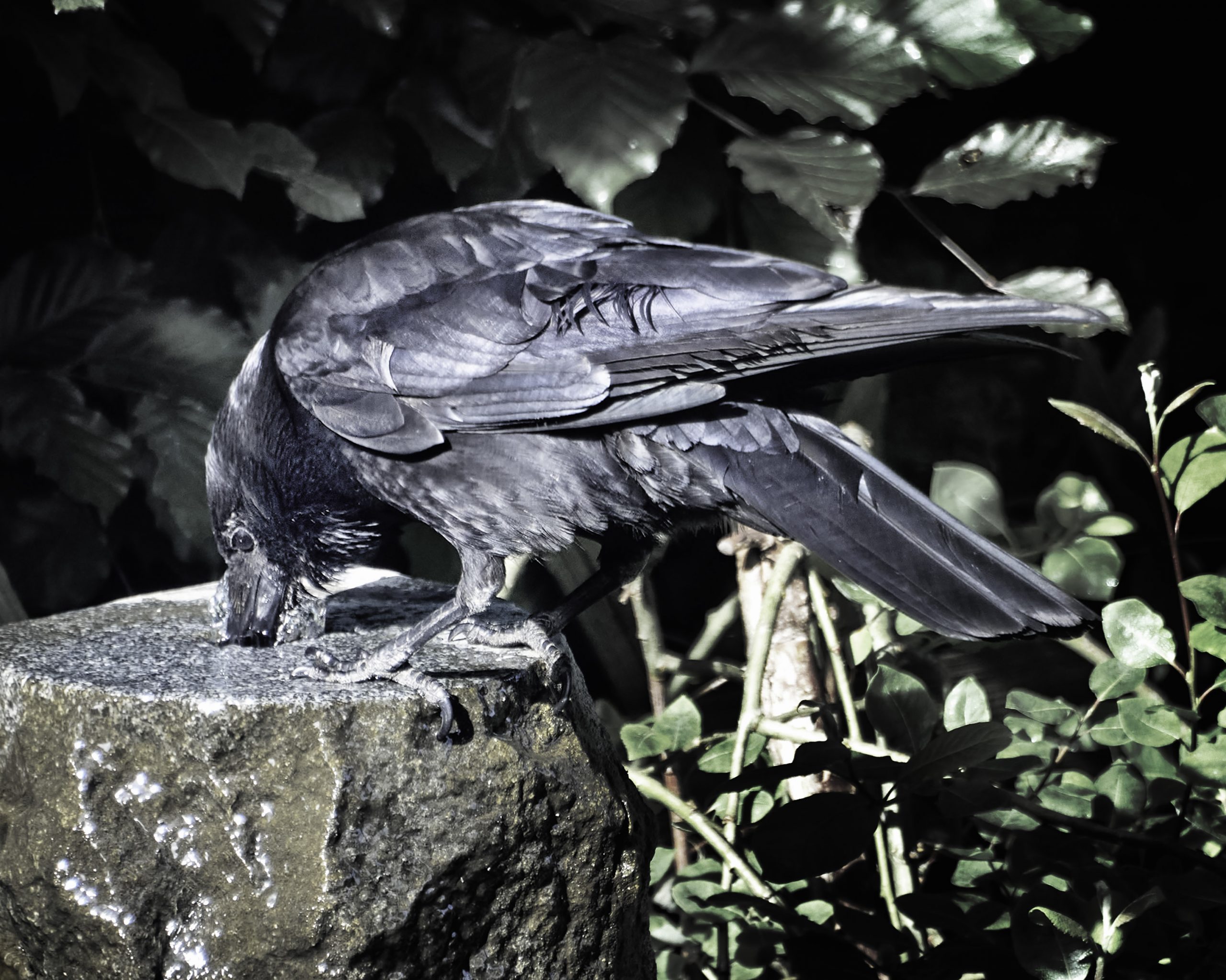
In our garden is a small fountain just beneath a hedge. A remarkable number of birds showed up to drink or to take a shower in it. The urge of the birds to bathe there was always stronger than the fear of our presence. What do they see in the fountain ? I couldn’t imagine an answer until today.
Today I made macro images of the fountain with a wide variation of exposure values to find a small world within it. Many of my fountain images remind me of the night sky and its wonders. Sometimes I had to think of our universe.
The birds might see this ? I cannot be sure. But they are not blind, for sure.
A macro of our fountain appears like a painting under many exposure conditions. A first glance of four images is presented here.
An Astilbe has an umbel-shaped inflorescence and therefore consists of countless small blooms. While blooming, its structure is extremely delicate and light. It looks as if spotted in the light that shines through everywhere. An Astilbe seems to be floating. What a delighting gift to get such a plant from my preferred flower dealer.
I had planned to reproduce this impression photographically. The three-dimensional impression of the human eyes is a complete different reality than a two-dimensional photograph. My photographs didn’t seem as delicate and fragile as the original.
The richness of the flower structure better unfolds in image crops. The resolution of my PhaseOne is high enough to have sufficient quality available in a cropped image.
We went to see our daughter Melitta today on the occasion of a first service after the lockdown, supported by her singing. Well, there’s always enough room in a church for appropriate seating during the service. We were downstairs, she was in the gallery. Moving half-way up, I captured the following image with the morning light from behind. Doubt and fright are best transported with the help of a slight desaturation.
On the square of reconciliation in front of the church St. Stephan in Würzburg there are coarse stones arranged into a kind of bursting structure. They are supposed to represent an opening bloom, which was formed from building blocks of the Third Reich. Its title is „The March of the Blocks“. A conciliatory act in this time of 100,000 victories over the Nazis.
Less color in the first image gives a more natural feel to the content. The play of light and dark in the second image reflects the severity and harshness of its subject.
Having left the church and the square of reconciliation a symmetry of branches caught my eye. The composition was just right for me to pre-visualize a print. Color in this image didn’t make sense to me. That way I found my inner balance.
Light is subject to permanent change. The transformations of light accompany us always. In the course of the day, we immerse ourselves in the light of various sources and their shaping unnoticed. In a photograph, too, the imperceptible shaping of light is our companion.
The light in a photograph and its impression is shaped or transformed by postproduction. The changeability of the light by postproduction helps an image to its final expression.
What light do we see in our dreams ? What light do we see when pre-visualizing an image ? What light do we see when we get the idea to a photograph ? The latter light we experience like „a flash within a long night“. It is only after the completion of the work that relaxation may take place.
Having learned how to do focus stacking on my PhaseOne camera, I made two series of 20 macro images with a rose on a lightbox, the box switched on and off for the two series. Combining the two light situations made this image possible.
On the penultimate day of our Out of Yosemite conference in Yosemite Valley, the Bridalveil Fall with Charlotte Gibb as instructor was on the agenda that Saturday morning at 6am. I hoped that by participating in her workshop I would gain a less technical or more creative approach to photography of waterfalls.
She gave us the topic of long time exposure in the preliminary discussion. The spot offers little freedom of movement. There was not much room for all of us, and on top that there were every now and then some people walking around in our compositions.
Bridalveil Fall shows a strong variability of location due to the influence of air movement. Especially at sunrise you can clearly feel the rising winds. So you don’t have much time for camera setup. An ensemble of stones in the waterfall can all of a sudden become dry and the composition becomes useless. In return, the neighbouring region becomes dripping wet and appears in a new light.
I know pictures from long time exposures with moving water. They’re interseting sometimes. I rarely find them really good. Often they exhibit a strong technical assessment and their message ist not really accessible to me.
I begann to study sections of the waterfall, which meant that the rock formations in the composition always showed a new character. That way many compositions can be made.
Probably an image that expresses changeability and constancy is best suited to make us think about the origin of the world. Planets orbiting their central star are a well known example for this. Or stars that orbit the black hole of our Milky Way in 11 years.
My last picture of Bridalveil Fall, with its interplay of light and dark, of flowing and solidification, steps and flow, forms and dissolution of forms, shows the coexistence of changeability and constancy. That’s what makes it so attractive to me.