-
X-ray photo of a ball from snail shells
Today’s fun was the X-ray of a sphere of snail shells, which I found as decoration in my sister-in-law’s house. It was immediately clear to me that the spherical structure of the glued snail shells would become a great X-ray image.
The original X-ray version with a black background is dark and strong. The whole thing looks like a picture of a virus. Nobody would ever think that it was a polystyrene sphere to which snail shells had been glued.
In the inverted version, the object comes to the fore much more as an independent unit. A flu virus ? A plant seed ?
-
Calendar 2020
Harold says: 9 out of ten attempts fail. That’s a good consolation. What happened ?
A company and I could not agree on the fee for an annual calendar 2020. I liked the selection of the proposed pictures, consisting of flower macros and fusion images with X-ray. „Don’t call us, we call you !“
I’m not a merchant and I don’t live on sales. But how many have to listen to such sentences every day.
With a little help from my elder daughter I did the calendar on my own.
-
New wine X-ray photo of Pinot Noir
The expression „new wine“ is ambiguous in the German language. On the one hand, this refers to grape juice that has not yet begun to ferment. On the other hand, this means the freshly harvested grapes.
By chance we were given a delivery of fresh harvested grapes of the Pinot Noir variety, which we immediately subjected to an X-ray examination. An additional photograph of the composition from below the exit point of the X-rays was taken quickly with a Leica Q.
The result of this image fusion is shown here:
-
X-ray photos of grapes and sunflowers
Grapes as an object of X-raying have been inspiring me for a long time. Their structure remind the doctor of the azini of a gland or lung. The phycisist likes very much the partial and complete overlays alternating with free positions. As an artist I get an unbelievable freedom of image design.
My first X-ray imaging attempts with grapes were carried aout in October 2017. I’d forgotten !
Can something succesful be repeated ? Can it be deepened ? What is the power of the composition ?
Two days ago I tried toput my creativity into the composition. Two pictures were taken from grapes which differ only slightly. Their X-ray view on our monitor had a clearly different effect.
My colleague by chance showed up with a bouquet of small sunflowers with long stalks. Amazing opportunity !
-
Vegetables X-ray photography
Harold implanted the idea of X-rays with onions in me. Although more than covered with professional requirements, I tried my hand at vegetable x-ray photography.
I can say it’s fun. Although a defective screen had to be replaced at the beginning. And you need some patience. Not every shot shows its beauty from the beginning. Some have to be developed first.
Let’s start with a corncob. It has many outer leaf layers, which lie close to it. X-rays look through and show the layers at the edge of the bulb as fine lines.
Here is a comparison of X-ray on the left side versus Mammography on the right side. A Belgian endive and a lettuce show much more contrast and fine structure in a mammography whereas X-ray gives more the impression of softness. Which goes well for a salad.
Onions have a lot of liquid and are therefore radiopaque. I was curious to see which method would make it better to reveal the layerstructure of the onions. To my surprise mammography did a pretty good job.
Conventional X-ray offers more mystery, especially when you stack onions.
Some kind of layered structure also has fennel. I got two specimen that looked like mittens.
This year we had so many apples in our garden. They are red and look juicy. I had the chance to take two of them to my X-ray machine. With the help of two different orientations an interesting picture succeeds, because on of the apples still has a small branch.
May be there is some truth in the saying: an apple a day keeps the doctor away. But as the dentist would say: no teeth, no apple.
-
Spider conch X-ray fusion photo
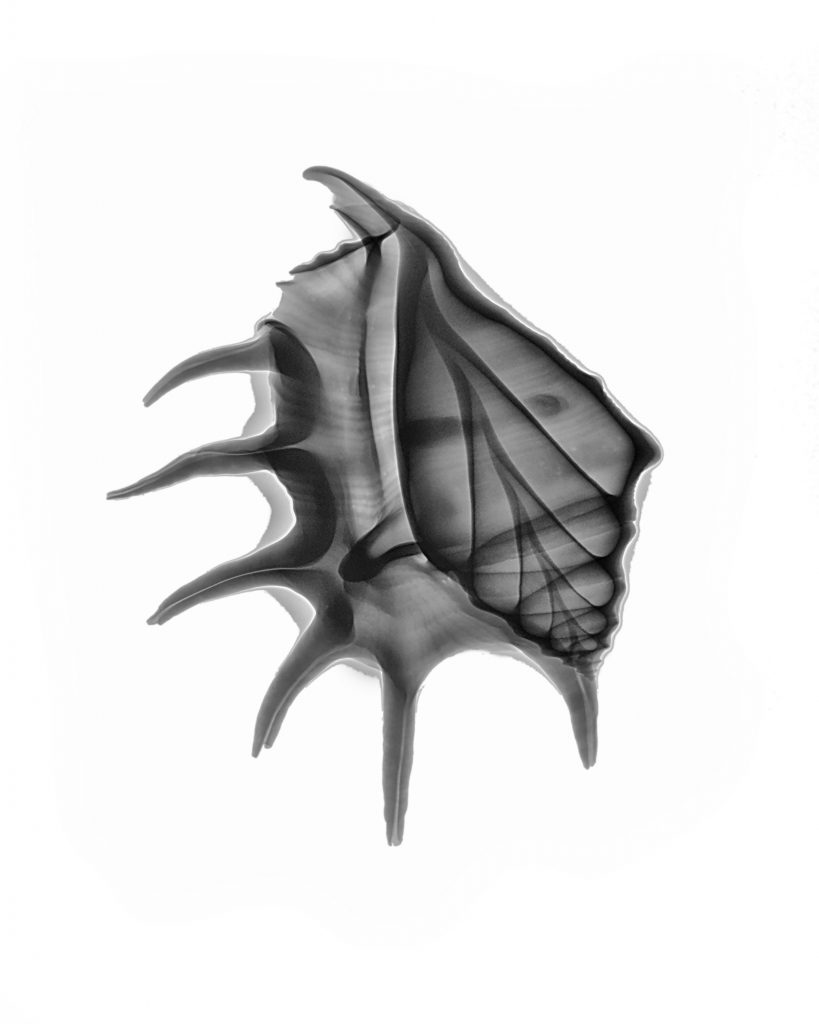
A friend gave me a shell of a spider conch to make more fusion images. The scientific name of the spider conch is lambis lambis and it is a sea snail. There is a nice Wikipedia article on it.
The hard shell with a lot of radiopaque lime made me doubt the success of my X-rays. On top, my first attempt at a HighKey image wasn’t really convincing. Only the combination of a normal photography for the color, a HighKey image for a transparency effect together with the X-ray image resulted in nice image.
The X-ray image appear less lively, but full of formal power. The orientation of the animal is conveyed by the photographically reproduced color. There are only minimal hints wich orientation the X-ray has.
These are the corresponding X-ray images:
-
Orchid X-ray fusion photo
It feels like very long ago. Harold and I were taking the shots and X-rays of new compositions last week of April this year. Our first try was an orchid with two stems. The transparency effect is very much augmented using an X-ray. A stem behind petals doesn’t show easily in HDR light box photography.
With a Phase One camera at my disposal a strong crop of the composition shows the tenderness of our orchid much better. With a resolution still sufficient.
-
Leipzig X-ray Convention
Since 1905 there is an X-ray meeting in Germany. It was the 100th time this year. Nowadays the convention takes place every year.
Besides the scientific news the convention offers the opportunity of caring for personal contacts. It is part of the beautiful things of the convention to meet old acquaintances and to exchange with them.
Leipzig fair is a great environment for this event. An agreeable tiredness affects me at the end of the day after many positive conversations. I left the celebration with relief.
-
Purple Clematis
Long lasting blossoms, turning up every year: my purple clematis in our garden.
It was my third X-ray session with flowers this week. Third fusion imaging attempt. After blue cornflower and blue aquilegia now a purple clematis. Big data on my hard disk.
Today we did it with mammography at 30 kV and 50 mAs. Lower noise ! Here is the positive representation of a single clematis:
I processed the lightbox HighKey series with a mask. There was a shift of 2 or 3 pixels from the lightest to the darker images. So I processed everything a second time to compensate for the shift. The HDR image shows a cut stalk. Photoshop is made for this.
The stalk can be lengthened like in the preceding X-ray. The fusion image shows hidden leaves, the core of the blossom and stalks much better:
The flower looks pretty fragile now, close to its natural appearance.
-
Spring and X-ray fusion photos
First flowers in spring show up. With much support from my colleagues I’m able to do some fusion images. We all would like to have another calendar.
Preparing the lightbox, the X-ray machines, my camera and picking out the data is a bunch of hassle.
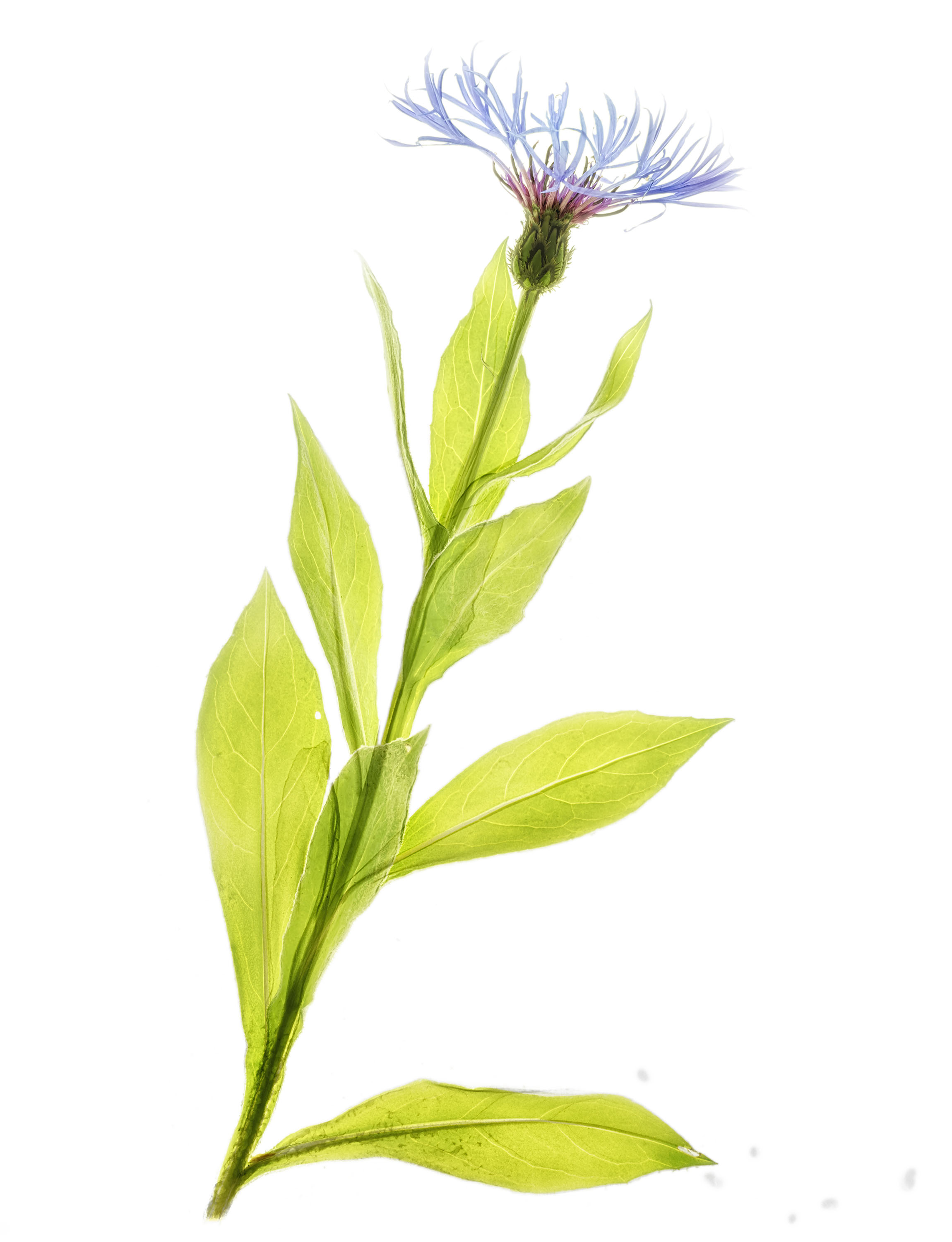
My personal favorite is the blue cornflower. It looks like a print of an old botanic book:
The next day I turned my attention to our white and blue Aquilegias. No chance to process the raw data yesterday. Eventually, there was a chance today, after quite a bit of tedious work at my desk: