-
Dahlias fusion X-ray HDR photo
Long time ago my friend Harold and I did these X-rays in my practice. There was so much to do. Today was a chance to process the fusion images. Some details can be found in my FAQs.
The manual HDR is already appealing to our eyes.
There is some charm in the X-ray image of the same composition. The hidden parts of the stalks can be clearly seen.
The fusion image of this composition shows both color and hidden structures.
Finished image with a background:
-
Nautilus shells 3D X-ray photo
How does an X-ray look like with a complete, unsplit specimen of a Nautilus shell ? Will X-rays go through the object ?
My three Nautilus shells I bought in Crete are split specimens. The following approach will give an answer to the question. My composition of my shells is 3-dimensional and in nearly upright position. X-rays were then done with different directions of the radiation to study the effect.
Positioning of the three Nautilus shells on the X-ray sensor © Julian Köpke
Positioning of the three Nautilus shells on the X-ray sensor © Julian Köpke The first image was obtained with radiation coming from the top. The native X-ray representation is with a black background. Historically this was a film negative. Radiologists speak of „transparent“ areas where a film is black. Consequently, white areas are called „opaque“.
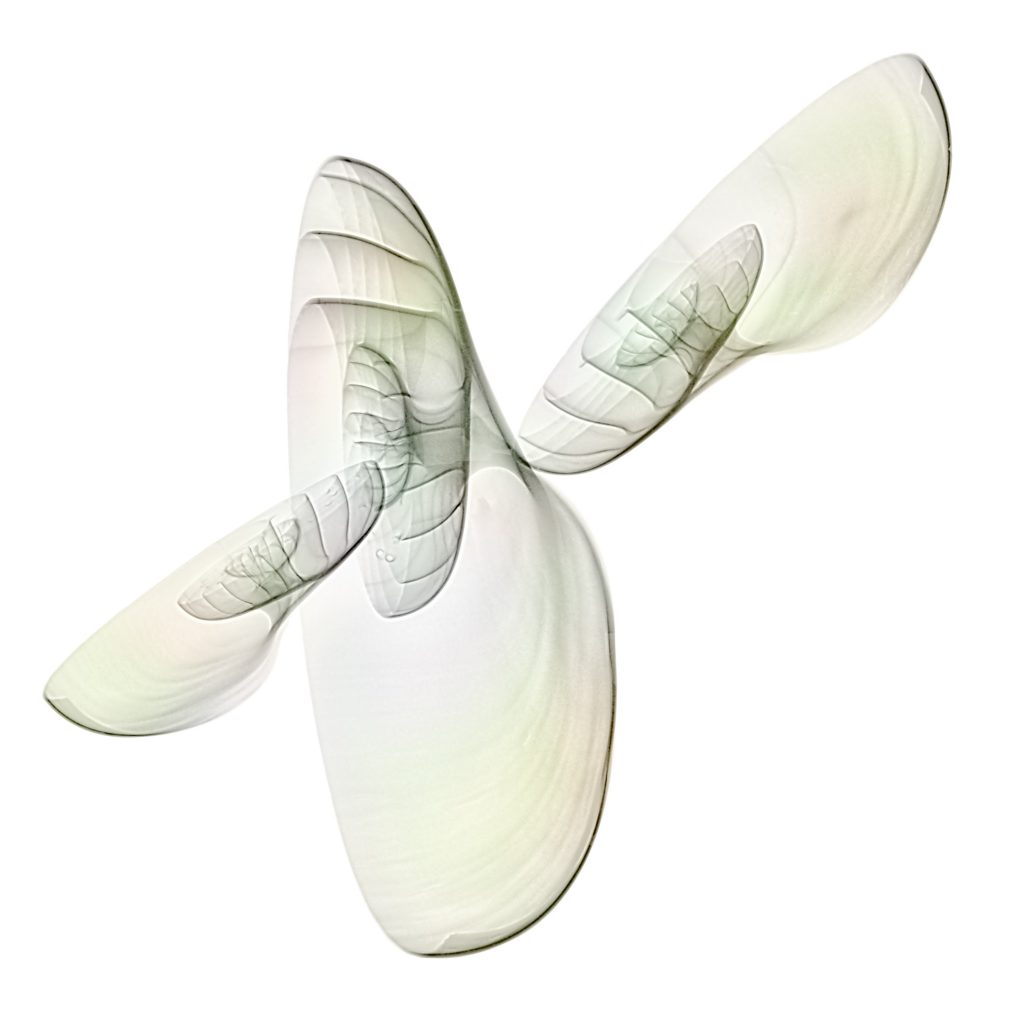
The result of radiation coming from the top and slightly tilted shells gives different insights of each shell. The composition looks like a complex mathematical surface or some flying insect.
The inverted (or „positive“) representation is weightless and our mind starts to produce lots of phantasies about the composition.
The effect of colorizing an X-ray is not only graphically. It looks more natural.
The following image was obtained by combining the inverted image with a flat projection of a single shell to a single image. Now one gets an idea of the effect of the beam path.
A tilted beam path shows the a bit more detail of the „wings“. Tilt was about 30 degrees.
Tilt by 45 degrees shows more of a Nautilus as we know it.
-
Sunflower X-ray photos revisited
How to show the sun in the middle of a sunflower ? For astronomers it is quite common to look at the sun in hydrogen alpha light, which is a pure red at 635nm. With artistic eyes, a red center might be overdone.
So I tried two different representations, one in BW that is close to the natural look and feel of a sunflower and one with a light blue in the center as complementary color to the yellow petals.
The surface structure of our sun can be seen like astronomers see it.
There is no photo of the next digital X-ray image of a sunflower with its stalk and a leaf:
-
Shells fusion X-ray photo
Long time I dreamed of this fusion image of shells. Because already on a lightbox some of the shells are transparent and have nice colors. I like the shining through effect very much.
The X-ray image is a compromise of structure and density resolution, depending on the maximum energy the mammography system is able to produce.
Today I’m not at all in a stable state due to a recurrent infection. So I allowed me to do this image instead of hard working.
It is the light inversion in Lab color mode that shows more of a X-ray look and feel. The colors are pretty close to the bright image.
-
Composite of a sunflower: X-ray, light and Hα
In a digital world we can combine different digital sources. This photo of a sunflower is a composit of its X-ray, its photo on a lightbox and monchromatic sunlight at a wavelength of 635nm (Hα light).
In fact: this is an example of an impossible thing. But you may be able to feel the warmth of a sunbeam emerging of the core of the sunflower. And the petals act as prominences.
-
Three vetches
X-ray images give an insight into the inner (or hidden) structure of a flower. HDR images on a light box are quite close to this.
Today I wanted to show the softness of petals and went to my dealer. She sold me three vetches, not really expensive for the purpose.
This is my third composition today of the three vetches on my lightbox. The play of the light in the petals resembles to some extent X-ray images.
-
X-ray Odyssey
How to communicate an erratic process in terms of an image ? The Iliadic greek were pirates of the Mediterranean with fast vessels, invading mainland from the seas, enslaving people, robbing stocks and much more.
The writing down of the Ilias was between 678 and 662 B.C., a time of Assyrian dominance and cultural superiority.
With three different Nautilus shells I bought last September on Crete I did this composition on my big X-ray sensor with 35cm x 43 cm and 170µm per pixel resolution. Two energy levels were necessary to get a high resolution image of the core of the Nautilus shells.
To overcome the look-and-feel of a medical X-ray it is a logical idea to invert the light. Black becomes white and vice versa. White means shining through of X-rays, black means opacity. It’s like a dream !
-
Nautilus and Flowers
How to prepare a X-ray session ? What flowers suit to a Nautilus shell ? Where does color come in ?
I went to my gorgeous florist to have a look what offer she can make during wintertime. My phantasy were spinning around something ethereal or unrealistic. I bought some flowers with respect to their shape.
The Anthuria caught my eye immediately. The Tulip was still closed and got more and more yellow within hours.
All these compositions shown here were made with dual energy X-ray. The lowest energy of the tube is 40kV, which yields with 4 mAs a quite good insight of flowers. For the center of the Nautilus shell, 70kV and 2.5 mAs is more appropriate.
My first composition was a Nautilus taking off a bouquet of flowers. This reminded me of Renaissance engravings full of symbols. I do not feel depressed. The representation as a X-ray positive jsut shows the bouquet.
A more grounded composition is the second with a Nautilus shell moving towards the roots of my bouquet. Hopefully, the plants will survive. The positive representation always needs some extra editing. By just inverting the Blacks and the Whites the Nautilus would be too dark. Our reception cannot be just inverted and feels alright.
With the look-and-feel of old engravings in mind the third composition ist between surreal and a still. It took me some time to mask out the flaws of an original X-ray to get a true black background. Masking can be done iteratively and easily combined with Photoshop. („That’s what Photoshop is made for !“).
Some colorizing was done to overcome missing photographic shots. There was simply no time in my X-ray unit to do both at a time.
My fourth composition is called „The Argonauts“. The Nautilus shell serves as Argo, the legendary fast ship, with its crew, called Argonauts. The colored version is more convenient for our eyes. As before the X-ray positive looks more ethereal.
-
FAQ: High Dynamic Range
26. Januar 2019 /X-rays were initially used for research in atomic physics and medical diagnostics and therapy. Their ability to reveal structures inside an object even with an opaque surface was the driving feature of scientific and technical development of X-rays. Nowadays, beside its proven medical usefulness, X-rays are used to examine technical structures and there are telescopes to map X-rays from our Galaxy and the universe. Every radiological technician who starts in its profession learns to do X-rays of common structures like flowers, animals or teddy bears.
In the digital era, X-ray images are obtained using sensors, while film was used historically. The sensors in the medical radiological field have dimensions such as 24cm x 30cm or 43cm x 43cm. The corresponding spatial resolution for these sensors is between 70µm and 140µm. A typical high-end camera used by a professional or advanced amateur photographer might have a pixel resolution between 4 and 8 µm. Therefore, photographers might well wonder if there is any precise imaging possible with such pixel size. Let’s look at this a little more closely.
X-rays, like visible light, can be characterized by their energy or wavelength. Shorter wavelengths correspond to higher energy. The capability to penetrate an opaque structure increases with energy. If you think of a photon as a particle, smaller particles with higher energies penetrate an object more easily. An overview of this relationship is given in the table shown here:
To make this more clear, here is a series of X-Ray images with increasing energy. The first image was obtained with 40 kV which corresponds to a wavelength of 0.031nm. Our eyes are only able to see wavelengths between 400nm (blue) and 750 nm (red). Therefore, photons with a wavelength at 40 kV cannot be seen with the naked eye. The peripheral parts of the Nautilus shell are clearly depicted. A photographer would classify the circle at the center of the shell as „blown out“. In fact, they are not blown out. The radiation is not able to resolve the structure, because the wavelength of the X-rays is too long in this case to penetrate the shell.
Let’s go to shorter wavelengths (implying higher energies). Using 50 kV or a wavelength of 0.024nm gives more structure to the central parts. The photographic impression of a „blown out“ center is reduced. However, looking at the peripheral parts of the Nautilus there is a loss of intensity and a more grayish impression. It is conceivable that this might be regarded as an overall acceptable but subtle effect.
To take this further, we can go up to 60 kV or down to 0.0207nm. The center is now close to perfectly „exposed“ with some detail apparent, although some smaller structures are still not resolved. The intensity loss at the peripheral parts increases and is now pronounced. A photographer would clearly regard the periphery as „underexposed“.
The last example of this direction of higher energy and shorter wavelengths is 70 kV or a wavelength of 0.0177nm. The photons wavelength is now 57% compared to 40 kV. You may think of this as „smaller“ photons. The result is a clearly depicted core with a complete loss of peripheral structure. A photographer would have every reason to be worried about „underexposure“ and loss of detail everywhere but the center.
What we’ve seen here is that the capability of X-rays to penetrate an object and to go through an object is dependent on energy levels. With shorter wavelengths X-rays go through an object without disturbance but our sensor is „blown out“ at the peripheral parts of the Nautilus shell. Using 70 kV the central parts are much better resolved, but the periphery is too dark. The energy to use for any X-ray image therefore often depends on the primary goal of which portion of the subject is most important to capture.
In a certain sense, the compositing of images with different energies into one image can be compared to the HDR process of photography in the field of visible light. Whereby in visible light the intensity plays the essential role and not the light energy, which determines the color. When X-raying an object that requires different energy levels for accurate representation, I would therefore also speak of a High Dynamic Range image.
If combined, the four exposures shown provide a beautiful, nearly weightless image:
-
Transparency and Energy in X-Rays
You always need some time to find out the best exposure values for a photo. Same idea holds in X-Ray imaging.
Today I did an x-ray series with my biggest Nautilus shell on a conventional radiography sensor, not a film. Starting from the lowest possible value 40kV an increment of 10 kV up to 70 kV can be seen in the images:
Black regions in the image a transparent, white are opaque. The center of the Nautilus has a loss of structure.
With 50 kV the structure in the center of the Nautilus is better depicted wheras the edge gets more transparent:
Same effect for the center and the edge can be seen with 60 kV:
With 70 kV it’s an exaggeration for the edge and best depiction for the center:
Higher kV means more transparency for denser structures but a loss of structure in transparent areas.
At fixed energy, X-Ray imaging behaves like a shadow related to visible light. When photographing, there is not chance to look through an opaque object. With higher energies, x-rays go through opaque objects and can be collected on a sensor.
Composing the images obtained at different energies is an X-Ray HDR image:
The representation of an X-Ray with white on black is a reminiscence of the film era. Radiologists just looked at the negatives ! Inverting black and white shows the positive image, like a print. Here I show the same image as positive, but rotated and flipped horizontally. Look how ethereal it appears now: