Everyone has an idea about infinity. Infinity always confronts us with the question of wether we can see or recognize it at all. Modern mathematics knows that infinite series of numbers may well have a finite limit. The ancient greeks had realized that Achilles will always outrun a tortoise, but they couldn’t prove it. For the solution remained hidden.
Photographing a single, well reflecting steel sphere I got on the surface pointing to my macro lens a distorted image of the surrounding. One can see the tree in our garden, the lens and the tripod of my equipment, even the photographer’s legs are visible. That’s why I think it’s sort of a selfie.
Immediately, I thought of my friend Harold, who had worked a lot on photographing water drops and who had made a book about the photography of water drops. In the juxtaposition of several water drops the environment is displayed several times side by side in the drops.
Well, this happens as well, if you place two well reflecting steel balls side by side. So far, there is nothing unexpected.
On closer inspection, the opposite sides of the spheres show further images of the surroundings slightly outside the original image, well visible on the tree. These images of the tree become smaller and smaller lying within the circular image of the first reflection.
An infinite series of images in one picture is created by the reflection on the surface of two adjacent steel spheres. As the reflected images become smaller and smaller, the total area of the image is finite. A similar effect is known with water drops as well.
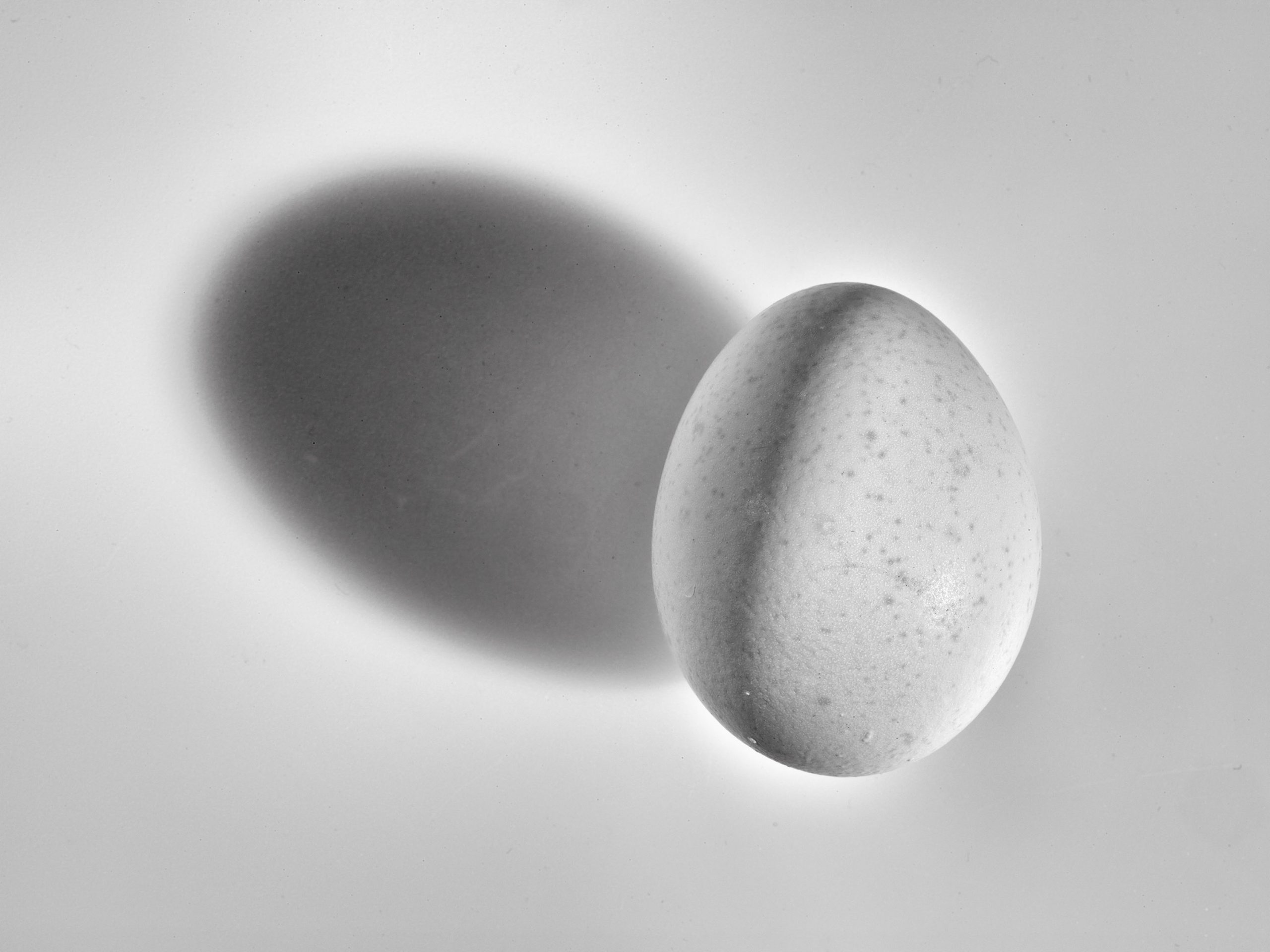
Shades of grey in interaction with light: this is a theme for monochromatic images. For a long time I wanted to photograph an egg against a white background. The idea was stimulated by photos, mostly of people I know personally. Geometric, white-colored bodies from the mathematical collection would also be fun for me. Unfortunately, access is not as easy for me as with an egg.
On the left side the egg is brighter than the background, on the right side it is the other way round. The background itself loses a little brightness from the left to the right, but is brighter than the the egg on the right. The contrast changes. There is no clearly defined shadow for this setup. The same is true in the next photograph.
With the help of a simple light source whose color temperature does not matter after conversion into a black and white image, a soft shadow can be achieved if the source is not point-shaped.
With daylight and a lightbox I took the cut off flower of an Alstromeria. With the lens I’m able to approach the bloom on approximately 20 cm. The blossom then fills almost the entire sensory. The ratio of the mapping is thus approximately 1:1.
The quality of the RAW images is convincing in itself. The creation of the finished HDR takes place in a combination of manual and automated steps.
RAW conversion is done using CaptureOne, HDR processing is done manually in Photoshop. Further, I generated two automated HDR developments using HDR Efex Pro 2 and Photomatix Pro 6 and layered them in. Some of the original color is transferred from the daylight image with the lightbox switched off.
A small stock of raw footage is always lying on my laptop. My florist had been able to give us a few flowers, some of which were sacrificed after a couple of days on my lightbox. These days in a hospital I benefit while the healing remains to be seen.
Is it possible to retain the idea of a picture for a long time ? What happens to the colors when you no longer have the originals in front of your eyes ? The blossom of the peonies looked like a living eye staring at me, not necessarily a human, maybe an animal.
The amaryllis showed an incredibly intense red. I managed to show the intensity best on a black background than on a white one. I use the inversion of the L-channel in Lab color mode.
It is a nice experience to walk the same path under changing light conditions at daily distance. In winter there is not much botanically happening, only the snow can be more or less – or the fog. The possibilities of imaging with a camera essentially change with the extent of the available light. A sunny day shows a maximum of available light.
Does sunlight make a picture atmospheric ? With cloudy skies or even some fog, the conditions for background and foreground change substantially and pictures without sunlight can be be very varied and gain a special depth of expression.
The above image shows: shadows during a day with a blue sky are blue, too.
The detection of expressive light situations without a tripod and without HDR technology requires a limited amount of light that the sensor can still process with out blown-out lights or drown depths.
January 6th is a holiday in our region, commemorating the three holy kings or three wise men, who had been probably astronomers. The Orthodox Churches celebrate Christmas. In the United States of America, a reigning madman with his mob is degrading his country to a banana republic. Looking at this rises questions about our German history 87 years ago.
I spent the whole night absorbing the latest news. Sleeping was almost difficult if not impossible. This morning a bug in the Flickr software ? A picture of mine with so many views and favorites ? Well, that was the good surprise this morning after all: an in explore for a picture I had been thinking about for a long time and that I repeatedly failed: taking tree trunks in landscape format.
This time it worked out better than expected. Christa and I started a late walk up at Posseltslust to see some people riding sledges. We took a forest trail away from the slopes. The twilight was already advanced, the ISO high and the aperture only slightly closed. A pleasant winter light surrounded us. Between the tress it became bright, the tree trunks covered with snow below. This image got an in explore.
Winter forest looks a it like a fairy tale to me. That is why color is also important, which additionally stimulates the imagination. Even a tree trunk presumably struck by lightning becomes a sight to behold. It works with the color even if there is only little light.
Our flower shops are sold out or closed. There’s nothing new to buy. Thank God. This allows me to take a closer look a t the seasonal flowers we have at home.
Photographing a white amaryllis against a white background I found particularly attractive in the last few days. Because it also contains many colors that you can bring out.
Concerning color a less courageous image is the left one, only shadows and some etheral green from inside the flower. Using Lab color mode and some ideas of my friend Harold Davis this image can get more pizzazz, as shown on the right hand side.
The plant broke off and had to be placed in a vase, but there it developed surprisingly well and even quite symmetrically, giving me the impression of antennas that listen into space because they look similar tho those with which Arno Penzias and Robert Wilson discovered the cosmic background radiation. A lightbox as background is easy to realize with a LED for the ceiling that you can get in any hardware store.
The blossoming red amaryllis has two sides, so I had the chance to photograph them both. In my eyes, one side resembled a dinosaur’s head and upper neck as it is about reach for food. Loosely based on an Arabic proverb: „If you see the dinosaur’s tongue, don’t think he’s smiling“.
This year we spent 5 weeks of our holiday involuntarily in Heidelberg. with the light of a late winter afternoon just before the winter solstice and some mist in the air, dreamlike impressions arise. We didn’t have to cover a long distance. In the hills above the town there is a plateau within walking distance with a farm, commemorative cemetery and a forest all around. Had it not been tor the photo equipment, we would have really been on foot up the mountain.
Going closer to the fence that surrounds the dairy cattle, you will see straight into the foggy valley. No roofs, no industry, no highway, no noise. Just a wooden house in the forest like in a fairy tale. The colors blur into a monochrome something.
At the end of the short walk we step on a Tori, which in the backlight shows us the lightness of Japanese beauty.It is probably to be assigned to the Heidelberg twin town Kumamoto on the southern most Japanese island Kyushu.
Longtime exposures hold a special appeal for me. Again and again I try do do it. I found the idea for this picture in a book about modern photography. The photographer took a picture of flowers in a vase with a specially built camera for many days until the first petals fell. The passing of time, which often cannot be experienced directly by us, can thus be illustrated by a photograph. Due to the new corona virus we had plenty of time at home to make flower photographs.
With my macro lens I can only realize the aperture value f/32, which means that even at ISO 50 the exposure time dose not rise above 15s possible when the lightbox is turned on. As an approximation to a true long-time exposure, I started a series of 23 HDR images at irregular intervals over the course of 4 days, just as it became apparent that my tulips would rise wide.
Each HDR image was created from6 shots at f/32 and ISO 50 with exposure times of 0.5s, 1s, 2s, 4s, 8s and 15s. The biggest difficulty was to block off a part of our living room before Christmas so that the exposures could always be done in the same way. Furthermore, the camera was not allowed to be changed by switching it on and off, changing the exposure times or removing the memory card.
I processed the layer stack of 23 TIF images in two ways. First straightforward as a smart object and then change the stacking mode in Photoshop as an average. Or fade out the layers after the start shot using black layer masks and gradually paint in interesting parts of the later images with a soft brush to create an overall impression. This approach was more promising to me than averaging the layer stack, which in my eyes expresses the flow of time too weakly.
Just to do the math: each image of my camera has 151 million pixels with a file size between 125 and 180 MByte in RAW format and 866 MByte after a RAW conversion to a TIF file. The total size of the project is something above 300 GB. 138 RAW files sum up to nearly 21 Billion Pixels. The final image has 159 million pixels due to some added background at the top of the result.
The sun is setting in the west. The Moon moves east and setting in the west, too. If one compares the position of the Moon relative to the prominent planets Saturn and Jupiter, because they appear close to each other, it is no longer below the two, but to the east next to them.
Temporarily there was much less haze today, so that the earthlight (in german: aschfahles Mondlicht) of the moon in the right hand image is very well visible. Yesterday you could only guess. With the spotting scope the crescent moon shows up well detailed.
The spotting scope allows to photograph the two planets Saturn and Jupiter with a full frame camera in a single field of view at lowest magnification (x30, which is about 800mm focal length). The structure of the planets ist better outlined with short exposure times (see insets), the Galilean moons of Jupiter need a longer one.