If you ever have the opportunity to see the work of the photographic pioneer Karl Blossfeldt (1865-1932), then perhaps you will also be as moved and fascinated as I am time and again. In 2014, Taschen-Verlag Cologne published a book about him entitled „Karl Blossfeldt The Complete Published Work“ (ISBN 978-3-8365-5072-7), which I have kept near my bedside table for years.
Karl Blossfeldt was interested in the forms that occur in nature and which he understood as „archetypes“. His main work was published in 1928 under the title „Urformen der Natur“ (translated version as „Art Forms in Nature“, 1928) and became an international bestseller.
On his way to college, he collected plants that he used as a source of inspiration for his work as a professor of decorative arts. His photographic works are monochromatic and usually made by placing the object on photosensitive paper. Technically, therefore, they are actually to be addressed as photograms and not as photographs, because the image was not based on any imaging optics. X-ray images are also photograms, but with a central beam geometry. Therefore, in a very free interpretation, Karl Blossfeldt’s works could be placed in the middle between photography and X-ray images.
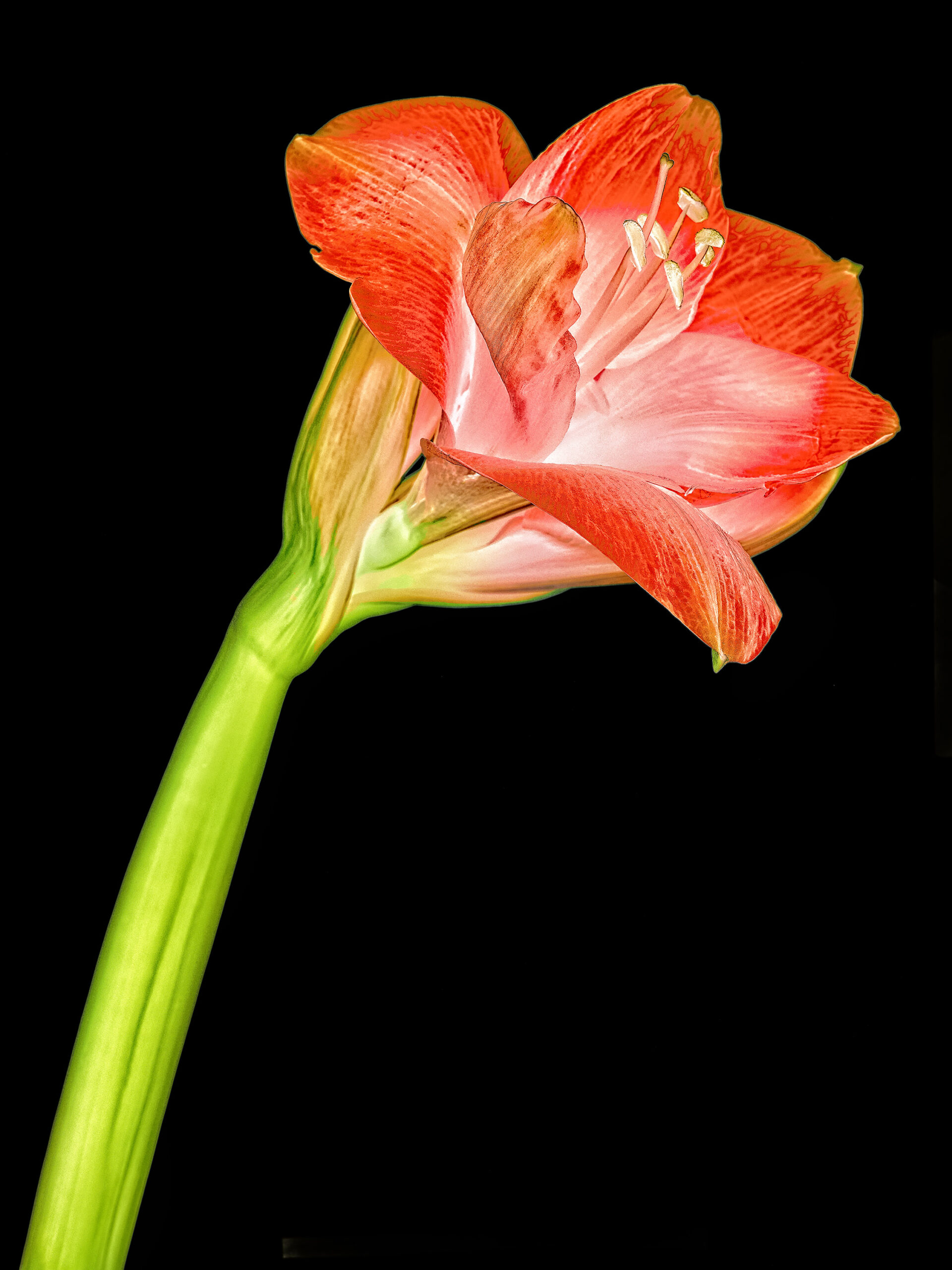
The images in this gallery are created with photographic optics and a digital sensor. Photographs of plants or better: parts of plants, which highlight selected structures, are excellently suited for a monochrome presentation. Harold Davis describes one way of creating the look-and-feel of a Blossfeldt image with the help of a photograph. Harold calls the result „The Blossfeldt effect“.
The format for recording an image can be very variable when fusion imaging is involved. In the example below, the image on the left is taken with a Phase One IQ4. The sensor size is 44mm x 55mm. The X-ray image on the right was taken with a Hologic mammography system with a detector size of 24cm x 30cm. The aspect ratio of both images is 4:5. The pixel size of the IQ4 is 6.5µm, the pixel of the mammography is 70µm long. Nevertheless, the images can be fused well.
I added some texture to the fusion image because it made it more appealing. Due to the fusion of the image from „visible light“ and the image with „X-ray light“, the definition of whether it is a medium format image or a large format image is no longer meaningfully applicable. It is simply an image.
In the meantime, 0.8TB of photo data has accumulated. It will be a challenge to process all these photos. Fortunately, I am concentrating on a few compositions, each of which will be studied in more detail. The themes of geometry, lines and planes stand alongside the theme of colour contrast, which is easy to focus on in Iceland.
The basalt rocks of Arnarstapi are ideal for this. With moderately homogeneous cloud cover, they lend themselves to long-term studies. The Phase One camera is able to do without the grey filter through frame averaging, which otherwise often leads to slight shifts in the composition.
I’m still not sure whether the basalt rocks of Lóndrangar look better in colour or in black and white. We had drizzle and fog again and again, but also very brief sunny moments. Icelandic weather has returned to normal.
A low probability does not mean that something will not happen. For a brief moment, auroras could be observed at night at Hotel Latrabjarg. However, by the time the camera was set up, the phenomenon had already subsided. The night remained cloudless and starry, and the next morning the windows of our car were a little frozen.
This very sunny day with cool air was the start of the return journey, which we shortened by taking a ferry in the evening from Brjánslækur to Stykkishólmur.
The bird cliff at the headland of Latrabjarg was completely empty. Only a few seagulls were circling without landing anywhere. The puffins had already left for the Atlantic a week ago.
From this position you can see the rocks of the Westfjords of Iceland lined up one after the other.
Westfjord cliffs seen from Latrabjarg
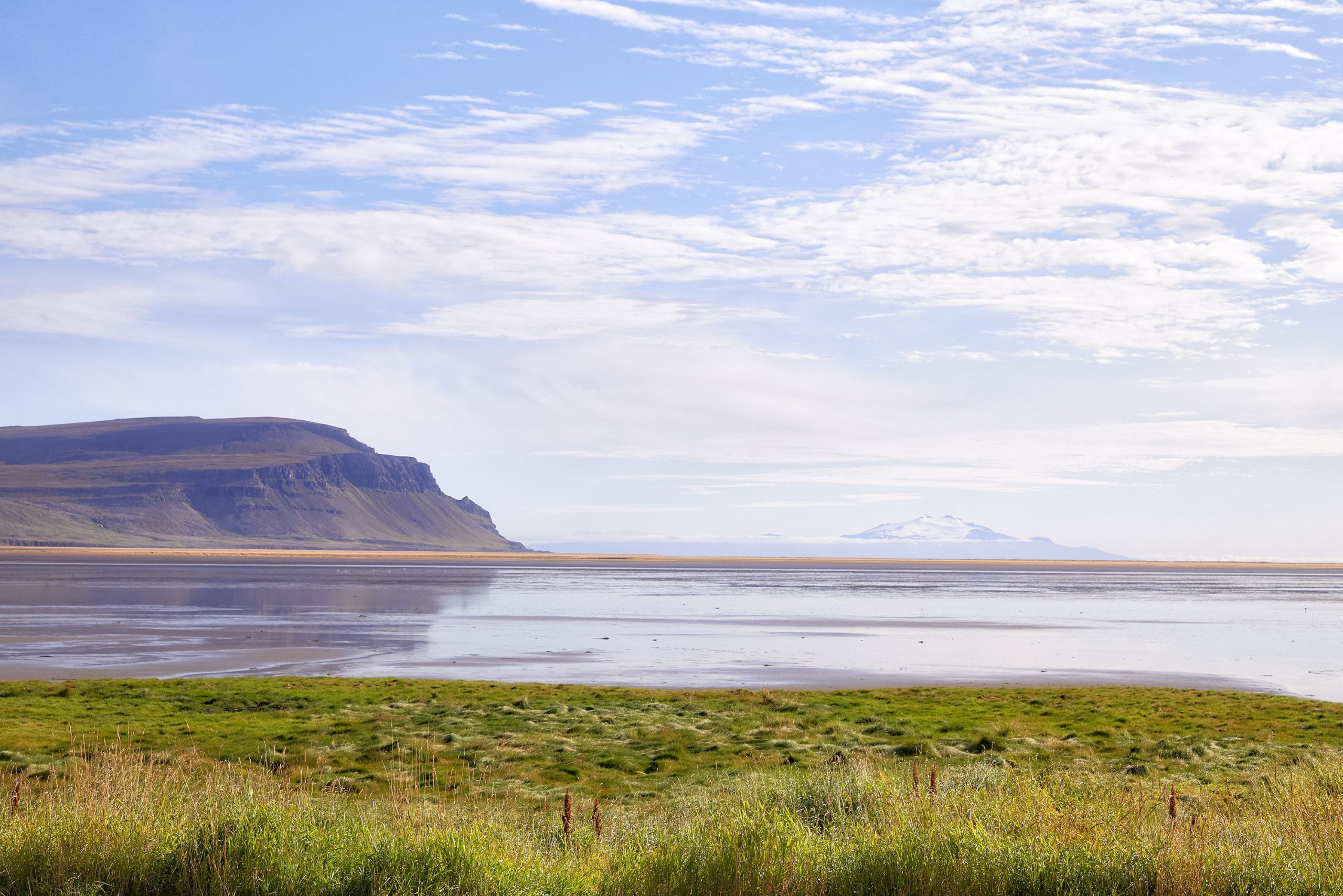
Our lazy day ended in Brjánslækur. This is where the Vikings first wintered in the 9th or 10th century. A historical plaque refers to boathouses and storehouses that had been built. It must have been a Herculean task to dig depressions in this stony ground. A few tree trunks anchored in the ground are left this. In the background line up the mountains of Snæfellsnes peninsula.
On a gentle hill, at the foot of a perhaps nameless mountain, stood another small church with a red roof. These buildings seem almost like a toy landscape when the mountains make them small.
The ferry ride was sweetened by a multi-coloured sunset. We drove between the small islands via Flatey to Stykkisholmur. The clouds, however, were to prevent the Northern Lights from appearing when we arrived in Boudoir.
The drive from Flateyri to Latrabjarg is in sunshine with intermittent light cloud. Winter is coming: warm autumnal colours dominate. In Iceland, you walk at sea level and look at glaciers or year-round snowfields.
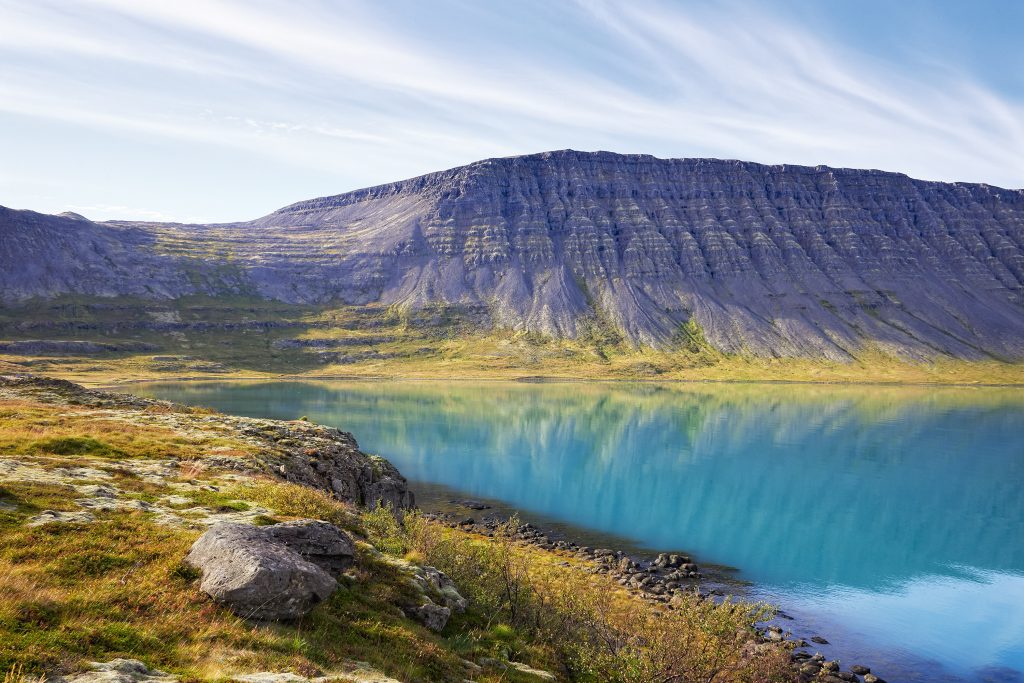
The second visit to Dynjandi made us stay down. The colours of the sea were strongly reminiscent of the Caribbean, still warmly outshone by the land in the late morning light around 11am.
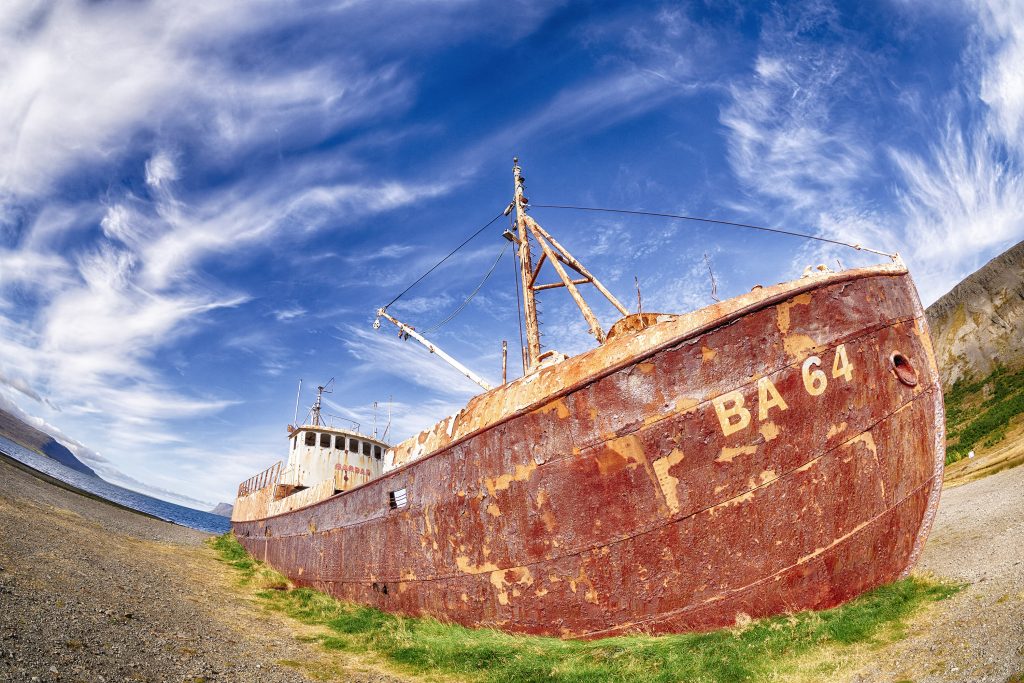
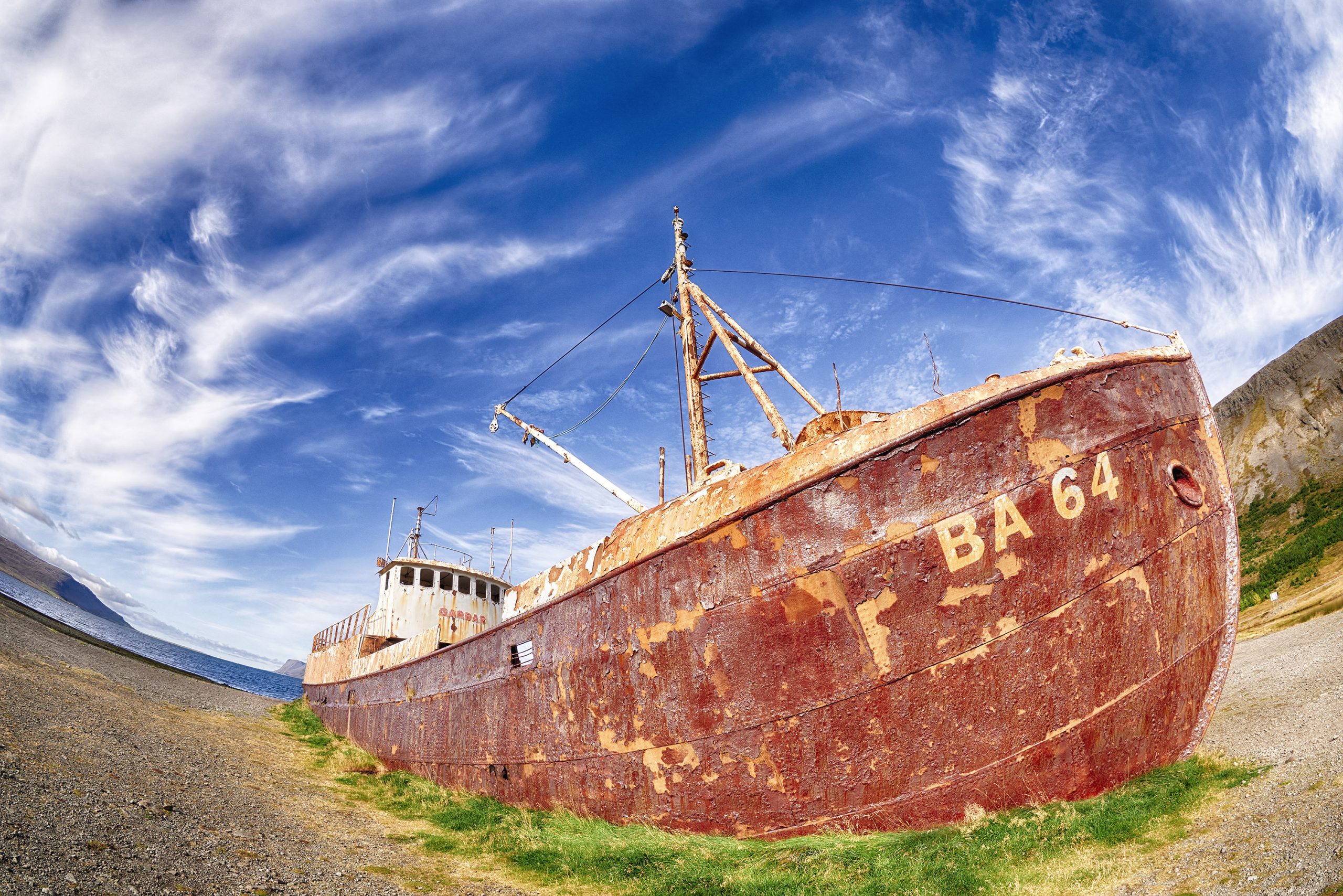
After the short second visit to Dynjandi in the morning on the way through, we came across the well-known shipwreck of the whaling ship Garðar BA 64. The weather cleared incredibly quickly and we were able to capture the rusting material as HDR. With a fisheye lens, the wreck deformed slightly in an arc under the circularly arranged clouds.
Shortly before the turnoff to our accommodation at Hotel Latrabjarg, the path led us to a red sandy beach. There are at least two of these, the other is on the south coast near Vik with the grave of a young Viking around 18. The red beach is called Rauðisandur in Icelandic. It lies far in front of the sea. Between the beach and the mountains is a marshland with farms, siels and cows.
The bridge, named Ponte dei salti, withthetwoarchesisfromRomantimesandis goodformanyselfies. Withalong-termexposure onecansee thearcuateconstructionwithitsreflectioninthewater. Andthemanyvisitorswhoflockon the bridgearemiraculously invisible.
TwoweeksagoIwenttoLakeConstancefor businessreasons. At7o’clockinthemorningIcouldseeared sunrisinginthe fog betweentrees. That’swhyImadeastopoveratLake Constancetotakepicturestherein theeveningandinthe morning.
Themorningdrivetwoweeksagomighthavemadeyou think ofghostsandofcoursethereisliterature on this subject from thearea. The eveningwhenIarrivedwaswonderfullysunnyandfogless. By carImadean“ascent”to HohenklingeCastleinSteinamRhein, toseethevalleyfromabove. Theviewremindedmeofa Renaissance painting.
Thereisnorepetitionforthe landscape photographer. The natural lightwillnever belikethatagainwhenyou go backtoaplace. Wherethesun wassupposedtoriseitwasnotfoggy. It was cloudy. From here the Upper Rhine begins.
Earlyinthemorning, all of a sudden, twowomendriftedintheriver. Thetwo ofthemwishedme from below a“goodmorning. ”
HereinSteinamRheinendsLakeConstance, whichlies betweentheHighRhineandtheUpperRhine. Before sunrise you couldseesomediscolorationofthesky, alongwithvery littlegroundfog.
Dahlia, my love. Flowers that make us forget the burden of a moment. Photographed each of them alone and as a pair. I tested HighKey shots instead of HDR, in the background different white tones.
The result did not leave me alone. Afterwards I wanted to try my hand at photographing a hen’s egg to study shades of different white (basically grey and yellow) tones. Unfortunately this did not happen today due to an emergency examination.