Julian Köpke
I like to make things visible the naked eye isn't able to see. That's part of my profession as a radiologist, too.
-
Snowdrops X-ray photo
I’ve never waited for snowdrops before. Inconspicuous and boring flowers. Strength of marsh mallows. The colors of a cold green and opaque white.
From my father-in-law’s garden we just dug up some freshly flowering specimen of snowdrops, at the roots the soil of his garden, which he can no longer cultivate.
My technician and I made a mammography of it, with low Voltage and lots of photons. The whole afternoon I could breathe in the scent of these flowers while working.
-
Time fusion tulips
Inspired by a photography of german photographer Michael Wesely, I tried to superimpose the movements of orange tulips in a white vase to create an equivalent to a longtime exposure image. A longtime exposure with 3 or 4 days exposure time was unfortunately not possible for me. Therefore I took 35 pictures with my camera at irregular intervals dictated by occupational requirements whose pixels were to be averaged. Here 4 examples of the highly active flowers in a vase:
Each RAW image has a file size of 125 MB, after RAW conversion this was 580 MB per image as TIF. The entire stack had a size of 21,5 GB. The image of the average then becomes 580 MB again. The pure mean value image was interesting to me but not exciting. Therefore I took this image and layered in parts of original images. The result became convincing:
-
Pile of oranges X-ray photo
This Monday arrived my new oranges from Valencia, Spain. They are sweet, juicy and just delicious. I shared half of the delivery with my employees who had also been waiting for it for a long time. We eat or drink them. Some were x-rayed for artistic reasons.
There is already a routine in doing these X-rays with food. But sometimes an X-ray machine has a life of its own. The first images are taken to check the exposure before we venture into a composition. The aperture of the X-ray tube may become narrower and unwanted images like the following may be produced.
This image was created by playing with textures and colours:
You can easily imagine a stack of oranges with the fruit lying on top of each other. The perspective of this X-ray image is from above, so that the effect of translucency is created. Because of the triangular arrangement of the oranges, one would think that the apex of the triangle would indicate at the top. In fact, the center of the triangle is at the top.
-
New X-ray fusion photo compositions
New year, new ideas. A superbe bowl of fruits inspired me to do more X-ray fusion photography today. I got a bundle of bananas, lots of lychees, two pears, figs, an apple and a pomegranate.
I changed my technique a bit. There is no chance to get a transparent banana image using a photo. But mixing the colors of the photo with the X-ray is also a fusion image. To my opinion, the bananas came out lovely, especially the color of the trunk.
I like stills. They often come with a fruit bowl. My first attempt was a fruit bowl without lychees. The structure of an orange or a pomegranate is known to me from earlier X-ray studies. And I liked the grain of the wooden bowl.
The following fusion image is resulting:
This is the first time I tried to x-ray lychees. I piled them up in my wooden bowl. That way it was a bit less complicated to transport them for photography. They shouldn’t move at all between X-ray and photography session. I was lucky.
Combining lychees, bananas, a pear and two figs in a fusion image yields a color explosion in the fusion image.
Last but not least an X-ray fusion photo of all fruit. Color explosion by means of Lab color. The dark blue at the image edges is a good counterweight to the intense yellow of the pears and bananas.
See also my FAQ section to learn more about fusion imaging with X-ray and photography.
-
Ammersee in wintertime
Our last day should be sunny. It started foggy with the rising sun. Landscape photography gets painterly without much processing efforts.
Some kilometers further in Aidenried we explored our well known landing stage. Attracted by an impressive reflection of the Marienmünster in Dießen I made two compositions. The first contains just the central part of the second image.
Before leaving this spot the second image contains a more outlined cross composition. Both images remind of colored old engravings.
After a walk along the newly piled up dam it became afternoon and the light more reddish. From the landing stage of Seehaus Riederau we could see the Alps at the horizon.
-
Painterly strokes or magnetic fields ?
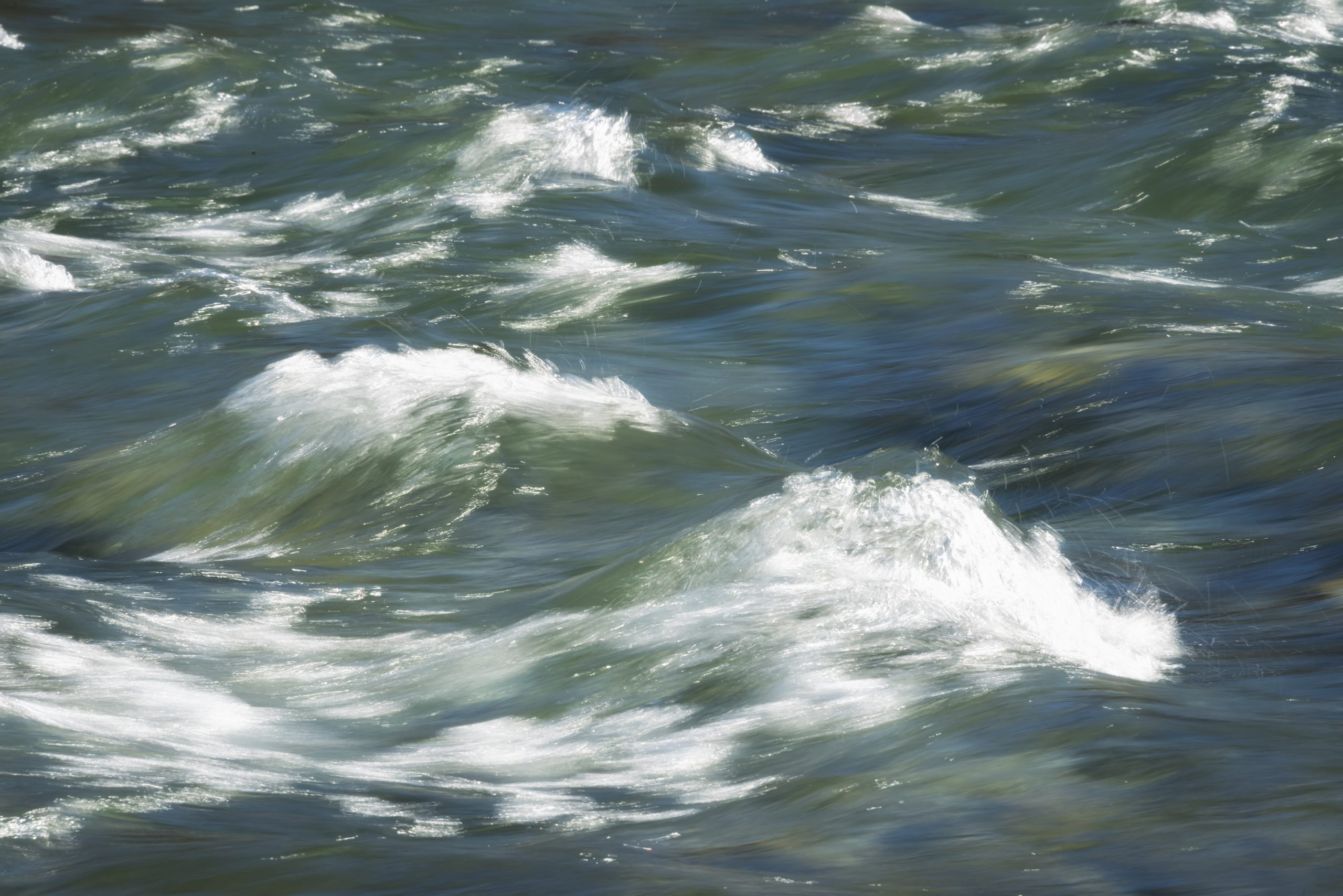
A short trip for recreation in Bavaria led us to a completely sunny Bad Tölz at the Isar river. That way I also increased my knowledge of local geography. With a long time exposure, taken without a filter, only with a large aperture and low ISO, some assembled pebbles on the ground instead of a tripod, I wanted to capture the wave play of river Isar.
It was only in our hotel on the computer that the resulting structure became more interesting and clear to me. For Christa the image shows picturesque brush strokes of an oil painting. I can think of the surface structure of the sun which is a fiery dance of magnetic field lines and mass distributions of hydrogen.
In the evening a long sunset glowed for us in Königsdorf. The rotational planes of sun, moon and earth are quite close and in a few days we expect a partial lunar eclipse.
The light takes 8 minutes from the sun to the earth. Due to atmosphere it remains visible to us longer than the sun itself.
-
Moonset in Alling
It had become very late last night and my tiredness did not let me think clearly. I also didn’t know what happened after I went to bed. It could easily have been the end of a human being.
With the warm morning sunlight from the left the winter fields of Alling in December were wonderful to look at. With my senses clouded, I thought the moon would rise. It took me a long time to figure out he was going down.
-
X-ray Xmas floral arrangement
Today was a day of dense work and many technical problems. The day before I had made some flower arrangements for Christmas from my preferred flower dealer. A technician took me some X-rays so I could study the exposure values when my wirk was finished.
The following two I liked most.
The vase on the right side seems to hover over the ground.
-
Snail shells X-ray fusion photos
A friend handed me out some snail shells that he had in mind for a long time to lend me. Eventually, he found 5 beautiful shells when cleaning up the basement.
The effect of the images depends strongly on the post-processing. Some of the results may not be combined in one presentation.
Here I show three images of them as dark jewels with an intrinsic undefinable light. Maybe, we are thousand miles below sea level.
Fusion imaging works with a light box. Without, too. It depends on your subject. The light images were taken with a Leica Q, pointing just in the same direction as the X-rays from below of the X-ray tube. The resolution and technology is completely sufficient for the color use.
I designed a new composition, which should allow me to have different positions of the shells in space. The surrounding snail shells serve as supports.
I wanted to take the yellow, quit radiopaque snail shell from above. So I had to rearrange the snail shells once more.
When looking at my flickr stream you may find other representations in the preceding neighborhood of this image.
-
X-ray fusion photo of a sphere of snail shells
This X-ray fusion image is untrue. No time during working hours to take the photograph. So I made a photo this morning at home. There are so many snail shells glued on the sphere that it is basically not noticeable if the rotation does not match exactly.
Here is my result:
The underlying structure in an image of visible light looks like this: