-
Radiating Beauty: Creating a new photographic form with fusion X-Ray images
The shapes and forms are recognizable, yet the level of detail is deeper than the human eye can normally perceive: Leaves appear minutely laced and surfaces are impossibly intricate, somewhere between translucent and opaque. Welcome to the captivating work of photographer Harold Davis and radiologist Dr. Julian Köpke, who combine their skill, passion, and vision to create stunning X-ray photography and pioneering fusion images. Read more on the Pixsy blog (article by Natalie Holmes).
This nice article was posted today to share the fascination of our common work on fusion X-ray images using a light box manual HDR photo of flowers and their X-ray.
Our X-ray data are the same, our photographic data a nearly the same: Harold used a Nikon D850 and I used a Nikon D810A, which is modified for astrophotography. Our common lens was a Zeiss Makro-Planar T* 2/50 ZF.2.
We have some techniques and some principles in common, yet we are different individuals with different results. The next image is partly inspired by Harold’s version. Blue is the complementary color to yellow and fits nicely into the petals. The red color in the center is an image of the sun in monochromatic Hα light using a Fabry-Perot-Interferometer. So this image is a triple fusion image of three different light sources ! If you look closer at 2pm in the center, there are two sunspots.
-
X-ray fusion photo of a Nautilus
Fusion imaging can be done retrospective. My split Nautilus shell on a light box rendered with manual HDR shows already a nice structure of the inner parts.
The X-ray obtained a couple of days earlier easily fits onto the HDR with not a big deal of processing.
The meaning of the fusion image may be different to the flowers. But it’s feasible to do it retrospectively.
-
Anyone can have a mishap
There are many stops put to a CT-scan, especially when dealing with women in reproductive age. We are always very careful before exposing any patient to radiation.
This middle-aged patient with repeatedly nausea and discomfort opposing pregnancy very strict and claiming menstruation 28 days ago underwent some medical examinations including gastroscopy and, eventually, a CT-scan.
We were prepared for a tumor when scanning the abdomen. We were amazed to find a baby despite many questions about patient’s history before the exam. Maybe, some obesity covered the situation with a veil.
You can see the bones of the upper and lower extremities, as well as the skull and some parts of the spine. The ossification of knees, feet and hands will take place the next ten years after birth.
It appears to be discussion-worthy if it’s a boy. Our methods didn’t lead us further on this.
To me the rotated, inverted and cropped image resembles to cave paintings. These paintings are assumed to be some kind of religious art, reflecting astonishment and grandeur of lost civilizations.
Certain is, the baby touches its right ear, as it was amazed by itself or reflecting its life. What else than human life is this ?
-
Tilted Nautilus X-ray photo
Imagine a Nautilus shell tilted to the surface of the X-ray sensor. The parts close to the sensor are sharp, the distant parts unsharp. Because the X-ray beam creates a central projection. The focal plane is the plane of the sensor, in focus are those parts close to the sensor.
The shell looks like entering the image or leaving it.
-
Nautilus shell X-ray fusion photo of energy levels
Different energies of X-ray radiation mean different transparency of an object. There is an example in my FAQ using a Nautilus shell.
Instead of compressing images of different energies to a single image today I subtracted the 70 kV image of a Nautilus shell from the 40 kV image.
The central parts of the Nautilus shell are more dense and show a significant higher difference. The core of the shell gets shiny. This is how it looks like:
In positive X-ray representation you can compare the results. Left hand is the compressed image of 4 different energy levels, right hand the difference image.
-
Organ music
I like organ music. And I like the architecture of an organ. It’s always a composition of different metals and woods.
Today my favorite organ player gave us nice preludes as a present during the service.
-
Dahlias fusion X-ray HDR photo
Long time ago my friend Harold and I did these X-rays in my practice. There was so much to do. Today was a chance to process the fusion images. Some details can be found in my FAQs.
The manual HDR is already appealing to our eyes.
There is some charm in the X-ray image of the same composition. The hidden parts of the stalks can be clearly seen.
The fusion image of this composition shows both color and hidden structures.
Finished image with a background:
-
Nautilus shells 3D X-ray photo
How does an X-ray look like with a complete, unsplit specimen of a Nautilus shell ? Will X-rays go through the object ?
My three Nautilus shells I bought in Crete are split specimens. The following approach will give an answer to the question. My composition of my shells is 3-dimensional and in nearly upright position. X-rays were then done with different directions of the radiation to study the effect.
Positioning of the three Nautilus shells on the X-ray sensor © Julian Köpke
Positioning of the three Nautilus shells on the X-ray sensor © Julian Köpke The first image was obtained with radiation coming from the top. The native X-ray representation is with a black background. Historically this was a film negative. Radiologists speak of „transparent“ areas where a film is black. Consequently, white areas are called „opaque“.
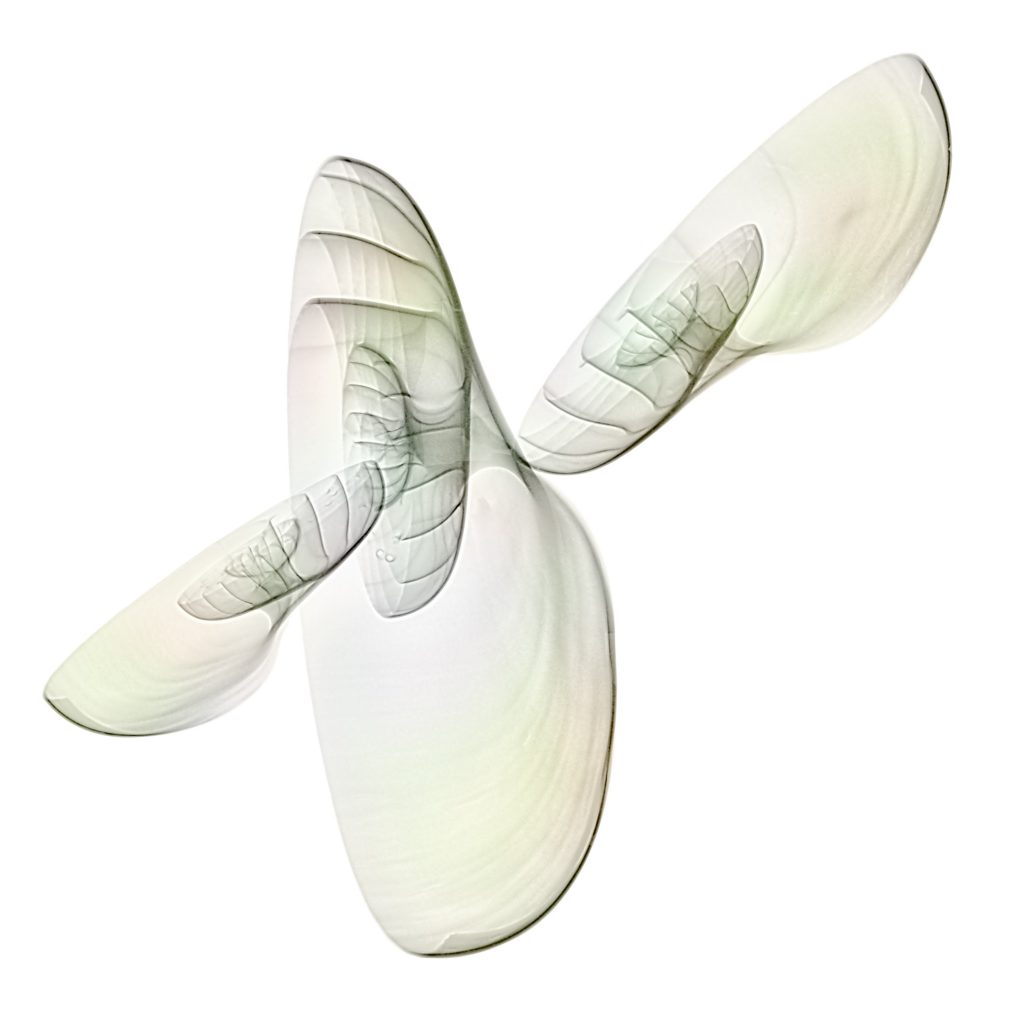
The result of radiation coming from the top and slightly tilted shells gives different insights of each shell. The composition looks like a complex mathematical surface or some flying insect.
The inverted (or „positive“) representation is weightless and our mind starts to produce lots of phantasies about the composition.
The effect of colorizing an X-ray is not only graphically. It looks more natural.
The following image was obtained by combining the inverted image with a flat projection of a single shell to a single image. Now one gets an idea of the effect of the beam path.
A tilted beam path shows the a bit more detail of the „wings“. Tilt was about 30 degrees.
Tilt by 45 degrees shows more of a Nautilus as we know it.
-
Sunflower X-ray photos revisited
How to show the sun in the middle of a sunflower ? For astronomers it is quite common to look at the sun in hydrogen alpha light, which is a pure red at 635nm. With artistic eyes, a red center might be overdone.
So I tried two different representations, one in BW that is close to the natural look and feel of a sunflower and one with a light blue in the center as complementary color to the yellow petals.
The surface structure of our sun can be seen like astronomers see it.
There is no photo of the next digital X-ray image of a sunflower with its stalk and a leaf:
-
Shells fusion X-ray photo
Long time I dreamed of this fusion image of shells. Because already on a lightbox some of the shells are transparent and have nice colors. I like the shining through effect very much.
The X-ray image is a compromise of structure and density resolution, depending on the maximum energy the mammography system is able to produce.
Today I’m not at all in a stable state due to a recurrent infection. So I allowed me to do this image instead of hard working.
It is the light inversion in Lab color mode that shows more of a X-ray look and feel. The colors are pretty close to the bright image.