• General,  Iceland,  Travel

    Cold composition

    On the drive from Raufarhöfn via Husavik to Akureyri, we moved along the coast for a long time. The sky was completely overcast and small showers were falling.
    Iceland’s public sculptures are always clearly visible along the roads . The colours blue and green created cool compositions. The image of the coastline with waves warmed up a little or harmonized by the cliffs.

    Public sculpture at Kopasker (85) (Presthólalón) © Julian Köpke
    Coastline near Husavik (Cold composition) © Julian Köpke
  • Iceland,  Travel

    Arctic Circle and Arctic Henge

    After this hot year, it’s starting to get cool, although Iceland is also uncharacteristically warm at the moment. With twists and turns we finally reach the hotel in Raufarhöfn via the 870 with stops in Raudinupur, Skinnalón and the Arctic Henge.

    To reach the lighthouse in Raudinupur we had to walk 6 km there and back. Just arrived, the sunny weather changed and a thick, icy fog surrounded us. We became unsure which would be the right way back. The chattering of the gannets did not stop.

    Lighthouse Raudinupur © Julian Köpke

    My personal highlight of the day is the abandoned farm Skinnalón. It lies at 66 degrees and 31′ north latitude, which is only 1′ below the Arctic Circle, just a few steps from the Arctic Sea. The area was closed off to vehicles, the footpath uneven and a strange smell drifted over to me the closer I got to the former farm. My eyes quickly became irritated and a headache set in, as if an allergic reaction was taking place.

    Abandoned farm Skinnalón © Julian Köpke
    Collapsed storerooms in Skinnalón © Julian Köpke
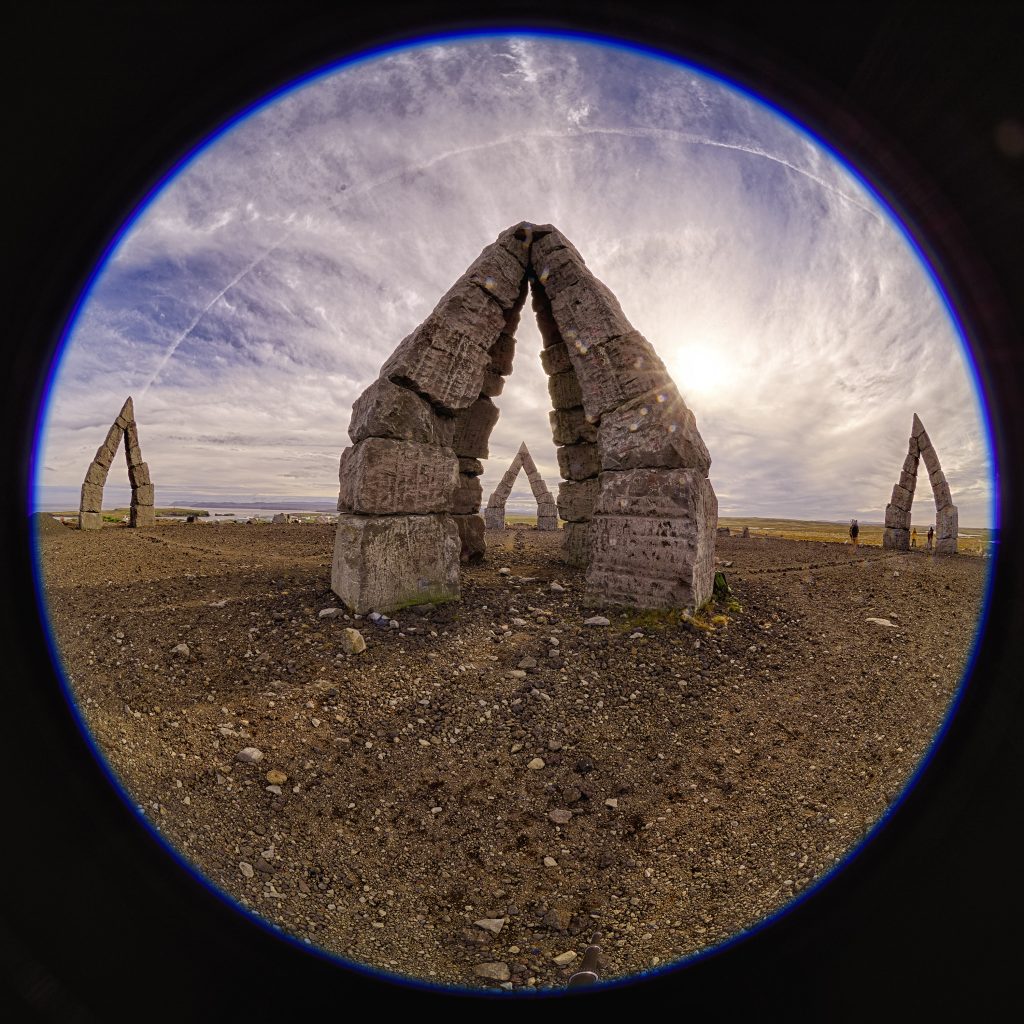
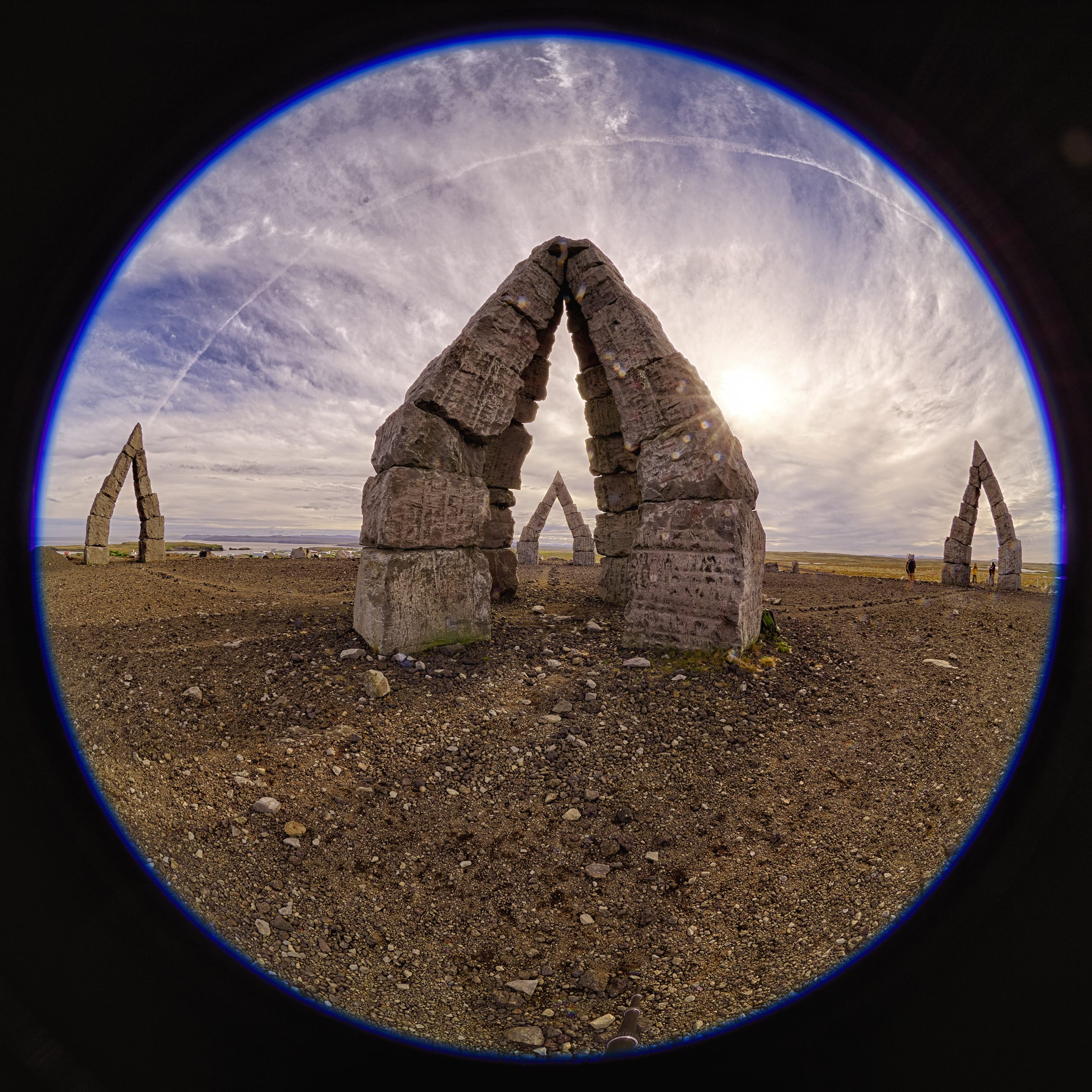
    The Arctic Henge has been under construction as a work of art since 2002 and is unfinished. Somehow the goings-on at the construction site are reminiscent of the Sagrada Familia in Barcelona, perhaps because the stone arches are irregular, but geometrically very precisely arranged.

    Arctic Henge in Raufarhöfn. Wikipedia tells: "The Arctic Henge is an Arctic monument planned in 1996 by the artist Erlingur Thorodsen, which has been under construction since 2002 and is up to 11 m high. The name Arctic Henge is based on the name Stonehenge. The Icelandic name is Heimskautsgerði." © Julian Köpke

    In the early evening, a fog began to settle over the place, so we went to Arctic Henge again at nightfall. For a long time I looked at the arch as a gate with a little moving person in the background. Only during post-processing did I recognise a stone.

    Nocturnal deception in the arctic mist at the Arctic Henge in Raufarhöfn © Julian Köpke
  • Iceland,  Landscape,  Travel

    Eystrahorn

    Besides the Vestrahorn near Höfn, there is the Eystrahorn near Hvalnes, situated right next to a lighthouse. The bay at Hvalnes was windless, sunny and warm. Just as we turned east at the lighthouse, the weather abruptly changed to stormy, cloudy and cold. It took me 3/4 of an hour to safely photograph the mountain group, because clouds obstructed the view.

    Fragile clouds at Eystrahorn beneath Hvalnes Lighthouse © Julian Köpke

    The view to the west shows the peninsula, the sea and Vestrahorn in the distance. The fragility of the weather situation is not noticeable in this direction.

    Hvalnes beach and peninsula beneath Eystrahorn. Vestrahorn at the horizon. © Julian Köpke

    In the evening it became increasingly overcast and the prospects of seeing the abundantly announced auroras sank into the bottomless pit. The clouds were coloured by the evening glow. Hotel guests gathered on the terrace to greet the sunset with many photos.

    Evening at Fosshotel Vatnajökull © Julian Köpke
  • Iceland,  Landscape,  Travel

    Patterns and glacial flows

    This morning we were far from convinced to book a photographic sightseeing flight. Because the clouds were hanging 20m above the ground when we left our hotel. The closer we got to Skaftfell, the brighter it became, but still plenty cloudy. Only on the peaks of Vatnajökull was there plenty of sun.

    The experienced pilot was sure we would have fun. And so it came to pass. Because our pilot liked to take pictures from the air himself and knew exactly how to get the best light conditions in front of our lens in the clearing weather. How impressive it was may be understood by pointing out my rapidly aching hands, which from focusing, positioning the camera and releasing the shutter on both sides had me feeling the saddle joints after only half an hour.

    Our flight was a complete success thanks to this young pilot whose machine was more than twice his age. Only the engine was new, he said.

    Glacial flows and patterns on Iceland © Julian Köpke
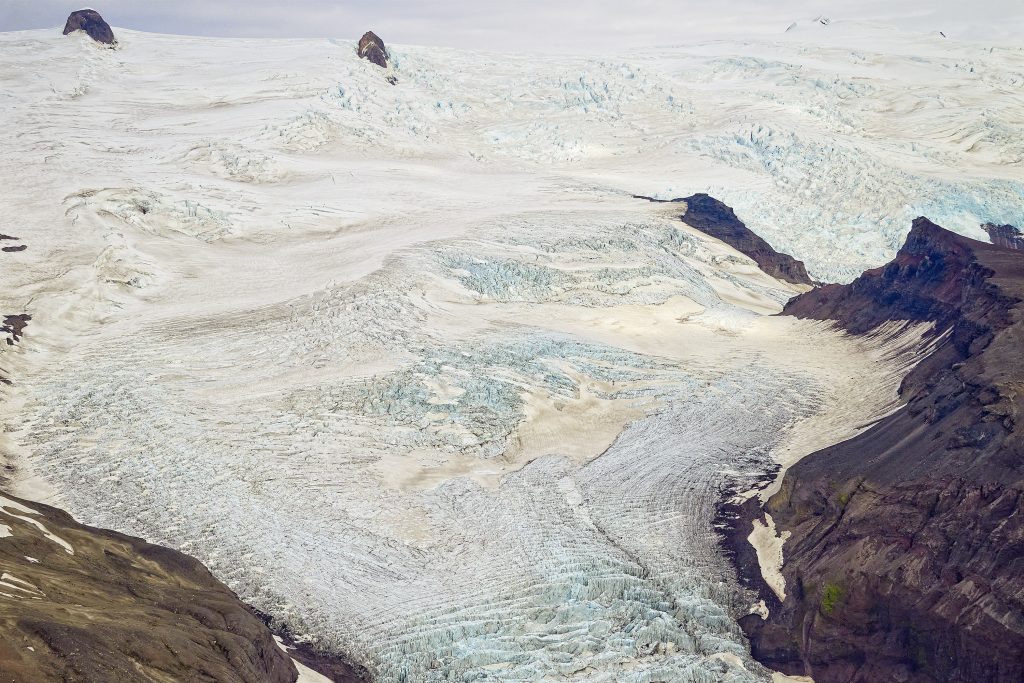
    After crossing the first glacier flow, we reached the glacier itself. With the old Cessan we slowly crept up the glacier. I felt reminded of films where the altitude limit is reached and the hero has to dare to jump. The cold downdraft winds were hard on the plane, but the pilot still guided us safely up the slope.

    The sight of a glacier reminds me of frozen waves that take you up and down with power. The frozen glacier seems less dangerous, almost still.

    Flying up the glacier Vatnajökull © Julian Köpke

    We left the glacier area again to approach the glacier lagoon Jökullsarlon. From above, everything looks small, I didn’t even notice the many icebergs I would later find from the plane.

    Flight from Vatnajökull to Jökullsarlon © Julian Köpke
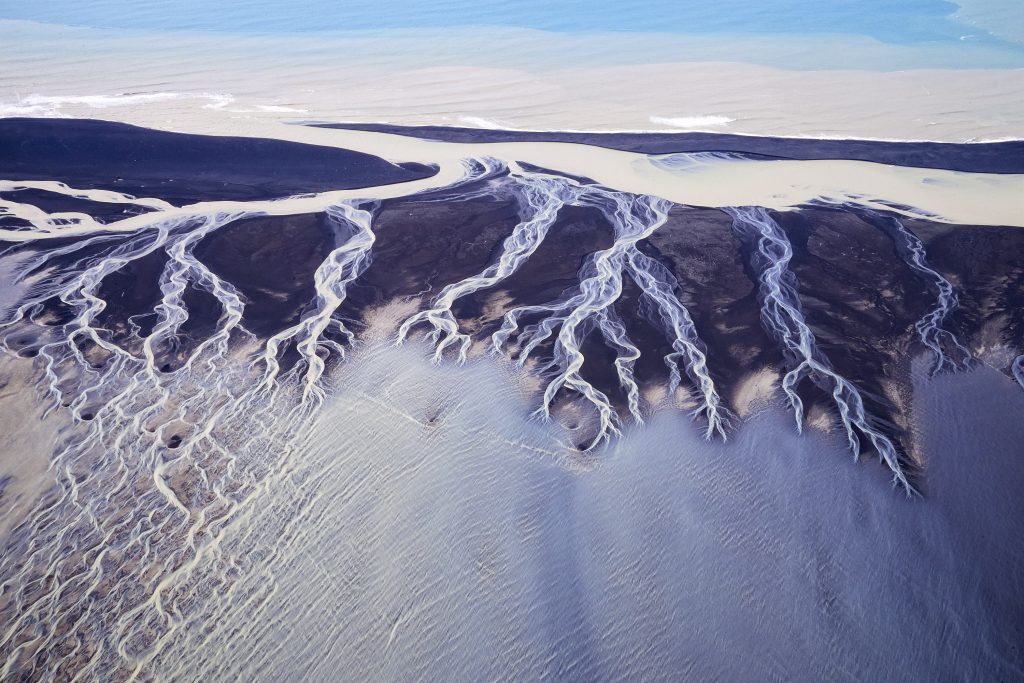
    In one hour I took 700 pictures, which is about 50 GBytes of data. At the end, the exhaustion of the hands and body was noticeable. We only had bananas and nuts for breakfast, as we had to leave the hotel before breakfast. Fortunately, we had gloves, scarf and hats to brave the cold that came in through the open plane windows.

    Glacial flows and patterns on Iceland © Julian Köpke
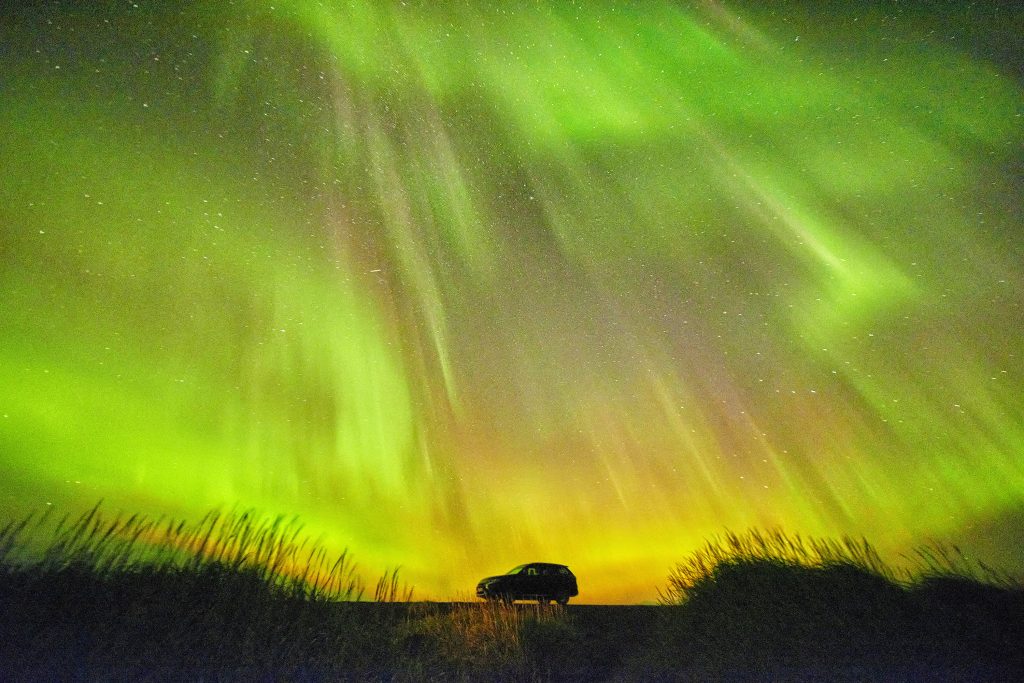
    Deep sleep had been indicated and possible before the evening excursion. With a small diversions via Hafnarnesviti lighthouse, we reached the Viking Café in Stocksness at 11 pm. Many cars took the same route. Northern lights at Vestrahorn were the final destination for all. For the first time I experienced polar lights with my cam under clear skies.

    Polarlights at Stocksness © Julian Köpke
    Polarlights at Stocksness © Julian Köpke
  • General,  Landscape,  Travel

    Iceland

    The prospects are good: with high probability northern lights are announced for tomorrow and the following days in Iceland. We had wished for northern lights, but in no way expected to see any, nor to be able to photograph them.

    Our first day of travel starts with a seven and a half hour delay of the plane. A short wait turned into a long day with lots of sun outside and little movement in the lounge.

    „Have camera, will travel.“ I can’t get this sentence out of my head. The prospects are good: beautiful Icelandic landscape and auroras with high probability.

    Have camera, will travel. © Julian Köpke
    Probability for Northern Lights
  • Architecture,  Travel

    Oslo

    Our journey to the Land of the Midnight Sun starts in Oslo. The hotel is just a stone’s throw from the harbour. lot of rain and constantly changing light from more or less dense clouds greet us. Because we don’t want to miss anything, we start our first tour right after arrival, despite a certain tiredness.

    The first building that caught  our eyes is the opera. Built with Carrara marble is white.

    Operaen Oslo (Opera house) © Julian Köpke
    Operaen Oslo (Opera house) © Julian Köpke

    A sculpture in the middle of the harbor attracted me. It took me some moments to see the resemblance to a painting of Caspar David Friedrich („Eismeer“).

    Failed Hope (Sculpture inspired by "Eismeer" by C.D. Friedrich). A flexible mounted sculpture in the harbour of Oslo. Light is different every moment: it will be never the same. © Julian Köpke
  • flowers,  General,  Travel

    Turn of the year

    The most surprising thing this year was the selection of many of my pictures in the Flickr Explore streamMy best picture in 2021 is again a black and white, this time of the Bernese Alps with a view of the mountain chain Eiger, Mönch and Jungfrau. The picture was taken on the Schilthorn when I fled the permanent James Bond exhibition.

    Mountain chain Eiger Mönch Jungfrau. There will be a weather change. © Julian Köpke

    The end of the year had some surprises in store for both of us. We drove to the Black Forest and hoped for snow to cool off. The snow did not come immediately and a red dawn on January 2nd seemed dangerous and not calming.

    Celestial fire: impression of a wildfire at sunrise in Alpersbach © Julian Köpke
    With plenty of snow, alternating sunshine and snow drift, there were beautiful moments in the countryside in Breitnau near Hinterzarten.
    Walk along the winter forest © Julian Köpke
    Snowfall at abandoned mill © Julian Köpke

    With the help of some tips from a photographer friend I was in school with a long time ago, I tried to improve my photographic technique and post-processing. This includes the trick of placing a piece of newspaper in the sharpness plane of the lens in order to speed up the focus. Very effective.

    Orchid on black © Julian Köpke
    Mysterious Amaryllis © Julian Köpke
  • Landscape,  Monochrome,  Travel

    Mürren II

    With the first cable car to the Schilthorn I started at 7:40 am in Mürren. Unfortunately, as a tourist I couldn’t go up earlier. On the terrace of the mountain station there were two cardboard figures with shooting irons in hand, which appeared to me on the pictures of the webcam as strangely motionless guests. The temperature at 0 degrees Celsius was not friendly for the hands, so I was mostly alone on the platform.

    How do you photograph mountains ? At distant mountains the colour disappears into a dull blue, which is why prefer black and white in these cases. Then a gripping dynamic may develop that draws you into the image.

    Snow field at Eiger (Alps of Bern) © Julian Köpke

    The technical side of a cable car has always fascinated me. cable car is a workplace for drivers, technicians, engineers and many others. The first ride in the morning is a cheerful encounter of these people, who have known each other for along time and take turns doing some work on the machines. That’s why we were allowed to listen to music for the morning gymnastics during the drive uphill.

    In fact, the construction of a mountain station on the Schilthorn before it became the location for the 4th James Bond movie starring George Lazenby was certainly controversial and economically questionable. After the movie, everything was clear. Today you can admire many scenes and their making of on a separate floor, as well as 10 minutes of impressive films about the local landscape and the film.

    Piz Gloria (Schilthorn) with 007 Café. Some scenes of the 4th 007 movie were shot there. It's been the headquarter of Blofield. © Julian Köpke

    It was only while processing the images that I noticed the many airplane tracks in the sky that had not been there for so long.

    The mountain range of Eiger (left), Mönch and Jungfrau also looks better in black-and-white technique. The imminent change of the weather is already clearly visible on the image.

    Mountain chain Eiger Mönch Jungfrau. There will be a weather change. © Julian Köpke
  • Landscape,  Monochrome,  Travel

    Lake Lucerne

    The cross-country trip to Lucerne with a 20-year-old navigation system took me along many country roads, which used to be the only connection to this city. It’s hard to imagine how the traffic might have moved then. That’s why the system guided me down from the motorway through beautiful Swiss landscapes.

    Mowed meadow near Affoltern

    A little tired I arrived in Lucerne and went to sleep. Just in time for sunset I made a tour through the old town to Lake Lucerne, on which wonderful sailboats were on the way.

    Lake Lucerne and Alps. Snow covered Tödi. © Julian Köpke
  • Travel

    Fagradalsfjall

    The last highlight of our trip through Iceland was the newly erupted volcano Fagradalsfjall in March in the Krýsuvík volcano system of the Reykjanes peninsula. After arriving at the parking lot, which we unfortunately could not pay for lack of local app without internet connection on site, was by a lava river on the footpath to the viewpoints a long walk fully loaded with photo equipment to tackle.

    A long horizontal path to a steep climb that should be worthwhile. The last part of the 150m ascent was provided with a rope on which you could pull yourself up. Then came a plateau, on which the visitors spread out over large area.
     
    Admiration and shiver at Fagradalsfjall © Julian Köpke

    Right hand side in the background on a hill has landed a helicopter. Since the beginning of the pandemic, I haven’t noticed so much aircraft noise. A burning smell was everywhere in the air, sometimes pungent. After a short time, I started to have slight headache.

    Volcanic fumes at vent of Fagradalsfjall © Julian Köpke
    Hot lava out of volcanic vent Fagradalsfjall © Julian Köpke

    The impression of a primordial landscape induces the last image.

    The very beginning © Julian Köpke