In autumn in South Tyrol, the changeable weather is a series of photographic opportunities. On mountains above 2200m there is already a loose layer of snow. A little below that, autumn shows itself after a hot summer.
The changeability unfolds a grandiose spectacle of clouds and peaks on the Dolomites around the Alpe di Siusi. All you need is a good seat in the café by the cable car to comfortably watch the light change and react to it.
If it really does rain during the day, a visit to the archaeological museum in Bolzano is a good alternative to board games in the holiday flat. Digital registration is worthwhile, but less significant in autumn.
The poor man who died 5300 years ago from a painful arrowhead in his left shoulder, probably in shock due to the rupture of the arteria subclavia, is a treasure trove or stroke of luck for science, which has made many research opinions have to be reconsidered.
The artistic reconstruction of the body by Adrie and Alfons Kennis from the Netherlands does not reflect the finding situation of the glacier mummy. It appears fragile and vulnerable, almost old and tired. One should not be deceived by the physical impression of the fictitious reconstruction. His last ascent from the valley over extremely rough terrain up to the Tiesenjoch at 3210m within about 6 hours was a physical challenge and probably a masterstroke.
In the meantime, 0.8TB of photo data has accumulated. It will be a challenge to process all these photos. Fortunately, I am concentrating on a few compositions, each of which will be studied in more detail. The themes of geometry, lines and planes stand alongside the theme of colour contrast, which is easy to focus on in Iceland.
The basalt rocks of Arnarstapi are ideal for this. With moderately homogeneous cloud cover, they lend themselves to long-term studies. The Phase One camera is able to do without the grey filter through frame averaging, which otherwise often leads to slight shifts in the composition.
I’m still not sure whether the basalt rocks of Lóndrangar look better in colour or in black and white. We had drizzle and fog again and again, but also very brief sunny moments. Icelandic weather has returned to normal.
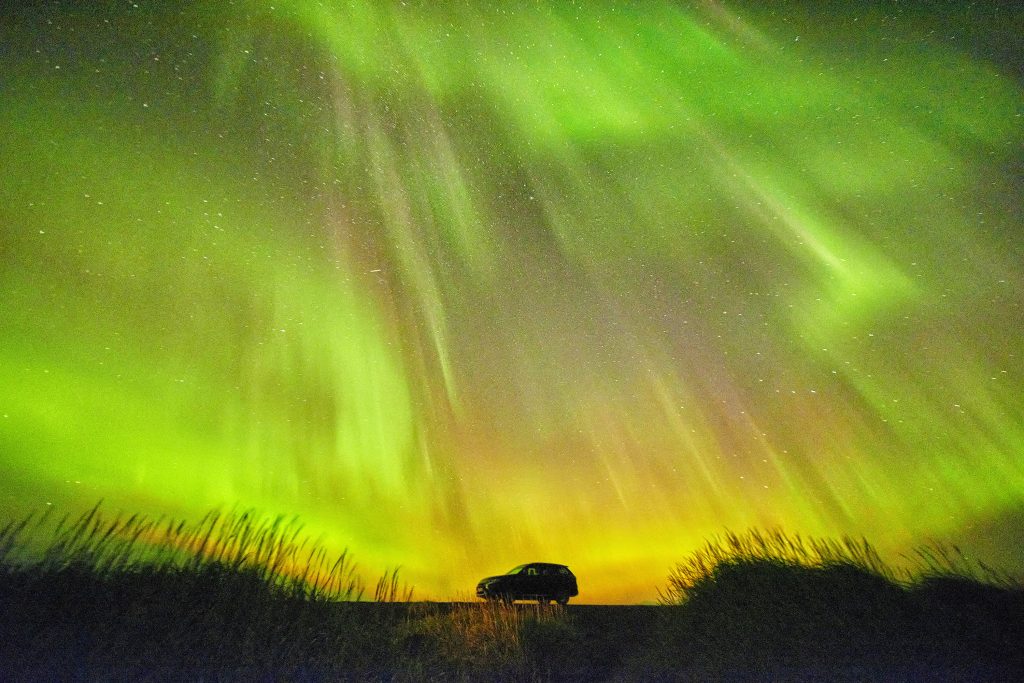
A low probability does not mean that something will not happen. For a brief moment, auroras could be observed at night at Hotel Latrabjarg. However, by the time the camera was set up, the phenomenon had already subsided. The night remained cloudless and starry, and the next morning the windows of our car were a little frozen.
This very sunny day with cool air was the start of the return journey, which we shortened by taking a ferry in the evening from Brjánslækur to Stykkishólmur.
The bird cliff at the headland of Latrabjarg was completely empty. Only a few seagulls were circling without landing anywhere. The puffins had already left for the Atlantic a week ago.
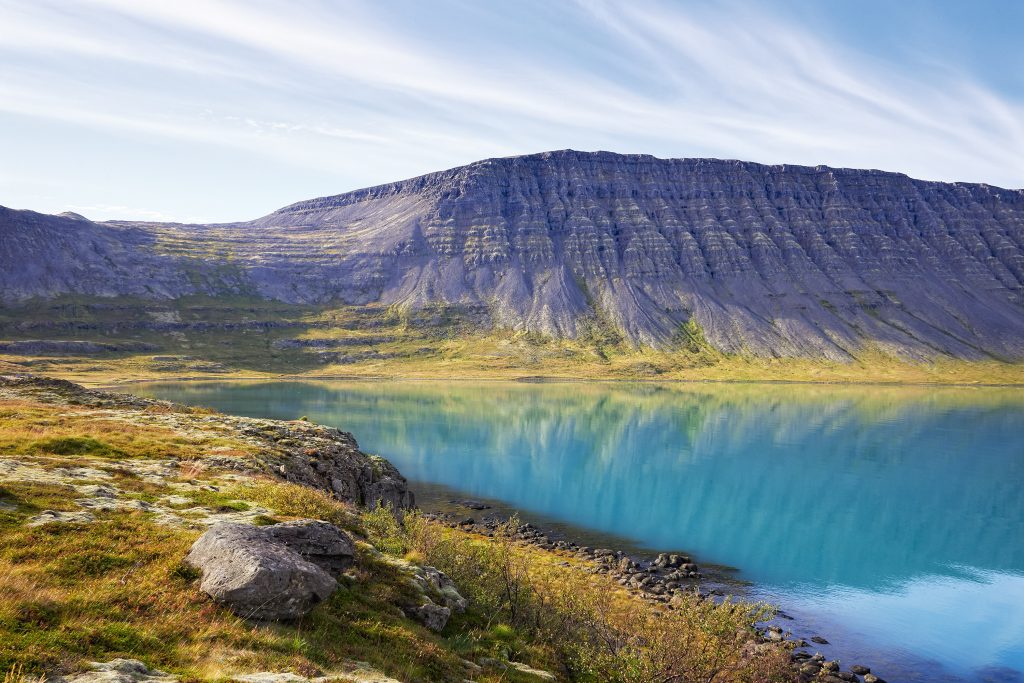
From this position you can see the rocks of the Westfjords of Iceland lined up one after the other.
Westfjord cliffs seen from Latrabjarg
Our lazy day ended in Brjánslækur. This is where the Vikings first wintered in the 9th or 10th century. A historical plaque refers to boathouses and storehouses that had been built. It must have been a Herculean task to dig depressions in this stony ground. A few tree trunks anchored in the ground are left this. In the background line up the mountains of Snæfellsnes peninsula.
On a gentle hill, at the foot of a perhaps nameless mountain, stood another small church with a red roof. These buildings seem almost like a toy landscape when the mountains make them small.
The ferry ride was sweetened by a multi-coloured sunset. We drove between the small islands via Flatey to Stykkisholmur. The clouds, however, were to prevent the Northern Lights from appearing when we arrived in Boudoir.
The drive from Flateyri to Latrabjarg is in sunshine with intermittent light cloud. Winter is coming: warm autumnal colours dominate. In Iceland, you walk at sea level and look at glaciers or year-round snowfields.
The second visit to Dynjandi made us stay down. The colours of the sea were strongly reminiscent of the Caribbean, still warmly outshone by the land in the late morning light around 11am.
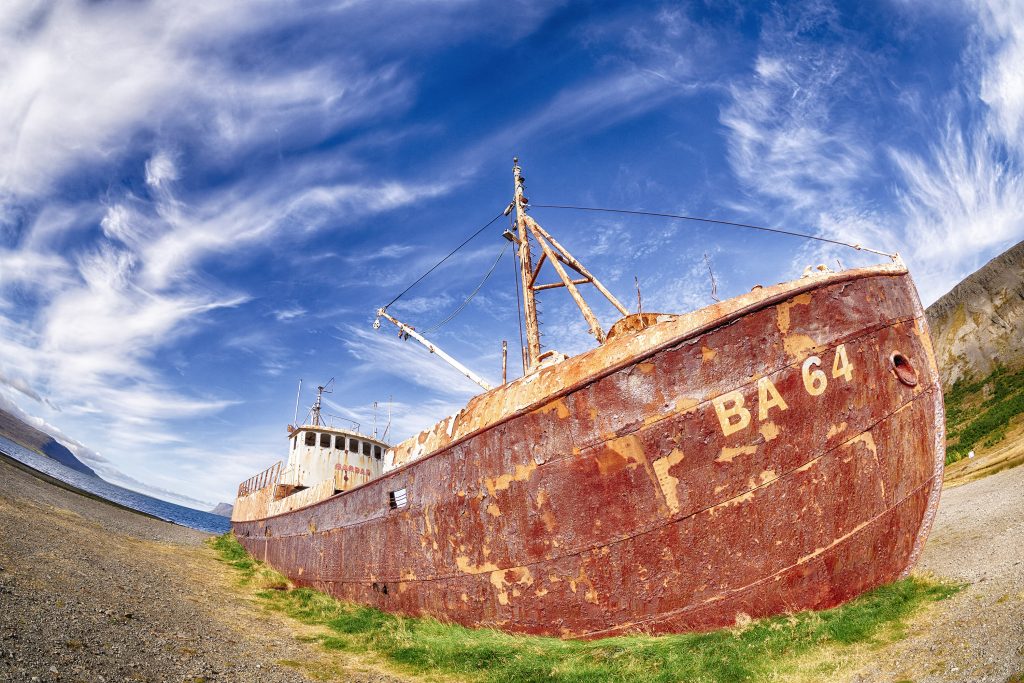
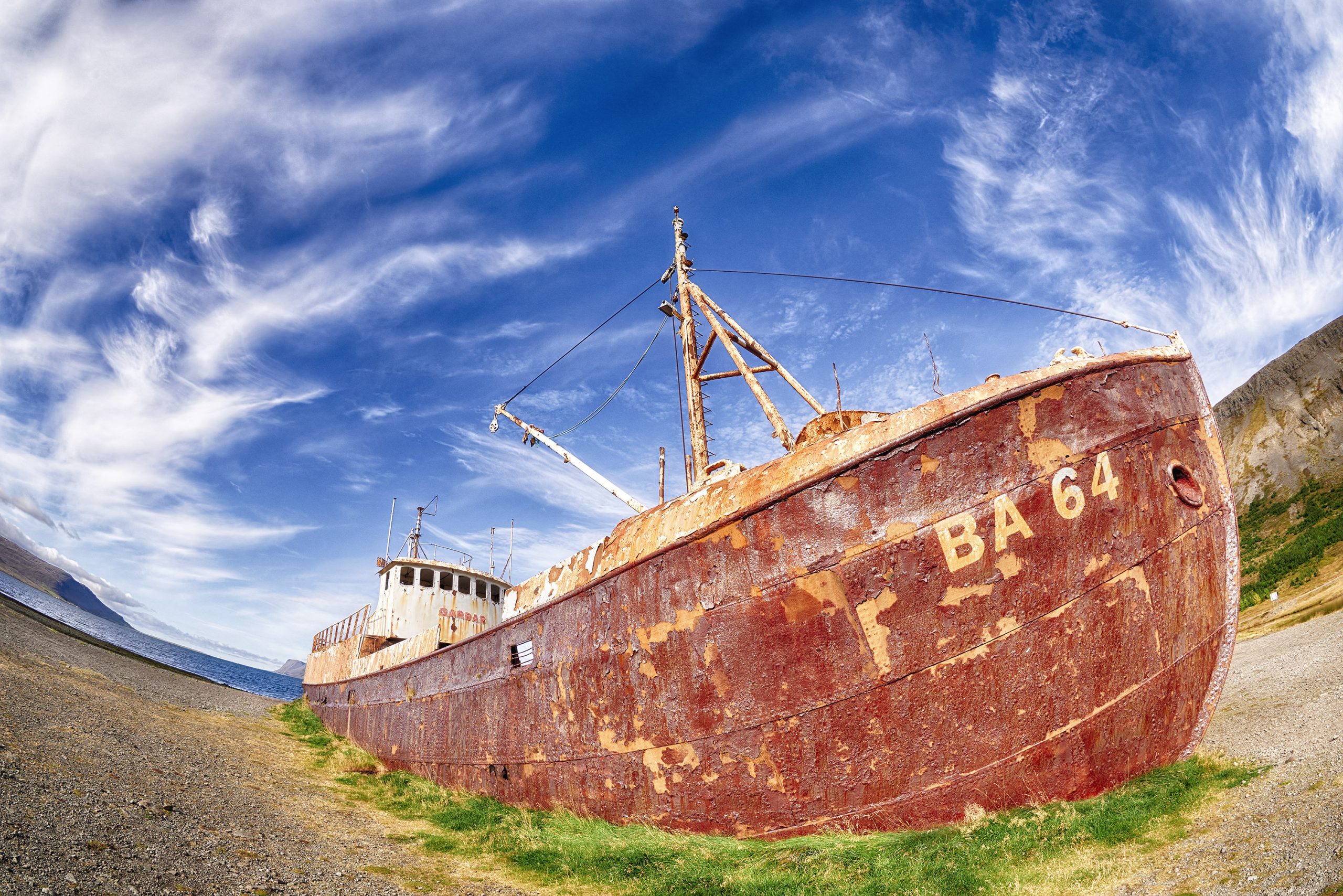
After the short second visit to Dynjandi in the morning on the way through, we came across the well-known shipwreck of the whaling ship Garðar BA 64. The weather cleared incredibly quickly and we were able to capture the rusting material as HDR. With a fisheye lens, the wreck deformed slightly in an arc under the circularly arranged clouds.
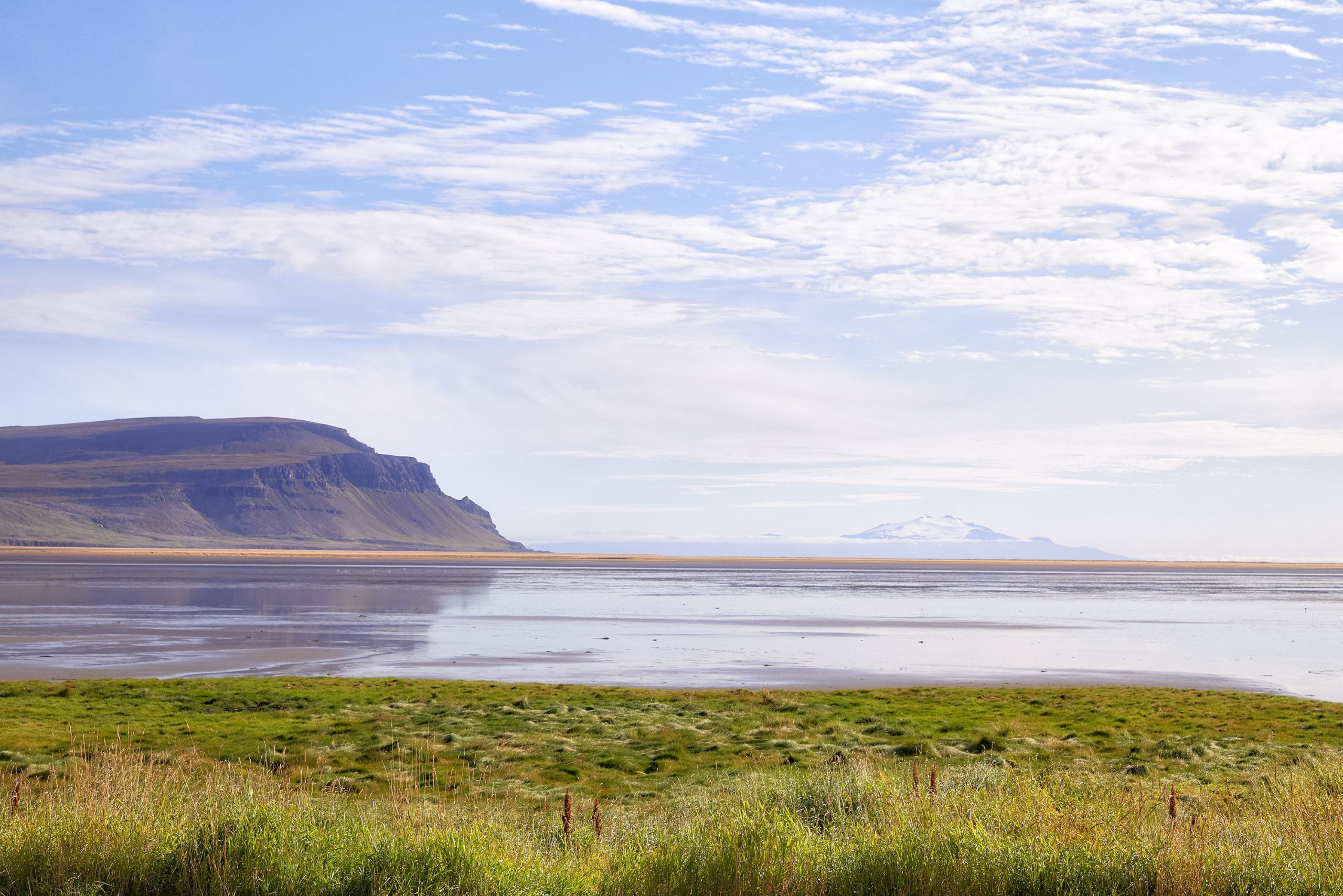
Shortly before the turnoff to our accommodation at Hotel Latrabjarg, the path led us to a red sandy beach. There are at least two of these, the other is on the south coast near Vik with the grave of a young Viking around 18. The red beach is called Rauðisandur in Icelandic. It lies far in front of the sea. Between the beach and the mountains is a marshland with farms, siels and cows.
Long days in Iceland with a time difference of 2 hours to Germany. It’s light here, while at home those who stayed at home go to bed. Early in the morning we started our tour to the lagoon of Hoffellsjökull. There is no tourist infrastructure, the car has to have a lot of ground clearance and the tyres have to be well inflated to reach the lagoon. A harmonious light situation awaited us today, light cloud cover making the sunlight a little more diffuse. The contrasts of the icebergs were clear.
The constantly changing light through the clouds made the icebergs alternately light and dark. The consistent structures were brought to life by the permanent change of light.
Changing the lens is not a change of perspective. Nevertheless, the change is worthwhile, because the higher focal length has the effect of enlarging a section. The change of light does its part.
The drive to Skalafellsjökull via the F985 pass road was somewhat adventurous. Although our Japanese car kept making very different beeps and noises, the meaning of which we could not always identify, the car was technically usable for this road.
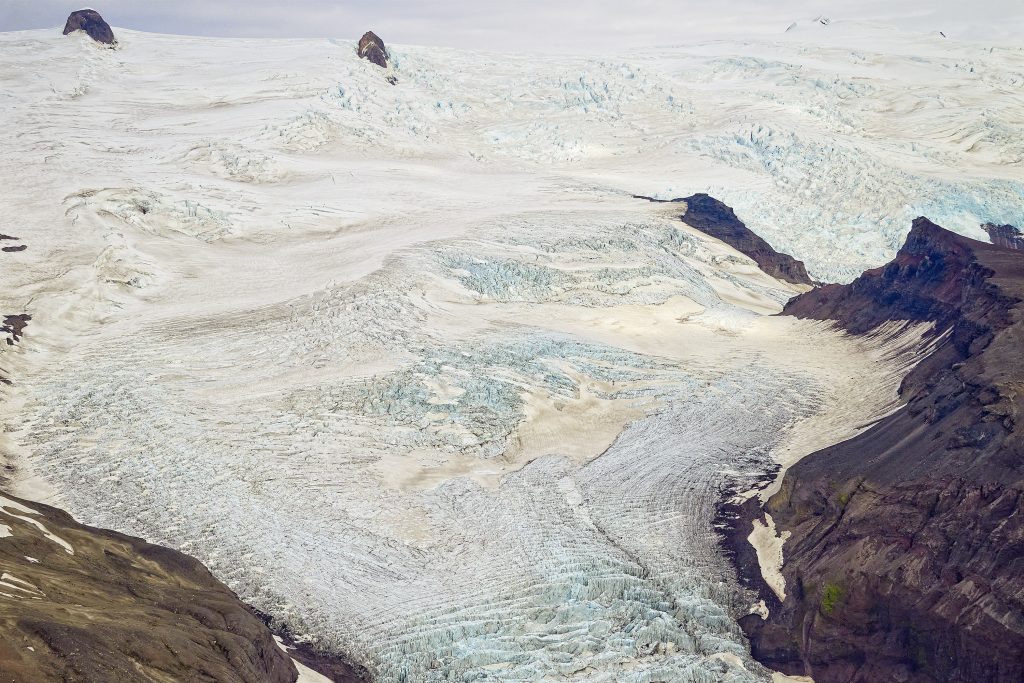
At the top we found a base camp for glacier tours with snowmobiles. A short walk over rocks of all shapes and sizes brought us to the edge of the glacier. A cool, almost constant wind blew around our ears. Gloves were great for working with the camera. With a rather dull light I created a panorama of the early glacier.
The most impressive structures of the glacier are found crosswise and lengthwise to the flow and are called „ogives“ resp. „band ogives“. We had already admired their charm many times on the ascent. We devoted ourselves to them on the descent.
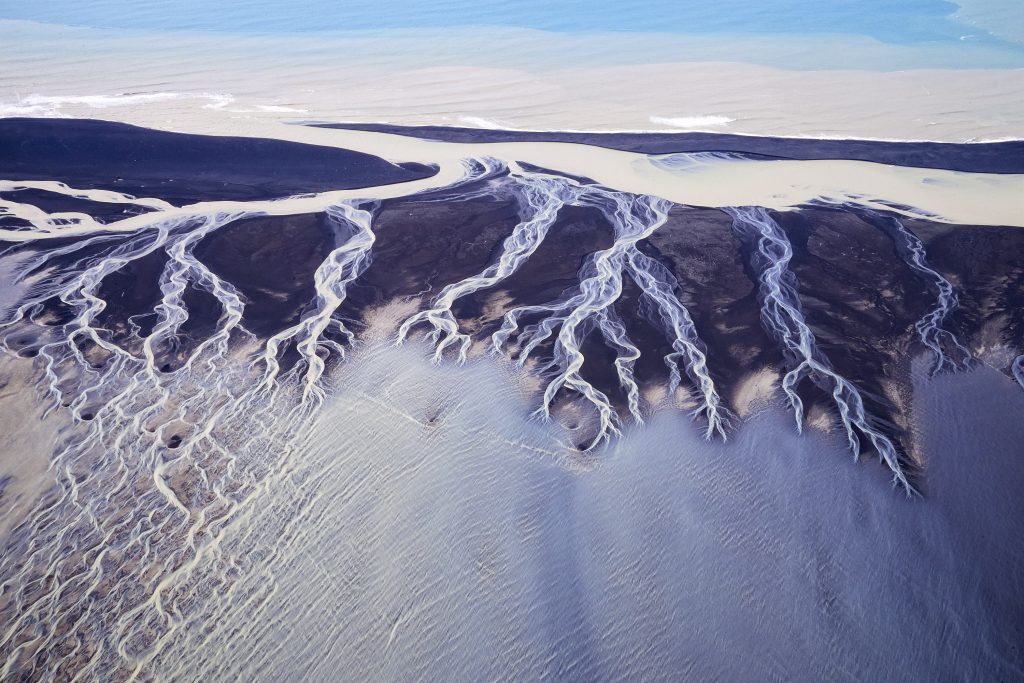
This morning we were far from convinced to book a photographic sightseeing flight. Because the clouds were hanging 20m above the ground when we left our hotel. The closer we got to Skaftfell, the brighter it became, but still plenty cloudy. Only on the peaks of Vatnajökull was there plenty of sun.
The experienced pilot was sure we would have fun. And so it came to pass. Because our pilot liked to take pictures from the air himself and knew exactly how to get the best light conditions in front of our lens in the clearing weather. How impressive it was may be understood by pointing out my rapidly aching hands, which from focusing, positioning the camera and releasing the shutter on both sides had me feeling the saddle joints after only half an hour.
Our flight was a complete success thanks to this young pilot whose machine was more than twice his age. Only the engine was new, he said.
After crossing the first glacier flow, we reached the glacier itself. With the old Cessan we slowly crept up the glacier. I felt reminded of films where the altitude limit is reached and the hero has to dare to jump. The cold downdraft winds were hard on the plane, but the pilot still guided us safely up the slope.
The sight of a glacier reminds me of frozen waves that take you up and down with power. The frozen glacier seems less dangerous, almost still.
We left the glacier area again to approach the glacier lagoon Jökullsarlon. From above, everything looks small, I didn’t even notice the many icebergs I would later find from the plane.
In one hour I took 700 pictures, which is about 50 GBytes of data. At the end, the exhaustion of the hands and body was noticeable. We only had bananas and nuts for breakfast, as we had to leave the hotel before breakfast. Fortunately, we had gloves, scarf and hats to brave the cold that came in through the open plane windows.
Deep sleep had been indicated and possible before the evening excursion. With a small diversions via Hafnarnesviti lighthouse, we reached the Viking Café in Stocksness at 11 pm. Many cars took the same route. Northern lights at Vestrahorn were the final destination for all. For the first time I experienced polar lights with my cam under clear skies.
The prospects are good: with high probability northern lights are announced for tomorrow and the following days in Iceland. We had wished for northern lights, but in no way expected to see any, nor to be able to photograph them.
Our first day of travel starts with a seven and a half hour delay of the plane. A short wait turned into a long day with lots of sun outside and little movement in the lounge.
„Have camera, will travel.“ I can’t get this sentence out of my head. The prospects are good: beautiful Icelandic landscape and auroras with high probability.
ManyofthephotographsItookwiththequadrupeds, whichwere laidoutasacoastalprotectionnearHörnum. Dependingonthe timeofdayandtheweather, theyareafantastic backdrop. This image was taken early in the morning short after sunrise.
Atthetimeofthehighestwaterlevelduringtheflood, these concreteblocks almost disappear underneaththewater surface. The next image is a combination of different exposure values to express the power of the incoming tide.
Withoutwind, theseaissocalmatlowtidethatyou don’twant toimplyanything violent toit anymore. Tocapturethe calmofthe low tidewaterIneeded30sofexposuretime. However, the Moonwould become blurredat that value. SoI combinedtwoshotsintoonepicture.