-
Frame averaging
Otto Flechtenmacher was a painter who lived in Austria, an uncle of Christa. I often did photography for documentary purposes, especially paintings.
This morning I listened to a workshop of portrait photography. To some extend the audience received explanations of the PhaseOne camera, which I use quite frequently. The vast dynamic range and the frame averaging feature of a PhaseOne were mentioned.
To reproduce these features I intentionally underexposed a photo of a painting of Otto. The original histogram can be seen on the left, the processed one on the right. The quality is quite surprising, when you are used to full frame sensors.
To compare the quality of a single shot image to frame average files, I did a sample of a single shot and two shots of 5 and 9 averages. Clearly, noise will be reduced. At the same time, structures come out more detailed, what might be seen from the following examples:
I never thought of using this feature for landscape photography – but it makes sense. By applying frame averaging you can get a landscape photograph with preserved highlights and well structured dark parts.
-
Darkroom studio II (glasses)
My darkroom studio is convenient for flower photography and high contrast, especially white. Today I tried out glasses with reflections and a nearly complete homogenous white vase. The only variations are reflections imposed on it from little light leaks of my improvised studio.
A photograph of a glass in a more documentary style is the following. The representation of the glass cutting is realistic. The stem out of the focal plane is appropriate for the focus of the photograph.
The combination of black and green thrilled me in the composition with traditional wine glasses for regional white wine. Unexpectedly, I got some copper allusions with some warmth in the transparent glass.
A more cool representation is the following composition with more glasses, including a tasting glass for Whisky. Is it the morning after a roaring party ? No leftovers can be seen so far …
A more detailed view ist the following photograph, which is more on the warm side. The glasses get a copper-like appearance.
-
Darkroom studio
The darkroom was the centre of analogue photography. In a darkroom were created the copies of a picture on photo paper, which had been planned when shooting with camera and film.
The “digital darkroom” is in a way the continuation of the darkroom from analogue times. Nowadays, the role of the film is taken over by the RAW image. The development of the film was linked to chemistry, intentional light and shadow effects and fine feeling. Each print was unique.
The “digital development” or postprocessing is non-destructive, repeatable and delivers a result, which at least theoretically can be printed as often as desired. In the digital workflow no print is unique anymore.With a dark background and systematic shading of daylight, my photo studio became a darkroom where I could photograph flowers. Exposure times became longer, almost like a long-term exposure at night outside. The saturation of the colors came out surprisingly strong.
The creation of a floating cloud with the help of white tulle did not require shading to achieve the effect of a darkroom. As my friend Lorenz mentioned, looking closer you can see nice interference patterns (Newtonian rings). I’m happy with this image idea: the image got two days later a Flickr in explore.
The soft variations of light and shadow fit well to a soft vetch.
-
Heidelberg Castle, flowers and flypaper textures
Heidelberg Castle is a landmark. In winter its red color becomes softer. For one winter Frederick V. became king with his home in this castle. After that, Germany sank into the 30 Years War. The castle had been ruined already by fire a couple of years before.
The delicacy and dreaminess of a photo is not always the result of intensive digital processing. The ranuncula of the following image hardly needed editing. You can feel it. With a tripod and a 85mm Lensbaby velvet at f/16 I shot this image with really delicate color.
The lavish feast is over. Paradise is no more. The king went into exile. We’re staying.
-
Callas and pink fern leave
For a short time the winter kept us still. Nature offers many motifs, the effect of which depends on the time of the day.
Shortly after, the snow has said goodbye to us. Still very, very cold cloudless nights, more and more often glorious sunny days let you catch your breath.
Yesterday I came across Calla lilies and rosé-fixed fern at the florists’s. „Expensive“, she told me. But I was already determined wether the many possibilities I had in mind.
Through a chemical process, the fern has received a fixation and new color. That would make it durable for many compositions ….
The next day, I combined the callas and the fern to a single composition. With a background the image looks soft and dreamy. This texture puts a kind of patina over the image.
-
Fibonacci numbers
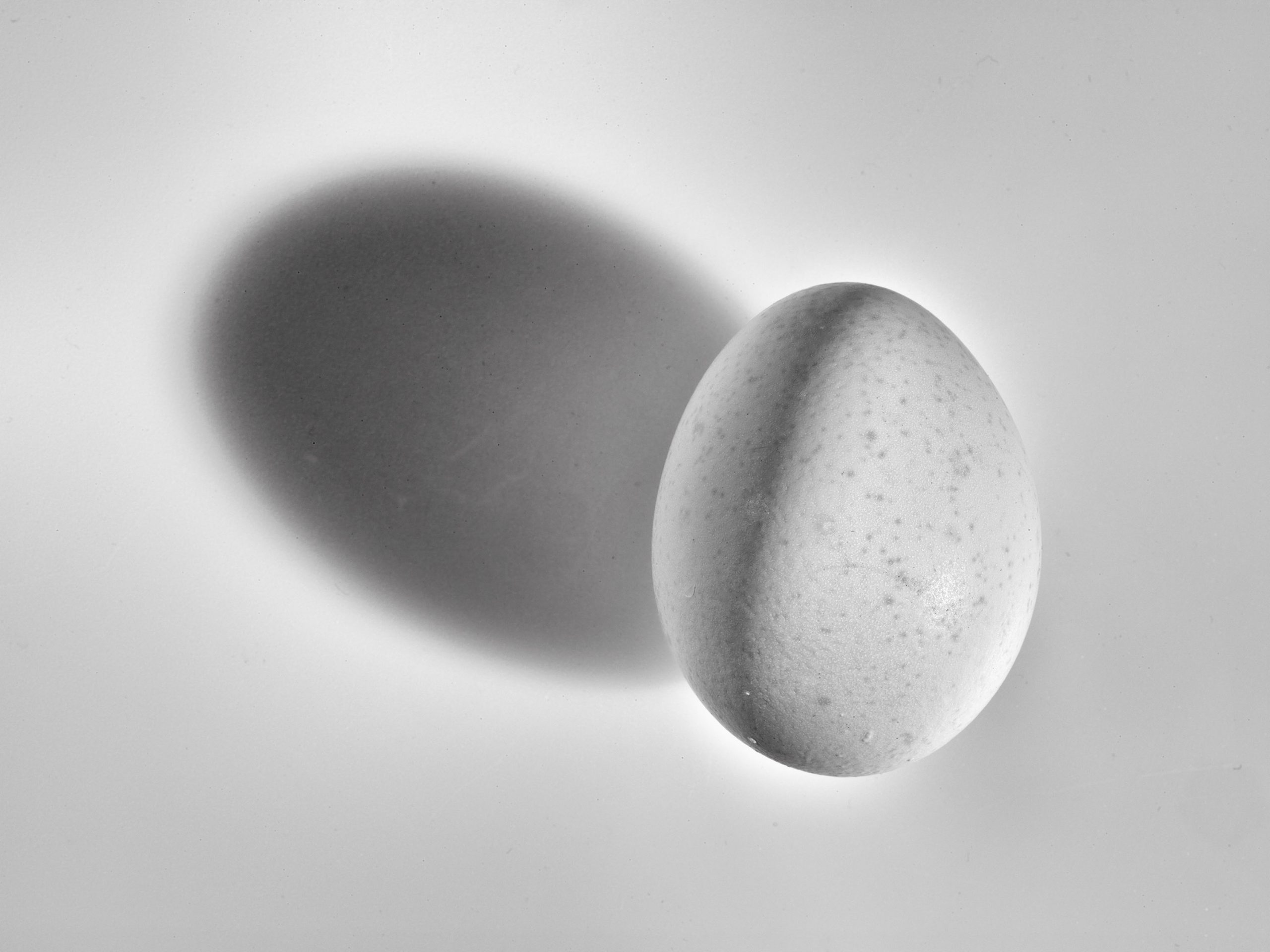
I wanted to study shadows of simple bodies again today. It all started with an egg last week. The shadow of last week’s egg photo was ring-shaped. I noticed that, but it didn’t bother me. Could the ring shape of the shadow be overcome by skillful selection of light and would the backside of the egg lie entirely in the shadow? This assignment was given to me by a school friend, who himself is a professional photographer.
The shadow looks better today, with a little help from Photoshop.
A neighbor had given me simple bodies, which I placed like an egg on the white background. First of all as a play with form and shadow, where I had to think of the X-ra image of a human hand.
The small wooden blocks were wonderfully colorful. Unfortunately, I didn’t have as many as my imagination would have liked. Arranged in concentric circles, they are delightful to the eyes. At the suggestion of a friend, I arranged, the number of blocks into Fibonacci numbers. The processing of the shadows leads to an exciting image, similar to solarization. Since it is a kind of negative, I named the picture after the impression it makes: „Flow of light“, although in reality it was the shadows of the blocks.
-
Infinity
Everyone has an idea about infinity. Infinity always confronts us with the question of wether we can see or recognize it at all. Modern mathematics knows that infinite series of numbers may well have a finite limit. The ancient greeks had realized that Achilles will always outrun a tortoise, but they couldn’t prove it. For the solution remained hidden.
Photographing a single, well reflecting steel sphere I got on the surface pointing to my macro lens a distorted image of the surrounding. One can see the tree in our garden, the lens and the tripod of my equipment, even the photographer’s legs are visible. That’s why I think it’s sort of a selfie.
Immediately, I thought of my friend Harold, who had worked a lot on photographing water drops and who had made a book about the photography of water drops. In the juxtaposition of several water drops the environment is displayed several times side by side in the drops.
Well, this happens as well, if you place two well reflecting steel balls side by side. So far, there is nothing unexpected.
On closer inspection, the opposite sides of the spheres show further images of the surroundings slightly outside the original image, well visible on the tree. These images of the tree become smaller and smaller lying within the circular image of the first reflection.
An infinite series of images in one picture is created by the reflection on the surface of two adjacent steel spheres. As the reflected images become smaller and smaller, the total area of the image is finite. A similar effect is known with water drops as well.
-
Light and shades of grey
Shades of grey in interaction with light: this is a theme for monochromatic images. For a long time I wanted to photograph an egg against a white background. The idea was stimulated by photos, mostly of people I know personally. Geometric, white-colored bodies from the mathematical collection would also be fun for me. Unfortunately, access is not as easy for me as with an egg.
On the left side the egg is brighter than the background, on the right side it is the other way round. The background itself loses a little brightness from the left to the right, but is brighter than the the egg on the right. The contrast changes. There is no clearly defined shadow for this setup. The same is true in the next photograph.
With the help of a simple light source whose color temperature does not matter after conversion into a black and white image, a soft shadow can be achieved if the source is not point-shaped.
-
Alstromeria
With daylight and a lightbox I took the cut off flower of an Alstromeria. With the lens I’m able to approach the bloom on approximately 20 cm. The blossom then fills almost the entire sensory. The ratio of the mapping is thus approximately 1:1.
The quality of the RAW images is convincing in itself. The creation of the finished HDR takes place in a combination of manual and automated steps.
RAW conversion is done using CaptureOne, HDR processing is done manually in Photoshop. Further, I generated two automated HDR developments using HDR Efex Pro 2 and Photomatix Pro 6 and layered them in. Some of the original color is transferred from the daylight image with the lightbox switched off.
-
RAW stocks
A small stock of raw footage is always lying on my laptop. My florist had been able to give us a few flowers, some of which were sacrificed after a couple of days on my lightbox. These days in a hospital I benefit while the healing remains to be seen.
Is it possible to retain the idea of a picture for a long time ? What happens to the colors when you no longer have the originals in front of your eyes ? The blossom of the peonies looked like a living eye staring at me, not necessarily a human, maybe an animal.
The tulip offered a wild confusion of petals. Unfortunately, it was monochrome orange.
The amaryllis showed an incredibly intense red. I managed to show the intensity best on a black background than on a white one. I use the inversion of the L-channel in Lab color mode.