-
Nautilus shell X-ray fusion photo of energy levels
Different energies of X-ray radiation mean different transparency of an object. There is an example in my FAQ using a Nautilus shell.
Instead of compressing images of different energies to a single image today I subtracted the 70 kV image of a Nautilus shell from the 40 kV image.
The central parts of the Nautilus shell are more dense and show a significant higher difference. The core of the shell gets shiny. This is how it looks like:
In positive X-ray representation you can compare the results. Left hand is the compressed image of 4 different energy levels, right hand the difference image.
-
Organ music
I like organ music. And I like the architecture of an organ. It’s always a composition of different metals and woods.
Today my favorite organ player gave us nice preludes as a present during the service.
-
Dahlias fusion X-ray HDR photo
Long time ago my friend Harold and I did these X-rays in my practice. There was so much to do. Today was a chance to process the fusion images. Some details can be found in my FAQs.
The manual HDR is already appealing to our eyes.
There is some charm in the X-ray image of the same composition. The hidden parts of the stalks can be clearly seen.
The fusion image of this composition shows both color and hidden structures.
Finished image with a background:
-
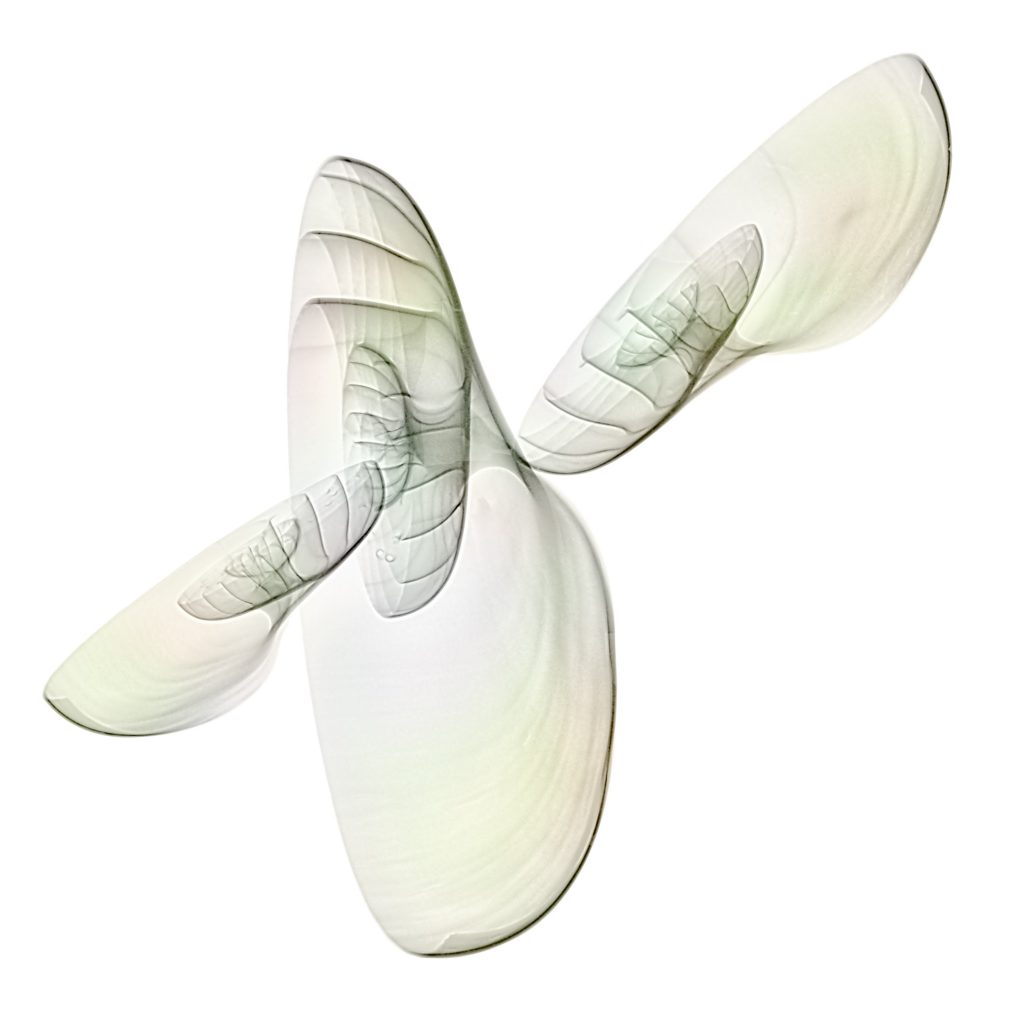
Nautilus shells 3D X-ray photo
How does an X-ray look like with a complete, unsplit specimen of a Nautilus shell ? Will X-rays go through the object ?
My three Nautilus shells I bought in Crete are split specimens. The following approach will give an answer to the question. My composition of my shells is 3-dimensional and in nearly upright position. X-rays were then done with different directions of the radiation to study the effect.
Positioning of the three Nautilus shells on the X-ray sensor © Julian Köpke
Positioning of the three Nautilus shells on the X-ray sensor © Julian Köpke The first image was obtained with radiation coming from the top. The native X-ray representation is with a black background. Historically this was a film negative. Radiologists speak of „transparent“ areas where a film is black. Consequently, white areas are called „opaque“.
The result of radiation coming from the top and slightly tilted shells gives different insights of each shell. The composition looks like a complex mathematical surface or some flying insect.
The inverted (or „positive“) representation is weightless and our mind starts to produce lots of phantasies about the composition.
The effect of colorizing an X-ray is not only graphically. It looks more natural.
The following image was obtained by combining the inverted image with a flat projection of a single shell to a single image. Now one gets an idea of the effect of the beam path.
A tilted beam path shows the a bit more detail of the „wings“. Tilt was about 30 degrees.
Tilt by 45 degrees shows more of a Nautilus as we know it.
-
Sunflower X-ray photos revisited
How to show the sun in the middle of a sunflower ? For astronomers it is quite common to look at the sun in hydrogen alpha light, which is a pure red at 635nm. With artistic eyes, a red center might be overdone.
So I tried two different representations, one in BW that is close to the natural look and feel of a sunflower and one with a light blue in the center as complementary color to the yellow petals.
The surface structure of our sun can be seen like astronomers see it.
There is no photo of the next digital X-ray image of a sunflower with its stalk and a leaf:
-
Shells fusion X-ray photo
Long time I dreamed of this fusion image of shells. Because already on a lightbox some of the shells are transparent and have nice colors. I like the shining through effect very much.
The X-ray image is a compromise of structure and density resolution, depending on the maximum energy the mammography system is able to produce.
Today I’m not at all in a stable state due to a recurrent infection. So I allowed me to do this image instead of hard working.
It is the light inversion in Lab color mode that shows more of a X-ray look and feel. The colors are pretty close to the bright image.
-
Composite of a sunflower: X-ray, light and Hα
In a digital world we can combine different digital sources. This photo of a sunflower is a composit of its X-ray, its photo on a lightbox and monchromatic sunlight at a wavelength of 635nm (Hα light).
In fact: this is an example of an impossible thing. But you may be able to feel the warmth of a sunbeam emerging of the core of the sunflower. And the petals act as prominences.
-
Primroses
I felt very much attracted by these primroses. They were close to purple and red and I could see them already as a beautiful print.
But how photographing them on a lightbox ? They always toppled over. Many efforts were useless. Blossoms tend to move, always.
On this photograph I put the blossoms top-down. Because any arrangement could be done then. It works !
A different color show the orange primroses. Composition with or without leaves ? Without gives more the impression of a painting.
-
Three vetches
X-ray images give an insight into the inner (or hidden) structure of a flower. HDR images on a light box are quite close to this.
Today I wanted to show the softness of petals and went to my dealer. She sold me three vetches, not really expensive for the purpose.
This is my third composition today of the three vetches on my lightbox. The play of the light in the petals resembles to some extent X-ray images.
-
End of wintertime
Our weather is more and more weird. Today was the second day with a warm sun and a blue sky. Nights are getting pretty cold, days up to 25 degrees Celsius.
Cleaning up our garden led us to some old physalis which were a little more than a skeleton. In autumn these fruits look like lanterns, now they resemble an X-ray.
I did this shot on a lightbox using manual HDR technique.In Lab color mode I obtained this image with a pur black background.
It’s an exoskeleton for the fruit inside which remains that way without bruises.