-
A special color palette
It’s the primary goal of many photographer’s who travel to Heligoland: bird photography. For more than 20 years now the Northern Gannet populates largely the red rocks of the island.
A short walk leads to the rim where these birds are breeding amongst seagulls and guillemots. Birders populate this rock early in the morning or late in the evening close to the rim, where the birds are nesting.
Gannets like to fly like students roam around in their school yard. Very attractive to see. A long and late sunset close to the summer solstice enhanced the experience.
The birder population varies largely with the year as the bird population does. This January, empty nests and no birders on Heligoland. This evening we were attracted by a beautiful sunset. After the sunset no further bird photos could be made. What a pity !
After sunset the color palette turned into orange and turquoise. Turner in Venice used these colors in his last watercolors often. A power plant still was working a little bit.
-
A rose is a rose is a rose
Recovering from a strenuous afternoon where I was exposed to an increasingly deep dementia I sat in my hotel to have a light meal. Nerve-racking music all over the room. A beautiful sunset with warm colors and flattering light after a grey and rainy day.
Dementia shows a person deprived of many intellectual capabilities. There is still the capability of a relation left, weak and vulnerable. There is no understanding left for us. Speechlessness counts the most.
-
Purple Clematis
Clematis is a reliably blossoming flower in our garden. Every year we look forward to her blooms for many weeks. Photographing flowers means sacrificing beautiful little things. It took me some time to go there.
With growing experience I feel less pain to sacrifice a bloom for artistic purposes. It relieves me a little, that I have the blooms swum after my photo and X-ray sessions in a soup-plate filled with water which is in the kitchen. Many people like the floating blooms in a soup-plate, if they are in a break.
The HDR series of my composition with three clematis gave me a hard time. Although a tripod is indispensable and always used, a small pixel shift between exposures was perceivable. After fixing this, light, color and structure was processed for an HDR image.
The X-ray of the three clematis was performed as mammography due to the size of my composition. The fusion image can be understood as a texturized HDR by means of a radiograph. But there is no unique solution to all compositions. The best solution has to be found out individually.
After all, the clematis look as light as a feather in this image. It was worth it.
-
Lake Constance
It’s only a short trip from Lake Lucerne to Lake Constance. Very different light conditions compared to Lucerne in Horn. A little haze, turquoise flares, soft winds. Looking down from our new apartment I saw a sailing boat gently cruising. All turbulences of the last time were settled.
The famous German painter Otto Dix lived his life here after his booting out of the art academy. He was a famous painter in the 1920s in Dresden.
The new light conditions and the rural life imposed hard days on him as he stated in his letters.
His house was recently reopened as a museum with a sophisticated measurement and air conditioning system to preserve building and art.
Isle of Mainau: in the castle gardens nicely arranged flowers, fern, trees, avenues. Memories of rainbow press publications about the owner and his life came up. Pleasant day with pleasant light. Lots of photo opportunities.
-
Goodbye Bürgenstock
Last evening in a special resort. Flowers in every room. A view like on an airplane window seat. Meeting friends from long ago and renewing friendship. Happiness, breathlessness, intense talks, laughter.
Great sunset seen from above Lake Lucerne and Lucerne itself.
Wonderful sunrise in the morning, blue sky and fresh air. Breakfast in the sky. Last conversations. Melancholy of farewell. Final goodbye. The composition resembles a painting of a former family member: Otto Flechtenmacher.
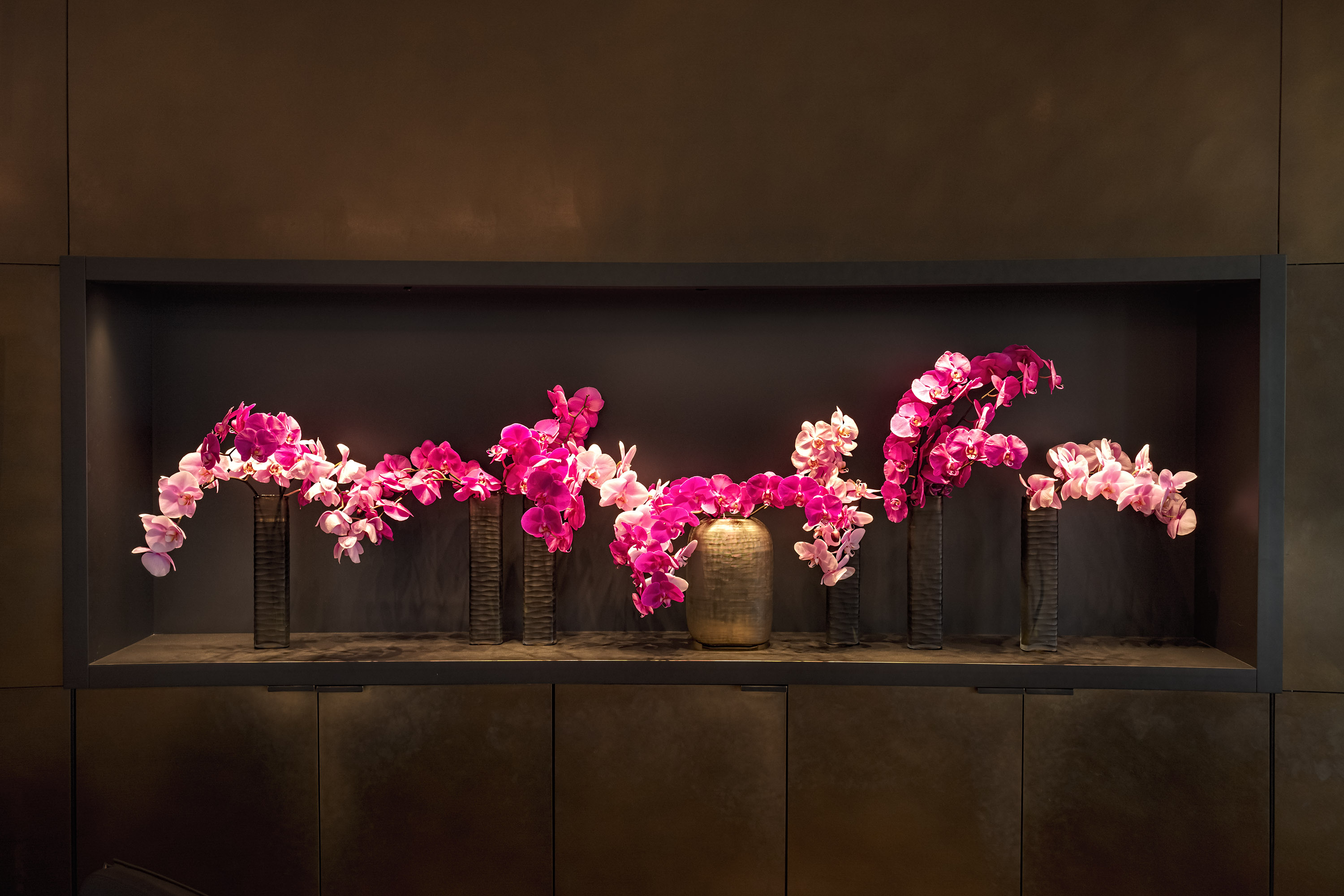
Luxuriant floral decorations everywhere in the lobby. Manual HDR without tripod: works.
-
Lucerne, Lake Lucerne
A trip to Lucerne to see friends. We were laughing a lot. Dining. Discussing unpleasant professional issues. Looking through lovely photo series.
This morning a distracting time in our hotel with lake view. We enjoyed many reflections on the surface of the water. Salsa festival at midnight. No activity on the lake in the morning. Light weighted tranquillity before sunrise.
-
Purple Clematis
Long lasting blossoms, turning up every year: my purple clematis in our garden.
It was my third X-ray session with flowers this week. Third fusion imaging attempt. After blue cornflower and blue aquilegia now a purple clematis. Big data on my hard disk.
Today we did it with mammography at 30 kV and 50 mAs. Lower noise ! Here is the positive representation of a single clematis:
I processed the lightbox HighKey series with a mask. There was a shift of 2 or 3 pixels from the lightest to the darker images. So I processed everything a second time to compensate for the shift. The HDR image shows a cut stalk. Photoshop is made for this.
The stalk can be lengthened like in the preceding X-ray. The fusion image shows hidden leaves, the core of the blossom and stalks much better:
The flower looks pretty fragile now, close to its natural appearance.
-
Spring and X-ray fusion photos
First flowers in spring show up. With much support from my colleagues I’m able to do some fusion images. We all would like to have another calendar.
Preparing the lightbox, the X-ray machines, my camera and picking out the data is a bunch of hassle.
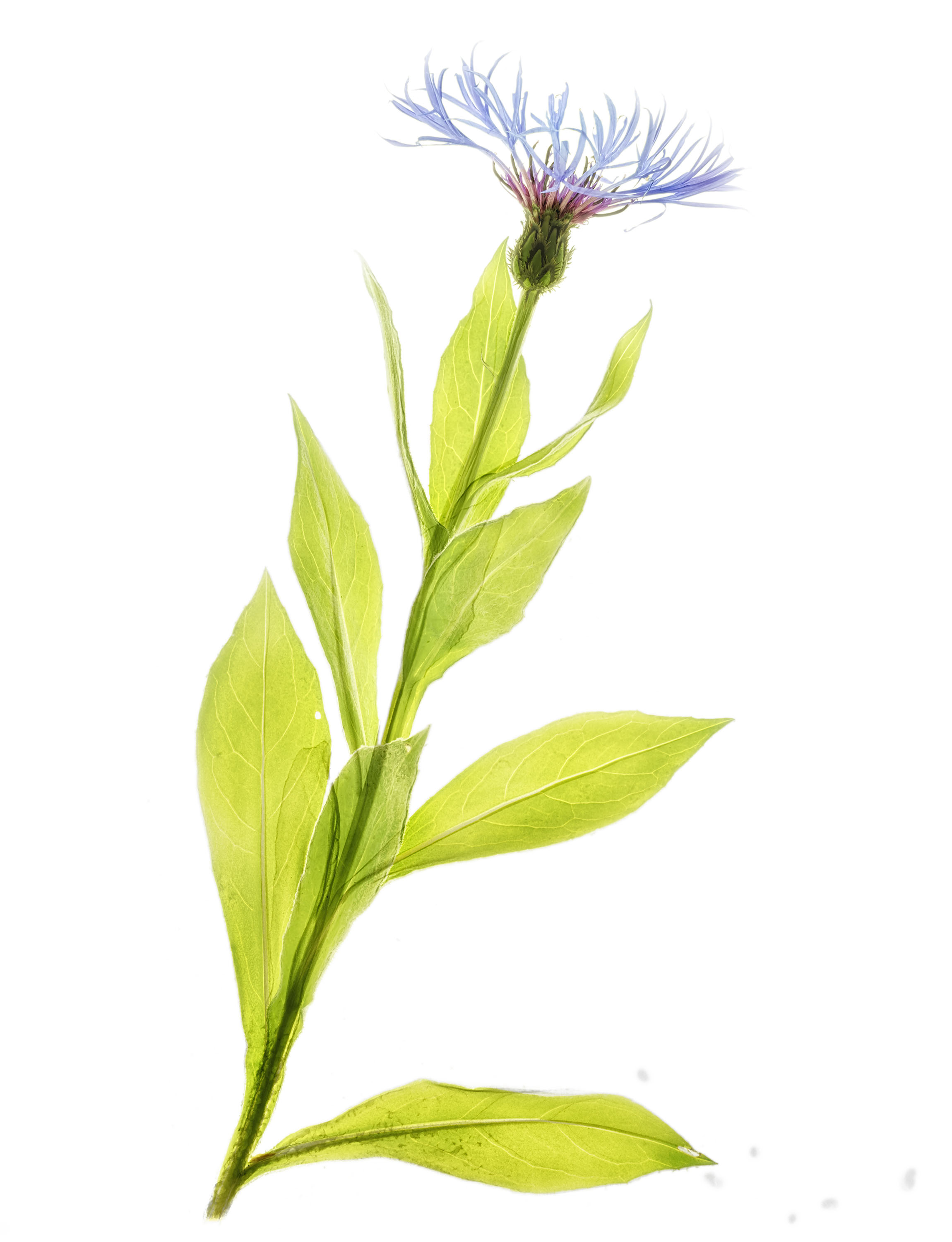
My personal favorite is the blue cornflower. It looks like a print of an old botanic book:
The next day I turned my attention to our white and blue Aquilegias. No chance to process the raw data yesterday. Eventually, there was a chance today, after quite a bit of tedious work at my desk:
-
Low water at Lake Constance
This year we suffer from low snowfalls and low rainfalls during winter and spring. Since end of January we had blue sky and one only few clouds. It was nice to see the night sky and many phases of the Moon. But our garden is dry.
A short vacation at Lake Constance showed this drama. The shorelines around the island of Reichenau are becoming more visible than ever. And a boat on the lake shore is no longer a reliable means of traveling.
-
RAW conversion matters
Every camera stores sensor image data in a file for further use. The sensor image data are just grey values of different intensities in every pixel. A single pixel doesn’t show color. Our sensor image data contain a black and white world. How sad.
How do we get color images with a sensor that maps only grey values between white and black ?
All the colors we know can be derived from a combination of a specific value of Red, a specific value of Green and a specific value of Blue. If we know the shares of Red, Green and Blue in a color we know the color.
Our camera sensor measures the shares of Red, Green and Blue with small lenses in front of each pixel on the sensor that act as filters for Red, Green or Blue. The complete sample of these filter lenses is called a color filter array or „CFA“. The distribution of Red, Green and Blue filter lenses on the sensor is completely known only to the manufacturer.
The file that contains the sensor image data is called a RAW file. Beside the sensor image data at the beginning of a RAW file are informations about the complete file content. I found a nice Wikipedia article pointing this out. A RAW files contains also exposure data and information about the camera lens.
A software converting the sensor image data of a RAW file into pleasing colorful images is called a RAW converter. A well known and popular RAW converter is Adobe Camera RAW (ACR). A Phase One Raw file can be straight forward converted by ACR to a 16-bit TIFF. No further postproduction has been applied (see left image below).
A RAW conversion of the same file with the Phase One manufacturer’s own RAW converter Capture One to a 16-bit TIFF shows different color and brightness (see right image below). There was no setting of temperature, hue and saturation to make the images identical.
Still. Conversion ACR. Courtesy P. Kleiber
Still. Conversion Capture One. Courtesy P. Kleiber One RAW file was converted to two different TIFF. The difference between the TIFF can easily be obtained in Photoshop with the difference layer mode. The difference is an image in itself. With a sensitive gradient applied the following image is obtained:
The difference TIFF (Capture One) – TIFF (ACR) is derived pixel by pixel. The converted TIFF using Capture One contains more green, more magenta and more yellow in the darker values. The impact on the final result is unclear at the moment.