-
Vegetables X-ray photography
Harold implanted the idea of X-rays with onions in me. Although more than covered with professional requirements, I tried my hand at vegetable x-ray photography.
I can say it’s fun. Although a defective screen had to be replaced at the beginning. And you need some patience. Not every shot shows its beauty from the beginning. Some have to be developed first.
Let’s start with a corncob. It has many outer leaf layers, which lie close to it. X-rays look through and show the layers at the edge of the bulb as fine lines.
Here is a comparison of X-ray on the left side versus Mammography on the right side. A Belgian endive and a lettuce show much more contrast and fine structure in a mammography whereas X-ray gives more the impression of softness. Which goes well for a salad.
Onions have a lot of liquid and are therefore radiopaque. I was curious to see which method would make it better to reveal the layerstructure of the onions. To my surprise mammography did a pretty good job.
Conventional X-ray offers more mystery, especially when you stack onions.
Some kind of layered structure also has fennel. I got two specimen that looked like mittens.
This year we had so many apples in our garden. They are red and look juicy. I had the chance to take two of them to my X-ray machine. With the help of two different orientations an interesting picture succeeds, because on of the apples still has a small branch.
May be there is some truth in the saying: an apple a day keeps the doctor away. But as the dentist would say: no teeth, no apple.
-
Is this a photography ?
My conference schedule allowed me a walk through the Berlin Tiergarten Park in the morning. Of course, with a cam handy. While I was sitting on the shore of the Landwehr Canal, I let myself be carried away by the waves.
The waves made the reflections of the trees and bushes softly tremble. The resulting reflections became like paintings.
The processing was carried out only with regard to brightness and colors. Lab colors were used. Light-dark-contrasts were given by the waves.
-
After the rain
Since days with an unsafe walk afflicted after an impact trauma with the head against a sloping roof in a Black Forest hotel last weekend I walk today after the first rain for weeks through our garden. Everything’s shines in rich colors under raindrops.
My first image is an attempt to capture two colors.
Warm and cold colors combined in these heucheria leaves.
Conflowers like stars within two colors.
-
Spider conch X-ray fusion photo
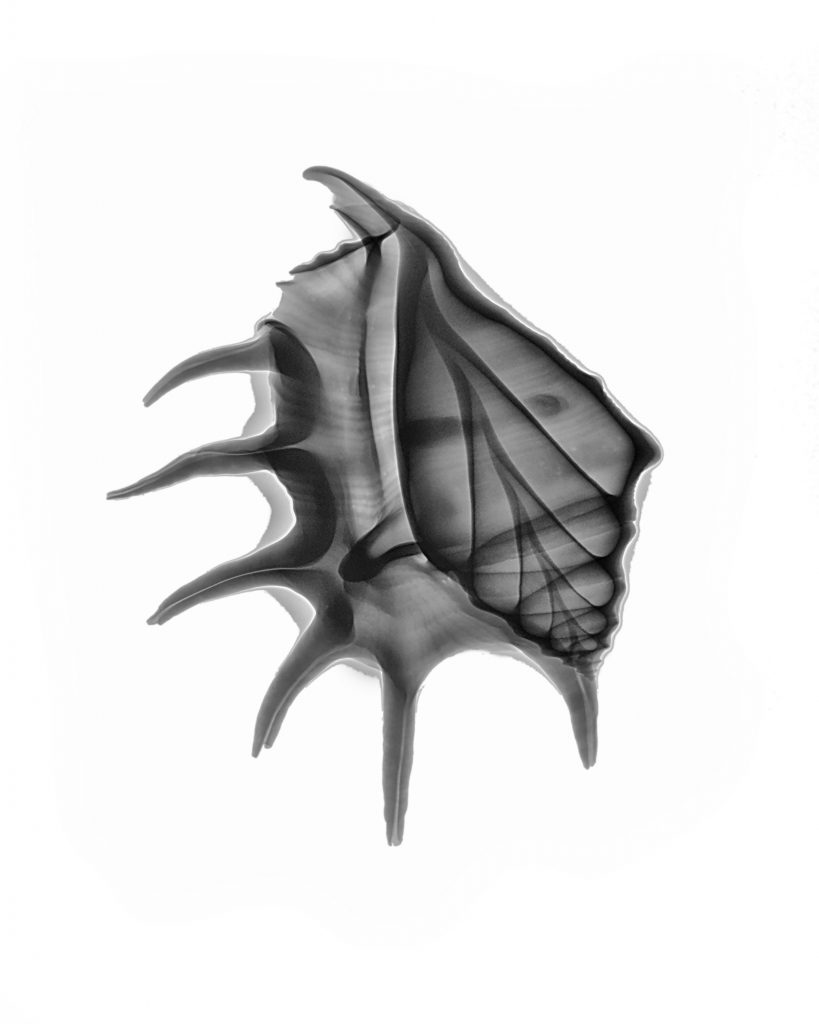
A friend gave me a shell of a spider conch to make more fusion images. The scientific name of the spider conch is lambis lambis and it is a sea snail. There is a nice Wikipedia article on it.
The hard shell with a lot of radiopaque lime made me doubt the success of my X-rays. On top, my first attempt at a HighKey image wasn’t really convincing. Only the combination of a normal photography for the color, a HighKey image for a transparency effect together with the X-ray image resulted in nice image.
The X-ray image appear less lively, but full of formal power. The orientation of the animal is conveyed by the photographically reproduced color. There are only minimal hints wich orientation the X-ray has.
These are the corresponding X-ray images:
-
Thundercloud vortex
Has the future ever been read from the migration of the clouds ? Their forms and movements have always been exciting and inspiring for me. A vortex of clouds immediately creates a vortex of emotions.
That is why clouds have long been the subject of my photographic interest and I have created a considerable collection of cloud images.
Last night a long heat wave ended with a thunderstorm. Above our house the clouds were swirling, lightning sometimes closer, sometimes further away. Islands of brightness changed rapidly in a threatening sea of black clouds.
In some ways, these clouds remind me of interstellar gas clouds in our galaxy. In the example below the colors of the panorama image of M8 (or „Lagoon Nebula“) are suppressed to better recognize the structure.
-
Port cranes in Heilbronn
Cranes have always fascinated me. When I was a little boy, I could watch her work for hours. When I arrived at the garden exhibition in Heilbronn, I initially only had eyes for the two harbour cranes that were unloading the cargo of sand from a ship.
The old cranes look historic, but were still in service. I especially liked their green and yellow and the many ropes with which the shovel from the boom reached into the ship to pack the goods.
-
Heucheria leaves
Backgrounds create a new image impression. Sometimes you need a background to add to the picture some more pizzazz. In these pictures I use the background to simulate a photographic base as I saw it in Karl Blossfeldt’s pictures.
The starting point is always a color image. With a background named „Aged Board“ the color image already shows an attractiveness of its own.
The Black & White conversion enhances the contrast a bit which is why I’m adding a little glow.
From another Heucheria leaf, which shone in a wonderful red, I show here only the black and white conversion with background. This makes the reproduction of its structure much better.
-
A rose is a rose is a rose
Just photograph a rose and show its beauty – how wonderful that would be. Is the light right ? Do false shadows emerge ? Is the structure correctly reproduced ?
Again and again I have to go through our garden and look at the flowers. Yesterday was it again. The sun had just set and the full moon should have decreased a little later.
I tried it with all f-stops the camera and lens gave to me. To my surprise the aperture 32 at ISO 50 with 45s exposure speed was my favorite. Only at the edge the picture had to be darkened and desaturated. Post-processing can be as simple as that.
-
Partial lunar eclipse
Night clouds may be a creative opportunity, although they generally lead to limitations in the visibility of a celestial event. Last evening was such an opportunity. The proof of the pudding is in the eating.
There is enough structure in the image to please one’s eye. The color of the Moon has a rusty tone outside the central shadow of the earth.
The composite of this capture with a mood picture on site is technically not completely satisfactory. I should have made more different exposures of the night sky.
-
End of the world
On a ball there is no such thing like an end or a beginning. Before the discovery of America the region we traveled to today was called „End of the world“ or „Finistère“ in French. The Atlantic Ocean shows its wild side here.
On our way from Camaret-sur-Mer to Pointe du Raz we came through many old villages of Brittany. St. Nic is such a place, where you can find a pretty church building.
Coming form Douarnenez you first reach Point du Van in westerly direction. The church is consecrated to shipwreckers.
Within sight of the western wall you can perceive a small lighthouse.
After a short drive, first in a southerly direction and then in a westerly direction, you reach Pointe du Raz. At low tide the is a strong current in southern direction. The water is visibly swirled between the rocks. At this point, where the world ended 528 years ago, you can easily imagine a wild Ocean.
Our journey to Brittany now has come to its end.
See more images in my album.