-
Best Images Annuals 2022
11. Februar 2023 /Lemon balm leaves on ice © Julian KöpkeWindows Upper West building Berlin Charlottenburg dyed windows © Julian KöpkeCurved space in Panthéon, Paris (The photographer). We cannot see curved time. © Julian KöpkeStairwell Samaritaine © Julian KöpkeMidnight sun at Mortsund, Lofot © Julian KöpkeMidnight sun at Rorbuer, Lofoten © Julian KöpkeReaching Moskenes, Lofoten on a ferry boat © Julian KöpkeQuiet rainbow over lighthouse near Gjesvær © Julian KöpkeRovaniemi small wood of birches © Julian KöpkeGlacial flows and patterns on Iceland © Julian KöpkeVestrahorn beach with clouds and reflections © Julian KöpkeHoffellsjökull glacier lagoon © Julian KöpkeWestern access to Godafoss at late afternoon © Julian KöpkeDettifoss detail western drop edge © Julian KöpkeDahlia X-ray photogram © Julian KöpkeMoonset at San Gimignano © Julian KöpkeVilla d'Este, Tivoli © Julian KöpkePorta del Cielo, Duomo di Siena © Julian KöpkeDuomo Orvieto with fog © Julian KöpkeSunset medieval quartiere Orvieto © Julian KöpkeOrvieto Piazaa Duomo before sunrise © Julian KöpkeAvenue of pines on the entrance road to Orvieto © Julian KöpkePonte Vecchio, Florence © Julian KöpkeFirst snow at Forggensee Füssen © Julian KöpkeLonely island Forggensee © Julian Köpke -
Best Images Annuals
11. Februar 2023 / -
Portfolio
11. Februar 2023 / -
Blossfeldt studies
11. Februar 2023 /Silver leaf © Julian KöpkeHeucheria leaf © Julian KöpkeFern © Julian KöpkeThuja conifer © Julian KöpkeThuja (Abendländischer Lebensbaum) © Julian KöpkeClematis I © Julian KöpkeTendrils © Julian KöpkePoppy capsule © Julian KöpkeBlooming thistle at the former railroad tracks © Julian KöpkePoppy © Julian KöpkeBlossfeldt Acorn © Julian KöpkeVetch © Julian KöpkeIf you ever have the opportunity to see the work of the photographic pioneer Karl Blossfeldt (1865-1932), then perhaps you will also be as moved and fascinated as I am time and again. In 2014, Taschen-Verlag Cologne published a book about him entitled „Karl Blossfeldt The Complete Published Work“ (ISBN 978-3-8365-5072-7), which I have kept near my bedside table for years.
Karl Blossfeldt was interested in the forms that occur in nature and which he understood as „archetypes“. His main work was published in 1928 under the title „Urformen der Natur“ (translated version as „Art Forms in Nature“, 1928) and became an international bestseller.
On his way to college, he collected plants that he used as a source of inspiration for his work as a professor of decorative arts. His photographic works are monochromatic and usually made by placing the object on photosensitive paper. Technically, therefore, they are actually to be addressed as photograms and not as photographs, because the image was not based on any imaging optics. X-ray images are also photograms, but with a central beam geometry. Therefore, in a very free interpretation, Karl Blossfeldt’s works could be placed in the middle between photography and X-ray images.
The images in this gallery are created with photographic optics and a digital sensor. Photographs of plants or better: parts of plants, which highlight selected structures, are excellently suited for a monochrome presentation. Harold Davis describes one way of creating the look-and-feel of a Blossfeldt image with the help of a photograph. Harold calls the result „The Blossfeldt effect“.
-
Press Releases
11. Februar 2023 /- 2023 06 01 Fusion imaging
- 2023 05 05 Fortschritte Röntgenstrahlung 2023; 195: 341
- 2023 05 04 Foto-Espresso 2/2023
- 2023 02 10 ÄrzteZeitung
Landscape Photography Magazine
- 2024 11 12 Frost Assignment Lonely Island Forggensee, Bavaria
- 2024 06 29 Lonely trees Assignment Deadvlei Trees, Sossusvlei, Namibia
- 2024 06 01 Sea stacks Assignment Pollboy Lookout, Clare, Ireland
- 2024 05 02 Sea stacks Assignment Reykjanesviti
- 2024 03 02 Blue hour Assignment Punta della Dogana
- 2023 08 29 Longtime exposure Selfoss Nordurphing Iceland
- 2023 08 16 Minimalism Assignment Lighthouse Heligoland Dune
- 2023 07 10 Minimalism Assignment List on Sylt
- 2023 07 05 Minimalism Assignment Lighthouse Raudinupur
- 2023 05 29 Moody Weather Assignement Stein am Rhein
- 2023 02 17 Mountain View Assignment Eiger Mönch Jungfrau
- 2023 02 07 Königstuhl Heidelberg
- 2023 01 29 Winter Visions Assignment Breitnau
- 2023 01 29 Villa d’Este Tivoli
- 2023 01 28 Alpe di Siusi
- 2023 01 28 Florence
Berufsverband der Deutschen Radiologen e.V.
- Flyer 2022 Vielfalt, Innovation, Kooperation (PDF)
-
About
11. Februar 2023 / -
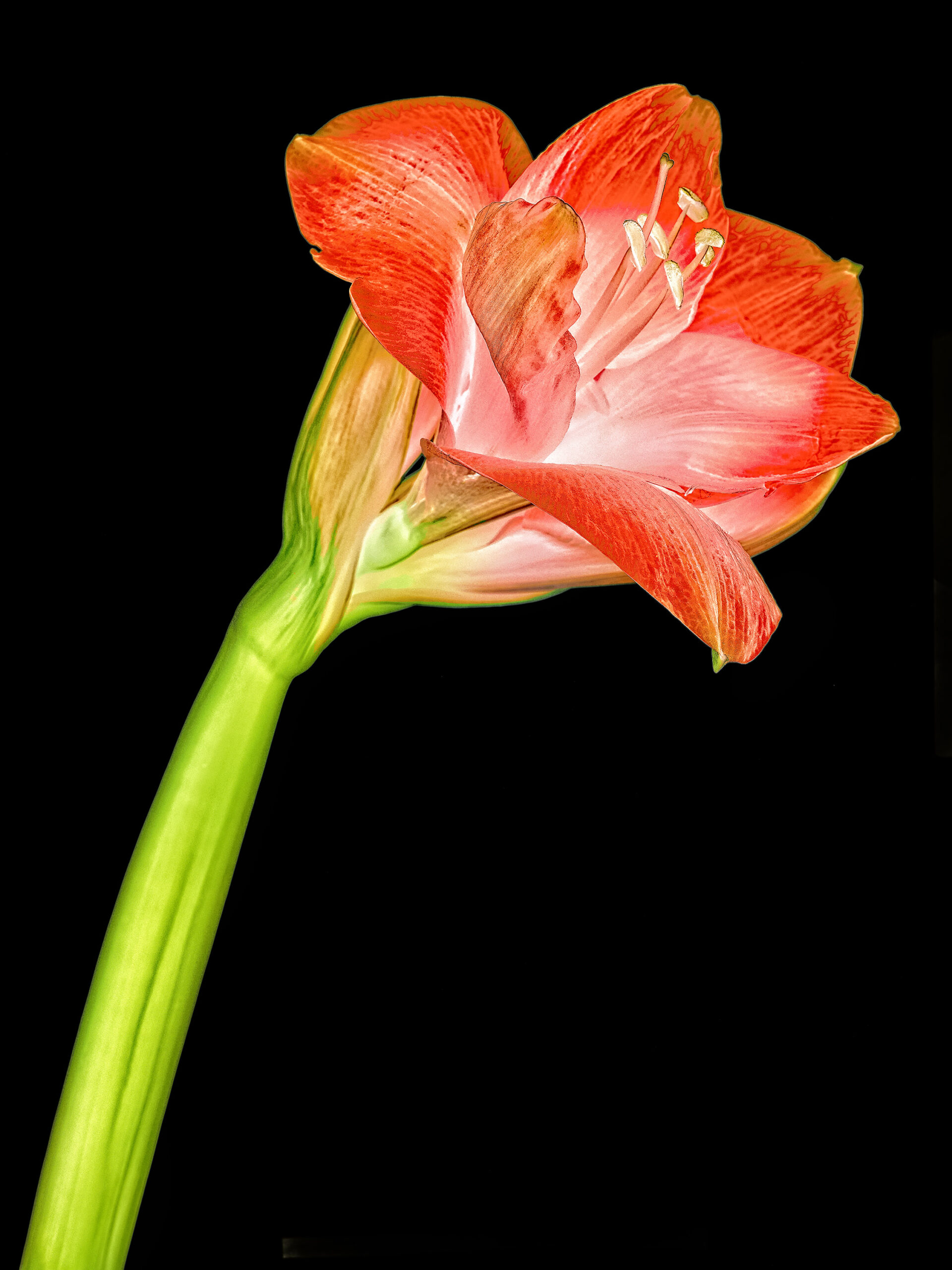
Amaryllis
The format for recording an image can be very variable when fusion imaging is involved. In the example below, the image on the left is taken with a Phase One IQ4. The sensor size is 44mm x 55mm. The X-ray image on the right was taken with a Hologic mammography system with a detector size of 24cm x 30cm. The aspect ratio of both images is 4:5. The pixel size of the IQ4 is 6.5µm, the pixel of the mammography is 70µm long. Nevertheless, the images can be fused well.
I added some texture to the fusion image because it made it more appealing. Due to the fusion of the image from „visible light“ and the image with „X-ray light“, the definition of whether it is a medium format image or a large format image is no longer meaningfully applicable. It is simply an image.
-
White and purple orchid
My LED ceiling light, which I use as a light box for flower photography, can be dimmed and the color temperature is adjustable. The cold and extremely bright light can be tamed and turned into faint, warm light. Together with my tent of linen, I manage to control the light.
With LiveView, the composition is created and the focus is worked out. The camera is controlled by cable connection via laptop (tethered shooting) and the recordings are made with mirror triggering. The colors become better and the impression of the picture more natural and vivid. -
Sunny day with spring character
A sunny day in winter without training or weekend obligations: we can let ourselves drift a little. The Hermannshof in Weinheim with its botanical garden attracts many visitors, especially those with cameras. Many kneel or lie down on the floor to gain a beautiful perspective. You don’t notice dirty trousers. Rather, trousers like that ennobles the wearer.
First light welcomes a crocus when the sun shines abundantly and the joy of photographing is written on the face of all visitors.
Winter residual flowers in the first spring light: Helleborus
At the end of our sunny stroll we sat down in front of a café for a tea. We met this Siberian Husky in front of our café. It took me a while to recognize three legs and a shaved fur on her right hip. Due to a chondrosarcoma her owner had decided to have an operation on the dog. She did quite well, as far as a human may understand.
-
Floral experiments
Changing colors in flowers are attractive, especially if you approach them closely. A group of 3 flowers looks like a communicative group. With targeted overexposure and instant images on the laptop, the compositional decision is easier and the colors become more picturesque, without too much processing with the computer.
A curtain over the illuminated background behind the focal plane creates an effect reminiscent of nebulae in the night sky.
Photography of flowers in a vase in an exposure series (HDR) is complicated by their light sensitivity, which causes a change of position in short time scales. Plants constantly rearrange their leaves and blossoms. This results in blurring, which can be compensated for e. g. by repeating the shot series, shorter exposure time series or tools for aligning the images. Or you can do your image without HDR, because the dynamic range of the camera data is sufficient.
The center of a Gerbera blossom is richly structured. Due to the high resolution of the camera back (150 MP), it is possible to crop out the center still in good resolution.
The transparent representation of the petals is achieved by using a light box. The light should be relatively bright, but does not have to be fully homogeneous. The heat of the light does not matter, it is adjusted using RAW format in post-processing. More informations about this method see web-pages of Harold Davis, who invented this method.