-
Effect of photon energy on X-ray images
I assume that everyone has had at some point the experience where less was more. Especially when dealing with computer based image postproduction. Software makes handy wonderful, or better: powerful, filters. Experienced artists know that only a pinch of something or homeopathy is a key to better results.
The same holds true in X-ray production. A maximum of energy does not provide better images. Let’s look closer at this point.
What is the influence of energy to X-ray images ?
Higher energies in X-rays mean shorter wavelengths and a higher resolution. Therefore it might seem reasonable to increase the energy in our X-ray tubes always to the maximum to produce incredible images based on a maximum resolution.
With four images below I show the influence of increased energy levels on X-ray images of a single rose. The applied energy levels are 40kV, 60kV, 90kV and 109kV. The steps of postproduction were the same in every image. Slight differences are owed to best contrast in each exposure.
Surprisingly to the novice we get an increasing loss of contrast (or less available contrast) in each image with higher energies. This effect of loosing contrast can easily be seen in this series of four X-rays and is highest at 109kV.
The explanation for less available contrast with higher energies is the following physical effect: the more photons have shorter wavelengths the more photons run unaffected through the object down onto the sensor. With all photons running through without any hindrance the sensor would show a homogenous gray value.
Every structure looses contrast when turning to higher energies. The optimum for a structure is found by experience and varies significantly.
In the medical field the applied energy strongly depends on the purpose of the examination and the structural demands to be diagnosed.
The above demonstrated meaningless low contrast for our single rose at 109kV doesn’t hold true at all in radiology. Radiologists use frequently 125kV for a chest film to get reproducibly valuable contrast in most patients.
-
Fusion X-ray of tulips
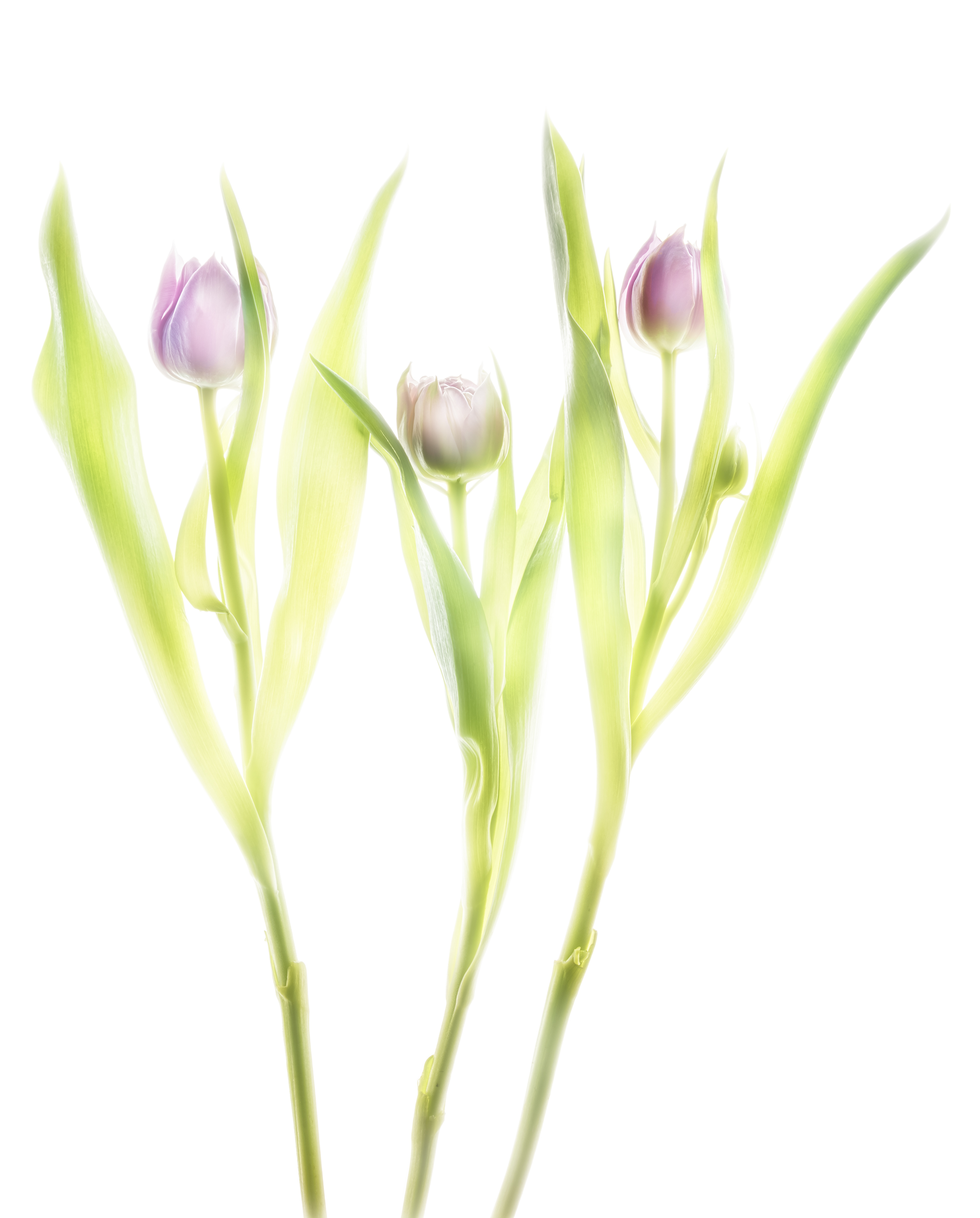
Fusion imaging is beauty made of composite X-ray images and HDR images on a light box. The primary question is what energy fits best for flowers. To my experience 40 kV is often suitable. But: the proof of the pudding is in the eating.
Mammography systems start e.g. from 20 kV and reach 39 kV. The sensor is up to 24cm x 30cm. Conventional systems start from 40 kV and reach 125 kV. The sensor is up to 43cm x 43cm what makes them more attractive to floral compositions.
The higher resolution and the lower energies of a mammography will suit better for transparent objects. But the spatial limit of a composition (which is 24cm x 30cm) might put hard restrictions on the artist.
Floral compositions have more creative space with a bigger sensor. But the X-ray tube starts with 40 kV and this might lead to overexposure of tender structures.
Thus I performed today more than ten compositions to study this relation.
After four exposure of three tulips I found this composition with four dense blossoms attractive to go further. The composition might somehow resemble to a sketch of three angels. The image is nice due to very soft edges of their „wings“, technically blown out portions in the image. The inner structure of the nearly closed blossoms is well resolved. The stalks serve as „body“. There is no advantage with higher energies.
The same composition was done immediately after the X-ray as a bracketing series on a lightbox. After returning I processed a manual HDR, the colors not to warm.
The final fusion image is a composite of the preceding two images. Compared to the lightbox photo, the hidden stalks reappear naturally, the inner petals are outlined like a sketch.
-
Radiating Beauty: Creating a new photographic form with fusion X-Ray images
The shapes and forms are recognizable, yet the level of detail is deeper than the human eye can normally perceive: Leaves appear minutely laced and surfaces are impossibly intricate, somewhere between translucent and opaque. Welcome to the captivating work of photographer Harold Davis and radiologist Dr. Julian Köpke, who combine their skill, passion, and vision to create stunning X-ray photography and pioneering fusion images. Read more on the Pixsy blog (article by Natalie Holmes).
This nice article was posted today to share the fascination of our common work on fusion X-ray images using a light box manual HDR photo of flowers and their X-ray.
Our X-ray data are the same, our photographic data a nearly the same: Harold used a Nikon D850 and I used a Nikon D810A, which is modified for astrophotography. Our common lens was a Zeiss Makro-Planar T* 2/50 ZF.2.
We have some techniques and some principles in common, yet we are different individuals with different results. The next image is partly inspired by Harold’s version. Blue is the complementary color to yellow and fits nicely into the petals. The red color in the center is an image of the sun in monochromatic Hα light using a Fabry-Perot-Interferometer. So this image is a triple fusion image of three different light sources ! If you look closer at 2pm in the center, there are two sunspots.
-
X-ray fusion photo of a Nautilus
Fusion imaging can be done retrospective. My split Nautilus shell on a light box rendered with manual HDR shows already a nice structure of the inner parts.
The X-ray obtained a couple of days earlier easily fits onto the HDR with not a big deal of processing.
The meaning of the fusion image may be different to the flowers. But it’s feasible to do it retrospectively.
-
Nautilus shell X-ray fusion photo of energy levels
Different energies of X-ray radiation mean different transparency of an object. There is an example in my FAQ using a Nautilus shell.
Instead of compressing images of different energies to a single image today I subtracted the 70 kV image of a Nautilus shell from the 40 kV image.
The central parts of the Nautilus shell are more dense and show a significant higher difference. The core of the shell gets shiny. This is how it looks like:
In positive X-ray representation you can compare the results. Left hand is the compressed image of 4 different energy levels, right hand the difference image.
-
Dahlias fusion X-ray HDR photo
Long time ago my friend Harold and I did these X-rays in my practice. There was so much to do. Today was a chance to process the fusion images. Some details can be found in my FAQs.
The manual HDR is already appealing to our eyes.
There is some charm in the X-ray image of the same composition. The hidden parts of the stalks can be clearly seen.
The fusion image of this composition shows both color and hidden structures.
Finished image with a background:
-
Sunflower X-ray photos revisited
How to show the sun in the middle of a sunflower ? For astronomers it is quite common to look at the sun in hydrogen alpha light, which is a pure red at 635nm. With artistic eyes, a red center might be overdone.
So I tried two different representations, one in BW that is close to the natural look and feel of a sunflower and one with a light blue in the center as complementary color to the yellow petals.
The surface structure of our sun can be seen like astronomers see it.
There is no photo of the next digital X-ray image of a sunflower with its stalk and a leaf:
-
Shells fusion X-ray photo
Long time I dreamed of this fusion image of shells. Because already on a lightbox some of the shells are transparent and have nice colors. I like the shining through effect very much.
The X-ray image is a compromise of structure and density resolution, depending on the maximum energy the mammography system is able to produce.
Today I’m not at all in a stable state due to a recurrent infection. So I allowed me to do this image instead of hard working.
It is the light inversion in Lab color mode that shows more of a X-ray look and feel. The colors are pretty close to the bright image.
-
Composite of a sunflower: X-ray, light and Hα
In a digital world we can combine different digital sources. This photo of a sunflower is a composit of its X-ray, its photo on a lightbox and monchromatic sunlight at a wavelength of 635nm (Hα light).
In fact: this is an example of an impossible thing. But you may be able to feel the warmth of a sunbeam emerging of the core of the sunflower. And the petals act as prominences.
-
Blog
3. November 2018 /
-
-
Fusion X-ray of tulips
-
Radiating Beauty: Creating a new photographic form with fusion X-Ray images
-
X-ray fusion photo of a Nautilus
-
Nautilus shell X-ray fusion photo of energy levels
-
Dahlias fusion X-ray HDR photo
-
Sunflower X-ray photos revisited
-
Shells fusion X-ray photo
-
Composite of a sunflower: X-ray, light and Hα
-
Blog