-
After the rain
Since days with an unsafe walk afflicted after an impact trauma with the head against a sloping roof in a Black Forest hotel last weekend I walk today after the first rain for weeks through our garden. Everything’s shines in rich colors under raindrops.
My first image is an attempt to capture two colors.
Warm and cold colors combined in these heucheria leaves.
Conflowers like stars within two colors.
-
Do you like Karl Blossfeldt ?
Karl Blossfeldt was a German photographer who lived from 1865 to 1932. He didn’t think himself a photographer. With his studies of plant forms he made an enormous contribution to plant photography. Here is a nice wikipedia article about him.
He started to do photograms. Plants or parts of plants were placed directly on film or paper suitable for exposure. Exposure then takes place without any optics. Later he built himself a wooden camera, which reminds me of Andreas Feininger.
Black and white backlit macro images with a background can be similar to Blossfeldt’s images.
-
Goodbye Bürgenstock
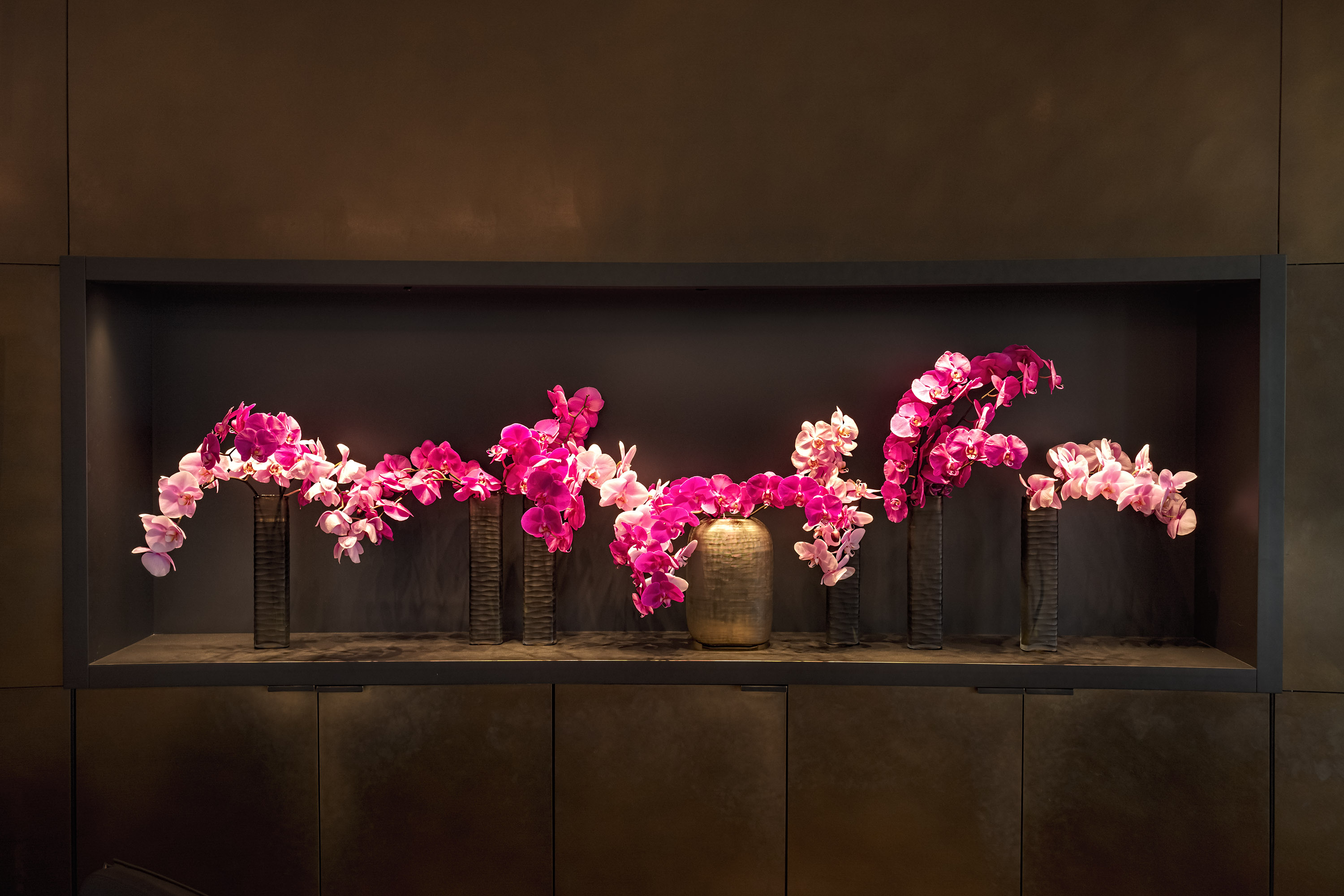
Last evening in a special resort. Flowers in every room. A view like on an airplane window seat. Meeting friends from long ago and renewing friendship. Happiness, breathlessness, intense talks, laughter.
Great sunset seen from above Lake Lucerne and Lucerne itself.
Wonderful sunrise in the morning, blue sky and fresh air. Breakfast in the sky. Last conversations. Melancholy of farewell. Final goodbye. The composition resembles a painting of a former family member: Otto Flechtenmacher.
Luxuriant floral decorations everywhere in the lobby. Manual HDR without tripod: works.
-
X-ray images
31. März 2019 / -
Red calla lilies
With my new glasses in my pocket I gazed the nearby market place on Saturday. I was captivated by six red callas whose price I could knock down to 10€ for all of them.
With my Zeiss 50mm Macro lens and no tripod I was trying to get nice shapes late in the evening. The following images have been processed using Lab color to enhance contrast and colors.
Just normal light of our living room let me to a nice coloring and interesting shapes. The blossom next to the lower right corner is a Siamese twin on a double stalk.
-
Effect of photon energy on X-ray images
I assume that everyone has had at some point the experience where less was more. Especially when dealing with computer based image postproduction. Software makes handy wonderful, or better: powerful, filters. Experienced artists know that only a pinch of something or homeopathy is a key to better results.
The same holds true in X-ray production. A maximum of energy does not provide better images. Let’s look closer at this point.
What is the influence of energy to X-ray images ?
Higher energies in X-rays mean shorter wavelengths and a higher resolution. Therefore it might seem reasonable to increase the energy in our X-ray tubes always to the maximum to produce incredible images based on a maximum resolution.
With four images below I show the influence of increased energy levels on X-ray images of a single rose. The applied energy levels are 40kV, 60kV, 90kV and 109kV. The steps of postproduction were the same in every image. Slight differences are owed to best contrast in each exposure.
Surprisingly to the novice we get an increasing loss of contrast (or less available contrast) in each image with higher energies. This effect of loosing contrast can easily be seen in this series of four X-rays and is highest at 109kV.
The explanation for less available contrast with higher energies is the following physical effect: the more photons have shorter wavelengths the more photons run unaffected through the object down onto the sensor. With all photons running through without any hindrance the sensor would show a homogenous gray value.
Every structure looses contrast when turning to higher energies. The optimum for a structure is found by experience and varies significantly.
In the medical field the applied energy strongly depends on the purpose of the examination and the structural demands to be diagnosed.
The above demonstrated meaningless low contrast for our single rose at 109kV doesn’t hold true at all in radiology. Radiologists use frequently 125kV for a chest film to get reproducibly valuable contrast in most patients.
-
Primroses
I felt very much attracted by these primroses. They were close to purple and red and I could see them already as a beautiful print.
But how photographing them on a lightbox ? They always toppled over. Many efforts were useless. Blossoms tend to move, always.
On this photograph I put the blossoms top-down. Because any arrangement could be done then. It works !
A different color show the orange primroses. Composition with or without leaves ? Without gives more the impression of a painting.
-
Three vetches
X-ray images give an insight into the inner (or hidden) structure of a flower. HDR images on a light box are quite close to this.
Today I wanted to show the softness of petals and went to my dealer. She sold me three vetches, not really expensive for the purpose.
This is my third composition today of the three vetches on my lightbox. The play of the light in the petals resembles to some extent X-ray images.
-
Nautilus and Flowers
How to prepare a X-ray session ? What flowers suit to a Nautilus shell ? Where does color come in ?
I went to my gorgeous florist to have a look what offer she can make during wintertime. My phantasy were spinning around something ethereal or unrealistic. I bought some flowers with respect to their shape.
The Anthuria caught my eye immediately. The Tulip was still closed and got more and more yellow within hours.
All these compositions shown here were made with dual energy X-ray. The lowest energy of the tube is 40kV, which yields with 4 mAs a quite good insight of flowers. For the center of the Nautilus shell, 70kV and 2.5 mAs is more appropriate.
My first composition was a Nautilus taking off a bouquet of flowers. This reminded me of Renaissance engravings full of symbols. I do not feel depressed. The representation as a X-ray positive jsut shows the bouquet.
A more grounded composition is the second with a Nautilus shell moving towards the roots of my bouquet. Hopefully, the plants will survive. The positive representation always needs some extra editing. By just inverting the Blacks and the Whites the Nautilus would be too dark. Our reception cannot be just inverted and feels alright.
With the look-and-feel of old engravings in mind the third composition ist between surreal and a still. It took me some time to mask out the flaws of an original X-ray to get a true black background. Masking can be done iteratively and easily combined with Photoshop. („That’s what Photoshop is made for !“).
Some colorizing was done to overcome missing photographic shots. There was simply no time in my X-ray unit to do both at a time.
My fourth composition is called „The Argonauts“. The Nautilus shell serves as Argo, the legendary fast ship, with its crew, called Argonauts. The colored version is more convenient for our eyes. As before the X-ray positive looks more ethereal.
-
Flowers on Black
4. November 2018 /