Julian Köpke
I like to make things visible the naked eye isn't able to see. That's part of my profession as a radiologist, too.
-
Infinite avenue of trees
On Sunday we met with friends to walk in the castle gardens of Schwetzingen, especially to the cherry garden of the mosque, because the cherry trees are starting to blossom. Weak intermittent clouds created a diffuse light in the park with warm intermediate tones. The well-designed baroque grounds everywhere show the joy of technical possibilities to expand – or even deceive – the human horizon of experience.
There is a small section in the park with a trompe l’oueil designed to make infinity tangible. In summer, ivy grows along the tunnel-shaped lattice to create a tube view.
When photographing the following avenue of trees at the edge of the mosque, it was of course clear that the perspective should give the impression of a long path. I tried 2 days later to increase this effect by repeating the image in the picture, which can easily be done with digital photography and post-processing. After the second repetition, I think the eye is very well deceived and no longer perceives a real end.
Compare to the original here.
-
Lilies of the Valley
Yesterday I came across a piece of music through a noble advertising trailer of a French watch company with the wonderful actors Catherine Deneuve and Rami Malek directed by Guy Ritchie. I was almost magically drawn to the film because there was a time when I lived in Paris.
But the most exciting thing was the soundtrack „Lilies of The Valley“, which exuded such an incredible lightness. I hadn’t heard of the composer Jun Myiake before, but I did know Arto Lindsay, who added his inimitable vocals. Perhaps one cannot leave the cosmos of one’s own taste.
That’s why I quickly set off to get some lilies in town. They were to be white lilies, of which I could only get two. Red lilies in all stages of blossoming I then allowed myself to enjoy. So I took some pictures with a mixed bouquet of paradisiacal blooming lilies. -
Spring Dance of Tulips
Today the sun shone warmly, almost too warm for a day in mid-February. A few tulips given as gifts were getting older in the vase and one started to hang its head. They had delighted us with their colourfulness for many days.
So I decided to do a photo series with tulips on my lightbox.
Tulips are best suited for scenic representations because they look like a human person against a light background. Dance is the most obvious association I have then. The leaves become whirling arms. The flower is the head. The legs are not really needed.
If the tulips lie close together, you get the impression of a tapestry. The light from the lightbox penetrates well enough to create an airy effect.
Here they show themselves in a formation like a dance group.
-
Amaryllis
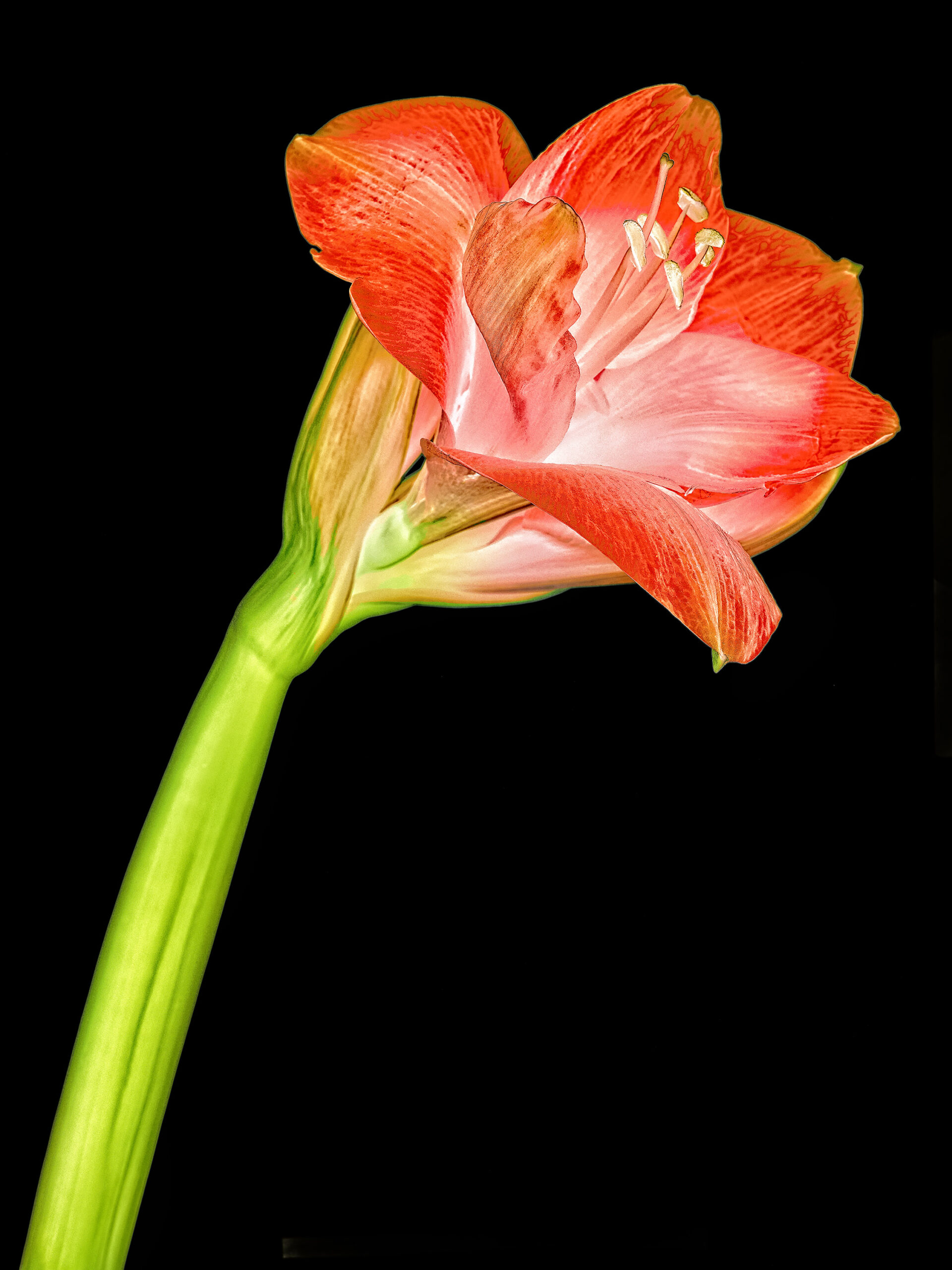
The format for recording an image can be very variable when fusion imaging is involved. In the example below, the image on the left is taken with a Phase One IQ4. The sensor size is 44mm x 55mm. The X-ray image on the right was taken with a Hologic mammography system with a detector size of 24cm x 30cm. The aspect ratio of both images is 4:5. The pixel size of the IQ4 is 6.5µm, the pixel of the mammography is 70µm long. Nevertheless, the images can be fused well.
I added some texture to the fusion image because it made it more appealing. Due to the fusion of the image from „visible light“ and the image with „X-ray light“, the definition of whether it is a medium format image or a large format image is no longer meaningfully applicable. It is simply an image.
-
Intimate Verzasca Valley
Intimate landscape photography is a term I can’t translate literally, although intuitively I think I immediately understand what it’s about. Historically, Eliot Porter (1901-1990) is considered the founder of this style of photography. I came across this style through an article by Charlotte Gibb, whom I had the pleasure of meeting personally in Yosemite Valley in February 2020.
The photographer’s gaze does not seek to capture the whole scenery of a landscape, but is concerned with a closer look at parts of the landscape. The sky is usually not part of the picture in this style and the light dynamics, which are often dramatic due to the sky, are greatly reduced. The tension in the picture is created by the arrangement and relationship of the objects. Reduction and simplicity become important components.
The church of Lavertezzo has become known from many photographs, especially its reflections in the Verzasca between the peculiar rocks. Unfortunately, the main building was completely scaffolded for renovation in November 2022 and not photogenic. I planned the following shot because of the beautiful, sometimes almost flowing rock formations that make the Verzasca appear as if it were lying in a fountain basin. The church tower is somewhat blurred by the movement of the water surface. While processing the shot, the colour selector showed me what a bath of colour had been created by mixing the colours of vertical rocks and horizontal water.
Not very far from the last picture, I had been walking around on the rocks and found this shot. Climbing can be very arduous on the rocks of the Verzasca. The rocks are of course slippery when wet, but even the dry rock does not always give the grip you want or expect. Everywhere you can read the warnings about this problem: 10:21h selfie, 10:38h search action begins. Expressed in typically Swiss terseness. It pays to take your steps carefully.
A large part of the spectrum is present in the photograph. The green of the Verzasca was not as emerald here as it usually is. The rocks in evening blue. A rock in stronger red. Golden shimmers a reflection down from the ridge. I only noticed the sea serpent when I was post-processing.At a certain point, there was no more water for a composition. The stones there speak to me through their colour and their shape and their relationships to each other.
I could not express it in words. Even weeks later, I can’t express it in a sentence. It is beautiful in any case.
-
Winter in Heidelberg
The Königstuhl in Heidelberg is a popular destination at any time of year and in almost any weather. It can be reached via many routes on foot or by bicycle, by car, by bus or by mountain cable car.
The first plans for a transport system were made in 1873 as a rack railway. Two years later, agreement was reached on a cable car, which was completed in 1889. It reached the castle and a viewing hotel higher up, but not the Königstuhl. It was not until 1907 that the Königstuhl mountain station was completed, which made it possible to travel all the way to the top with a change at the level of the lookout hotel. The difference in altitude to the valley station is 436m.
The building of the mountain station is a mixture of half-timbered house and the same red red sandstone as town houses in the city or the castle, which originates from the area. A flat is included above the operating level.
The noise of the valley does not penetrate up here. The snow provides further reassurance. The house stands here as if fallen out of time. Only the weather station on the roof and the flagpoles on the right indicate modern times.
The position of my photograph was on an icy footpath with icy steps. I didn’t fall, but I was standing very unsteadily. The shot nevertheless radiates a lot of calm, the house in warm tones, the landscape wintry cold.
-
Narni
The drive to Narni took us from San Gemini through beautiful landscapes that we did not expect. The overcast sky offered rich variations of composition. With a series of HDR shots, more expressive images can be achieved later. An abandoned house became a harmony of cold colours.
In Narni, it was the old town that interested us first and foremost, with alleys and archways, already devoid of tourists and being prepared for winter.
Famous is the Via del Campanile, which you automatically come across when you ascend the city from the car park.
-
Chocolate
4 bars of chocolate were meant as a reward for a calendar of the year 2023. To eat, of course. However, it is a special pleasure to subject them to an X-ray examination with the mammography before opening them. After three attempts, I placed them on top of each other, which is why their penetration with radiation required 20% more energy so that the image was not underexposed.
-
Black Forest
A picture I like turns my gaze inwards and I stop staring at it. It is not possible for me to give the reason why I avert my gaze. For it is no longer my eyes that look.
Is it a spell ? Has a string of my existence been made to vibrate ? Is it a vortex that draws me into its depths ?
The simple shot of a farm in the Black Forest can take on the attractiveness of a shot from the early days of photography by processing the lighting conditions. Immediately, the antennas on the roofs of the farm look like evidence of a long past, although they can be no more than 50 years old.
The first day of the new year ended at the little church of Maria Lindenberg with a warm sunshine that almost protectively enveloped the promenaders. The gaze inwards is lost in the apparent aimlessness of the walking movement.
The forest area, which takes its name from the effect its conifers have on the viewer, has not always been a Black Forest. The visitor becomes smaller to tiny when the fog makes the forest even more impenetrable.
The farm was named after an Ignaz, locally always with the associated diminutive Nazi, but this designation has since been banned from the signs as unacceptable.
-
Italia bel paese
A trip to Italy always has the whiff of a quest. We started across the Verzasca Valley, which is in the Italian-speaking Ticino region of Switzerland, close to Locarno. Harold couldn’t wait to see and photograph the Ponte dei Salti. There in Lavertezzo, the emerald green Verzasca creek crosses an area of streaky rocks with small depressions where the water collects and does not flow any further.
There was a moment on the day of arrival when seemingly golden light from the late afternoon sun made the hollows look like liquid gold. The next morning, time seemed to stand still, only the electric supply showing the arrival of modernity.
Stopover in Pavia, whose main dome shows a honeycomb-like structure, especially when using a focal length of 11mm in full frame. The river Ticino flows quietly and slowly, a counterpoint to the traffic noise of sporting Italians. The photo on the right was taken on the Ponte Coperto.
A short overnight stay in San Gimignano, the next morning still exploring the area at a distance from the old town. A large car park, a charging station for electrical energy in a multi-layered state of construction – in statu nascendi.
Arriving in Siena, we immediately studied the cathedral in the light of the afternoon sun. The contrast between inside and outside could not be greater.
Probably more famous than the cathedral is the Torre del Mangia of the Palazzo Communale. We could see it from the cathedral and from the Piazza del Campo, where the annual Equestrian Festival takes place.
In Assisi, the accommodation did not allow us to be creative because it was far too cold. The man who handed over the flat to us could not be described as sober at all.
We took up quarters in San Gemini, Umbria, and roamed the area from there. On the way there, we passed Trevi. The towns are situated on hills, which made them easier to defend in the past. Inside the old cities, you encounter a maze of alleys and bridges between the houses.
At the southernmost point of our journey, in Tivoli in Lazio, we began to feel the winter change. The light and the clouds were now becoming more dramatic, the garden of the Villa d’Este was devoid of blooming flowers, the visitors might be fewer than in summer, all the more eager to take a selfie everywhere. With a little patience, it was possible to take pictures without other visitors in them.
In Orvieto, in Umbria, north-east of Tivoli, we then found the perfect fog. The entrance with the car a bit tight on both sides, nevertheless we got away without any scratches. The sunset after the foggy day in the medieval quarter of Orvieto with a break in style because of the electric street lamps.
The front of the cathedral was for me of outstanding beauty, always accompanied by a demonstration of former power and wealth, yet also of simple beauty. Before sunrise, the building seems almost threatening, the outer splendour only coming to light in the morning.
On a foggy and rainy day, Orvieto was a good place to pass the time in the Pozzo di San Patrizio or the city’s underground economic spaces dating back 3 millennia. On the Torre del Moro there was fog at first without any view. We were also not really oriented about the points of the compass. We philosophised about Ed Weston and Ansel Adams, who also argued about whether one should hold out in a place or better moving on. Ed Weston was for staying, Ansel Adams for moving on. Harold, however, did not want to accept my suggestion to simply leave the tower on a trial basis, that the fog would have a chance to clear for me. After one and a half hours, the time had come. In just a few minutes, the sunlight broke through the fog of the old town and exposed magnificent compositions.
We had come through Switzerland and driven through Tuscany via Umbria to Tivoli in Lazio. The last stopover of our Italy trip in a bright red electric car took us from Orvieto to Florence. If a farewell is to be particularly difficult, one must leave Italy from Florence. Florence would be our last stop together on this trip through Italy. Arriving at the hotel, we found ourselves in rooms overlooking unappealing walls and buildings. The exhaustion of driving was not to overtake us at all. It seemed to me that Piazzale Michelangelo was made for taking farewell pictures of Florence. The walk to Piazzale Michelangelo took us from the hotel next to the Uffizi across an uncharming car bridge to the opposite bank up a steep slope. The photo equipment became heavier, the sun made us even more exhausted. A warm sun greeted us with the last of its summery strength, the arrival of winter already noticeable here.
The sun bathed the city’s buildings in an ever-changing light through shifting clouds. There were not so many visitors in the early afternoon of this Friday, so the corner on the parapet at the front right with the best view of the city was free. Images of cityscapes appeared in my mind’s eye. The Ponte vecchio seemed to me to be made for a photographic city view, which I wanted to make from a series with different exposure levels. In this way, the finest differentiations come into their own best.