-
X-ray photos of grapes and sunflowers
Grapes as an object of X-raying have been inspiring me for a long time. Their structure remind the doctor of the azini of a gland or lung. The phycisist likes very much the partial and complete overlays alternating with free positions. As an artist I get an unbelievable freedom of image design.
My first X-ray imaging attempts with grapes were carried aout in October 2017. I’d forgotten !
Can something succesful be repeated ? Can it be deepened ? What is the power of the composition ?
Two days ago I tried toput my creativity into the composition. Two pictures were taken from grapes which differ only slightly. Their X-ray view on our monitor had a clearly different effect.
My colleague by chance showed up with a bouquet of small sunflowers with long stalks. Amazing opportunity !
-
Vegetables X-ray photography
Harold implanted the idea of X-rays with onions in me. Although more than covered with professional requirements, I tried my hand at vegetable x-ray photography.
I can say it’s fun. Although a defective screen had to be replaced at the beginning. And you need some patience. Not every shot shows its beauty from the beginning. Some have to be developed first.
Let’s start with a corncob. It has many outer leaf layers, which lie close to it. X-rays look through and show the layers at the edge of the bulb as fine lines.
Here is a comparison of X-ray on the left side versus Mammography on the right side. A Belgian endive and a lettuce show much more contrast and fine structure in a mammography whereas X-ray gives more the impression of softness. Which goes well for a salad.
Onions have a lot of liquid and are therefore radiopaque. I was curious to see which method would make it better to reveal the layerstructure of the onions. To my surprise mammography did a pretty good job.
Conventional X-ray offers more mystery, especially when you stack onions.
Some kind of layered structure also has fennel. I got two specimen that looked like mittens.
This year we had so many apples in our garden. They are red and look juicy. I had the chance to take two of them to my X-ray machine. With the help of two different orientations an interesting picture succeeds, because on of the apples still has a small branch.
May be there is some truth in the saying: an apple a day keeps the doctor away. But as the dentist would say: no teeth, no apple.
-
Purple Clematis
Long lasting blossoms, turning up every year: my purple clematis in our garden.
It was my third X-ray session with flowers this week. Third fusion imaging attempt. After blue cornflower and blue aquilegia now a purple clematis. Big data on my hard disk.
Today we did it with mammography at 30 kV and 50 mAs. Lower noise ! Here is the positive representation of a single clematis:
I processed the lightbox HighKey series with a mask. There was a shift of 2 or 3 pixels from the lightest to the darker images. So I processed everything a second time to compensate for the shift. The HDR image shows a cut stalk. Photoshop is made for this.
The stalk can be lengthened like in the preceding X-ray. The fusion image shows hidden leaves, the core of the blossom and stalks much better:
The flower looks pretty fragile now, close to its natural appearance.
-
Spring and X-ray fusion photos
First flowers in spring show up. With much support from my colleagues I’m able to do some fusion images. We all would like to have another calendar.
Preparing the lightbox, the X-ray machines, my camera and picking out the data is a bunch of hassle.
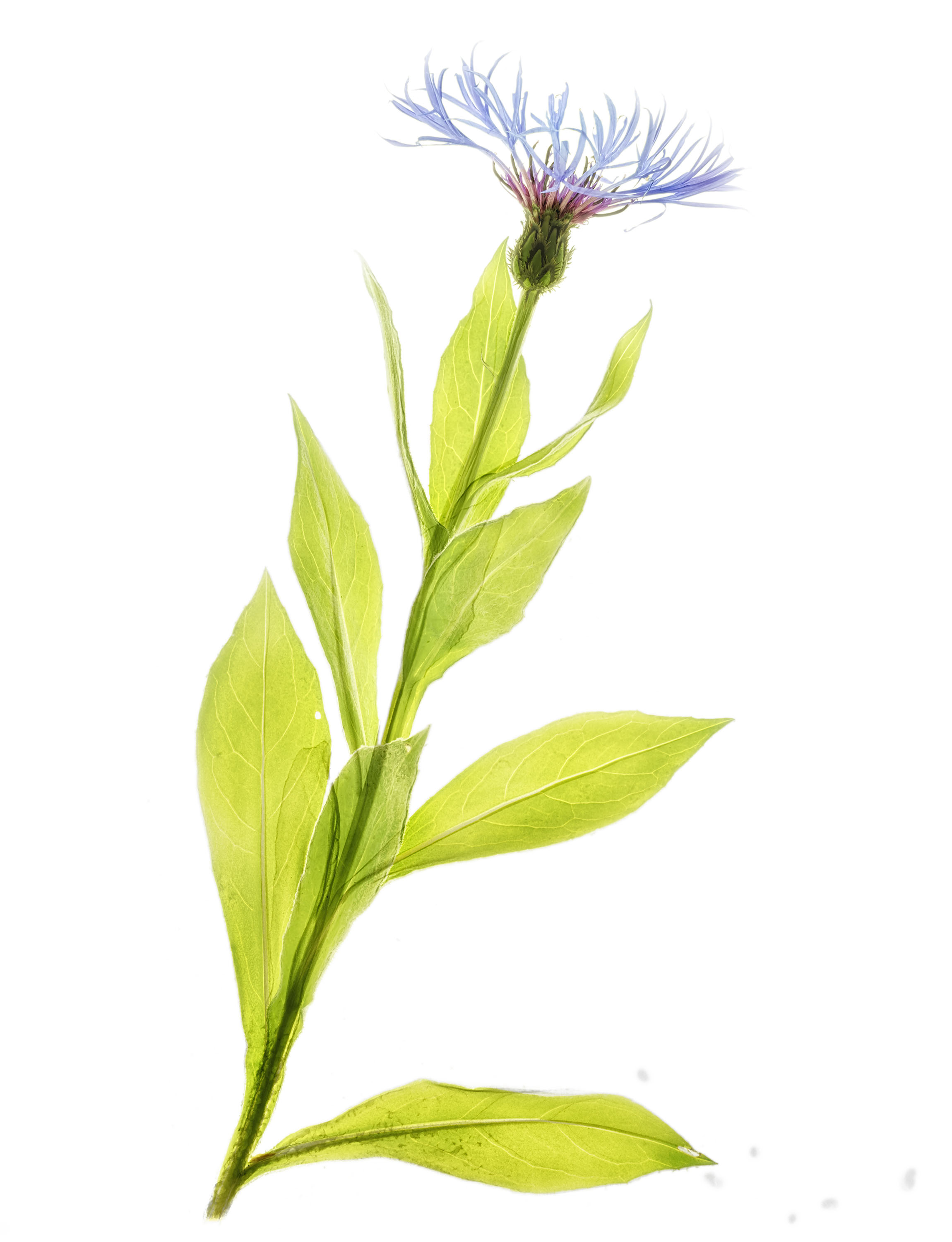
My personal favorite is the blue cornflower. It looks like a print of an old botanic book:
The next day I turned my attention to our white and blue Aquilegias. No chance to process the raw data yesterday. Eventually, there was a chance today, after quite a bit of tedious work at my desk:
-
X-ray images
31. März 2019 / -
Red calla lilies
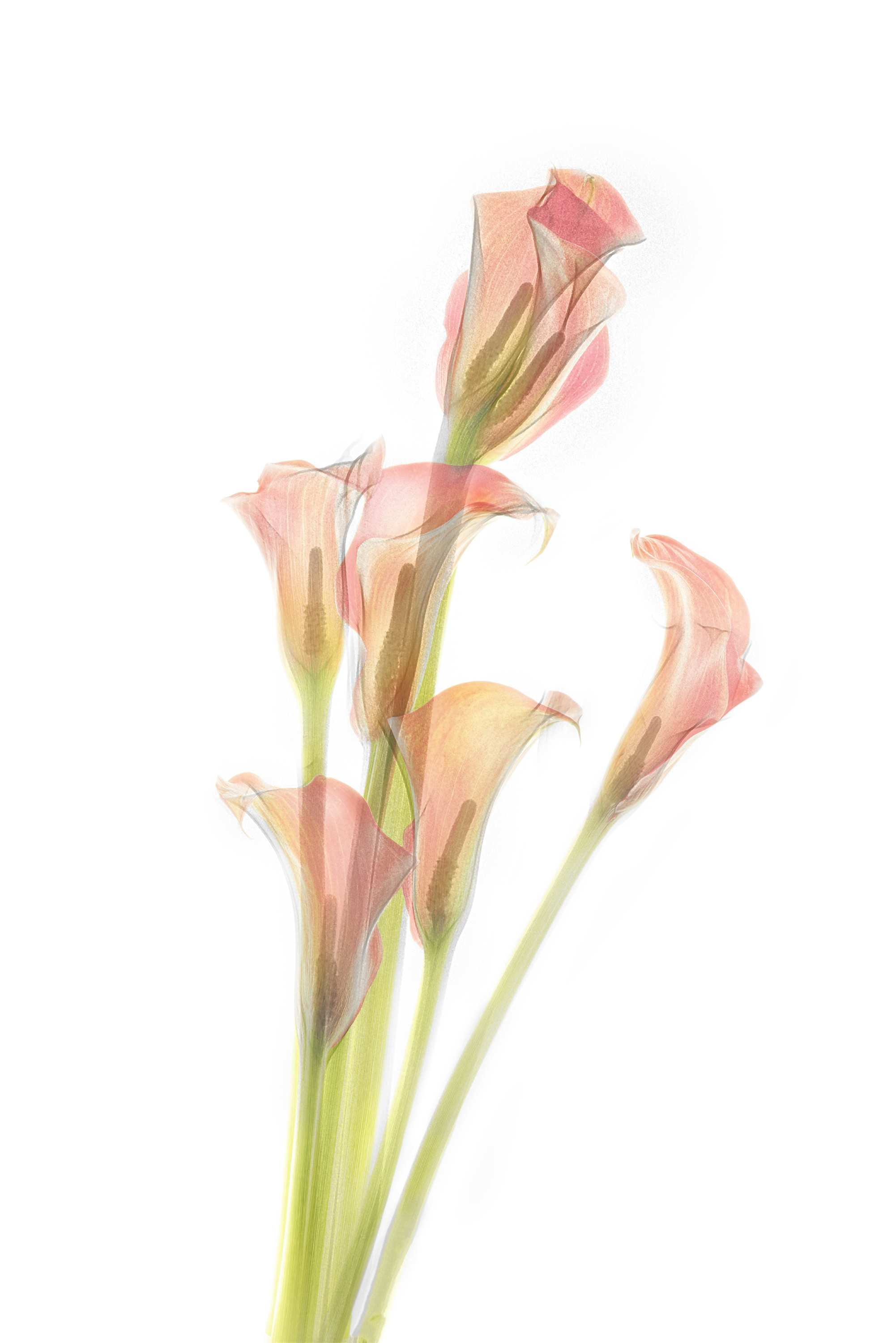
Sometimes reality falls behind our expectations. With 6 red calla lilies I felt well prepared to do some new X-rays and HDR images for image fusion. But my X-ray system surprisingly raised a barrier. The main computer stopped doing his job.
Many thoughts ran through my brain. Will we be able to examine patients the next day ? How fast the supplier will be able to react ? Will the company find a cause of this disturbance ? How many days will my calla lilies be alive ?
I found a work-around by thinking over the interacting hardware. Doing some steps and with a newly restarted system I was able to create 7 different compositions without further disruption of which I show here No. 4.
With X-rays emerges a more impressive illusion of transparency than a plain HDR would have been able to produce. Even when using a lightbox.
Similar to a lightbox it produces better results when laying a petal or a complete blossom over the top of the stalk of another one.
On top of the longest stalk is a twin blossom !
You never know if the inversion in Lab colors leads to an attractive result. It’s always worth looking at Lab color transformations. In this case the black background yields vivid colors.
-
Red calla lilies
With my new glasses in my pocket I gazed the nearby market place on Saturday. I was captivated by six red callas whose price I could knock down to 10€ for all of them.
With my Zeiss 50mm Macro lens and no tripod I was trying to get nice shapes late in the evening. The following images have been processed using Lab color to enhance contrast and colors.
Just normal light of our living room let me to a nice coloring and interesting shapes. The blossom next to the lower right corner is a Siamese twin on a double stalk.
-
X-ray exam of stone age tusk
A couple of days ago I went to see a friend who knows my weakness for X-ray examinations. He gave me a mammoth tusk. At first glance I doubted if there would be any possibility to produce an image because of the estimated high density of this stone age tooth.
So I decided to try a CT scan. I had some butterflies in my tummy and feared an artistic disaster. Indeed, the first slices emerging from our scanner weren’t much convincing. As a first step of postproduction My technician and I decided to do a volume rendering of the 0.75mm slices. We got a surprisingly good result that showed interesting details of the inner structure of this biological remnant.
A tusk is a tooth of the upper jaw of the mammoth (or elephant). A major blood vessel branching off while running to the tip can easily be seen. The caves on right hand side are assumed to stabilize this life long weapon of a mammoth.
This tusk has been stone age ivory and consists mostly of calcium phosphate and calcium carbonate.
As there is no restriction to trading of mammoth ivory there is an increasing amount of siberian stone age ivory emerging to the market.
-
X-ray fusion photo of a Nautilus
Fusion imaging can be done retrospective. My split Nautilus shell on a light box rendered with manual HDR shows already a nice structure of the inner parts.
The X-ray obtained a couple of days earlier easily fits onto the HDR with not a big deal of processing.
The meaning of the fusion image may be different to the flowers. But it’s feasible to do it retrospectively.
-
Tilted Nautilus X-ray photo
Imagine a Nautilus shell tilted to the surface of the X-ray sensor. The parts close to the sensor are sharp, the distant parts unsharp. Because the X-ray beam creates a central projection. The focal plane is the plane of the sensor, in focus are those parts close to the sensor.
The shell looks like entering the image or leaving it.