General

General

  • General,  Macro,  Monochrome,  reflection

    Reflection II

    Most of what we do see with our eyes is a reflection. Any light from a bouquet of flowers is just reflection. Looking through a bottle shows beside reflection some refraction.  The only exception, where we don’t see reflected light is e.g. offered by an open fire or a light bulb. The sight of a star also shows direct light, which is usually subject to refraction due to the atmosphere.

    Our eyes seem to absorb the light when we see. In fact, they can also reflect the incident light. We know this phenomenon from cat images that we have mistakenly photographed with a flash light. 

    Sitting in front of me my right eye is on the viewers left side and the left eye is on its right side. The instrument uses a red and a green laser at a harmless energy dose.

    Fundus of right eye seen in red and green laser light © Julian Köpke
    Fundus of left eye seen in red and green laser light © Julian Köpke

    With different wave lengths of a laser an ophthalmologist is able to see different structures of the fundus and uses this property for diagnostic purposes. Looking at the green color only that stems from the green laser, the result is a monochrome image that shows vessels of the surface of the retina and smalls nerves joining the papilla.

    Fundus of right eye seen in green laser light © Julian Köpke
    Fundus of left eye seen in green laser light © Julian Köpke

    Looking at the red channel displaying the reflections of the red laser light, monochrome images show deep vessels behind the retina.

    Fundus of right eye seen in red laser light © Julian Köpke
    Fundus of left eye seen in red laser light © Julian Köpke

    Beside the medical point of view there is an aesthetic one, too. Dr. Gösele, to whom I owe these beautiful pictures, confirmed to me the impression of an astronomical night shot, which other viewers also feel. With a courageous crop you get there:

    At a certain crop the fundus of a human eye seen in laser light resembles and emission nebula with a star in its center. © Julian Köpke

    This is how the central part of my sensor looks like when creating photographs or X-rays. My wife immediately urged me not to fall into a narcissistic trap ….

  • General,  Macro,  reflection

    Play of colors and light

    In our garden is a small fountain just beneath a hedge. A remarkable number of birds showed up to drink or to take a shower in it. The urge of the birds to bathe there was always stronger than the fear of our presence. What do they see in the fountain ? I couldn’t imagine an answer until today.

    Great Titmouse (Kohlmeise) © Julian Köpke
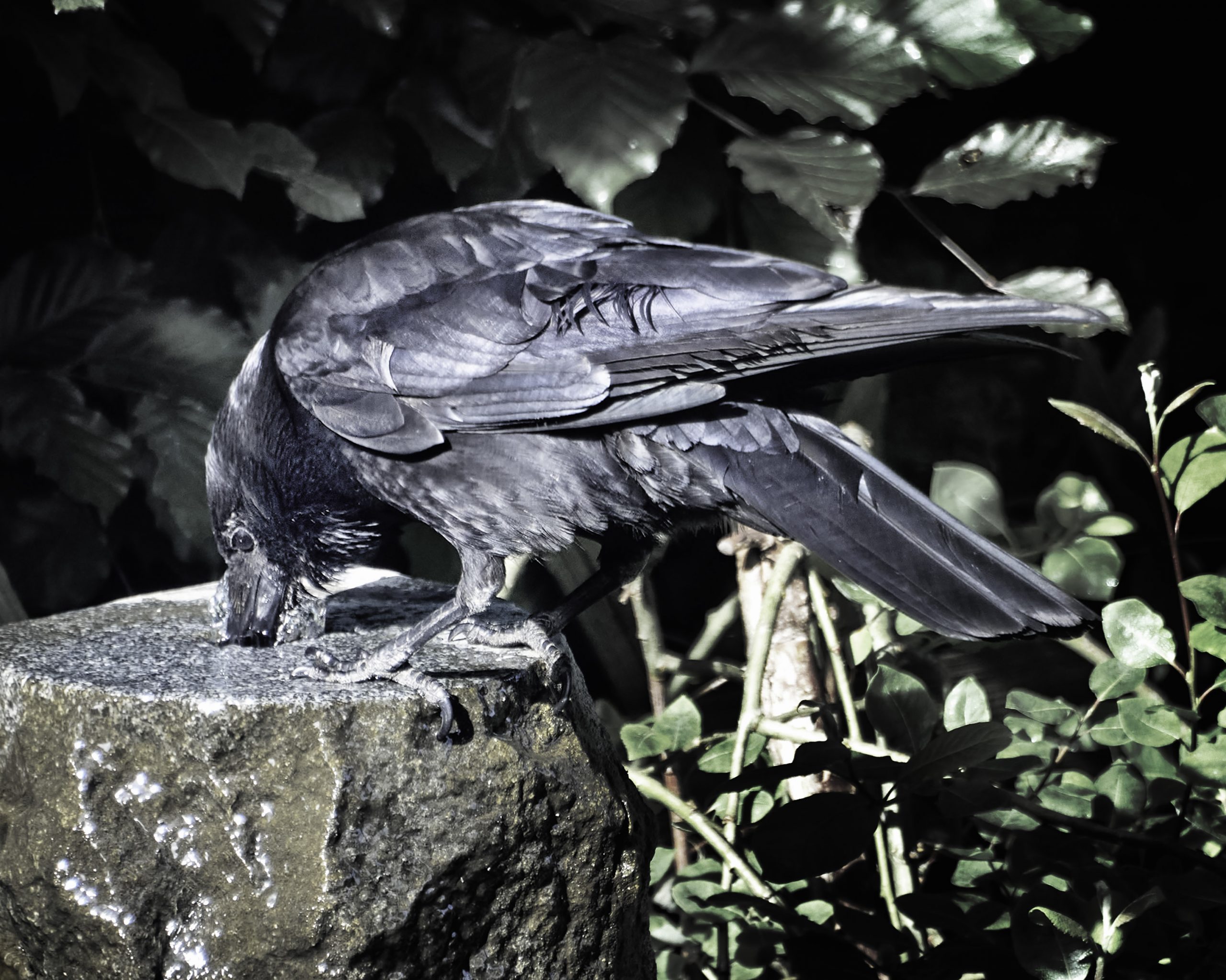
    Crow in our garden © Julian Köpke

    Today I made macro images of the fountain with a wide variation of exposure values to find a small world within it. Many of my fountain images remind me of the night sky and its wonders. Sometimes I had to think of our universe.

    The birds might see this ? I cannot be sure. But they are not blind, for sure.

    A macro of our fountain appears like a painting under many exposure conditions. A first glance of four images is presented here. 

  • General

    Autumn in the castle garden of Schwetzingen

    Good weather is now over. The days are getting dull. With a light haze in the sky, the sun runs a little deeper than yesterday. It gets dark noticeably earlier.

    Another photographer had the same thought, to spend this day in the castle garden of Schwetzingen. And the same vision to shoot the Japanese white bridge over a pond with nice reflections.

    Japanese bridge castle gardens Schwetzingen © Julian Köpke

    It has become autumn and the reflections in the ponds of the castle garden unfold a greater charm.

    Castle gardens Schwetzingen © Julian Köpke

    The rest of the park is already prepared for the winter and seems inhospitable to the photographic eye.

    Waiting for winter in Schwetzingen castle gardens © Julian Köpke
  • General,  Travel

    Is this a photography ?

    My conference schedule allowed me a walk through the Berlin Tiergarten Park in the morning. Of course, with a cam handy. While I was sitting on the shore of the Landwehr Canal, I let myself be carried away by the waves.

    The waves made the reflections of the trees and bushes softly tremble. The resulting reflections became like paintings.

    Reflections © Julian Köpke

    The processing was carried out only with regard to brightness and colors. Lab colors were used. Light-dark-contrasts were given by the waves.

  • General,  Monochrome

    Thundercloud vortex

    Has the future ever been read from the migration of the clouds ? Their forms and movements have always been exciting and inspiring for me. A vortex of clouds immediately creates a vortex of emotions.

    That is why clouds have long been the subject of my photographic interest and I have created a considerable collection of cloud images. 

    Last night a long heat wave ended with a thunderstorm. Above our house the clouds were swirling, lightning sometimes closer, sometimes further away. Islands of brightness changed rapidly in a threatening sea of black clouds.

    Swirling Thunderclouds © Julian Köpke
    Swirling Thunderclouds. Before the rain starts © Julian Köpke

    In some ways, these clouds remind me of interstellar gas clouds in our galaxy. In the example below the colors of the panorama image of M8 (or „Lagoon Nebula“) are suppressed to better recognize the structure.

    M8 Lagoon Nebula Panorama of 6 tiles © Julian Köpke
  • General,  Travel

    Anchor at Camaret-sur-Mer

    Camaret-sur-Mer is a place with a long history, which tells the former economic and military importance. Cabaret has been also the most important lobster port in France. The place is located on a peninsula of strategic importance for the security of Brest. The peninsula was therefore coveted by Great Britain and Spain in their fight against France.

    The Vauban tower bears witness to France’s fight against the conquerors. I took the following image with my tripod in front an old warehouse of the former shipyard.

    La tour Vauban Camaret-sur-Mer © Julian Köpke

    The civil shipwrecks show the decline of fishing in the region. You can’t find warships here.

    Shipwrecks in Camaret-sur-Mer © Julian Köpke
    Èpaves à la port de Camaret-sur-Mer © Julian Köpke
    Épaves à Camaret-sur-Mer © Julian Köpke

    All ships are damaged, by time, by economic ruin. This is where they found their last port.

    Épaves à Camaret-sur-Mer © Julian Köpke

    Where is our final anchor point ? Will it be interesting to look at us ?

    Anchor and Moon à Camaret-sur-Mer © Julian Köpke

    See also my album „Camaret-sur-Mer„.

  • Architecture,  General,  Travel

    Leipzig 2.0

    Second journey to Leipzig. Half way stop at Schloss Seehof in Memmelsdorf. Finest square architecture. Splendid water cascade.

    Cascade Schloss Seehof Bamberg Castle Gardens © Julian Köpke

    Leipzig has been a town since round about 1200. Many places were reconstructed after destruction during socialist dictatorship. The horrible blast of the Pauliner Church in 1967 lead to a beautiful and appealing reconstruction after 1989.

    Leipzig Paulinum © Julian Köpke
  • Background,  flowers,  General

    Do you like Karl Blossfeldt ?

    Karl Blossfeldt was a German photographer who lived from 1865 to 1932. He didn’t think himself a photographer. With his studies of plant forms he made an enormous contribution to plant photography. Here is a nice wikipedia article about him.

    He started to do photograms. Plants or parts of plants were placed directly on film or paper suitable for exposure. Exposure then takes place without any optics. Later he built himself a wooden camera, which reminds me of Andreas Feininger.

    Black and white backlit macro images with a background can be similar to Blossfeldt’s images.

    Silver leaf © Julian Köpke
    Heucheria in bloom © Julian Köpke
    Vetch © Julian Köpke
    Day lily © Julian Köpke
  • General,  Travel

    Stuttgart Television Tower

    You never know in advance what it means to return to the place of childhood. On top of a 217m high television tower physically overlooking the years I spent near a forest in Stuttgart Gablenberg there was a feeling of returning or being at home. 

    A few memories to the first visit to this tower mixed with the fantastic view. My daughters had invited me to this evening as their birthday present to me. The waiter is friendly and brings us as a special exception a white tablecloth to celebrate the day. So it’s fun to get to know the carefreeness.

    We enjoy delicious local food while the sun is getting lower and lower. Occasionally I feel a touch of fear of heights. Our table stands directly at the window with a view of the city.

    Nevertheless, we go up to the higher viewing platforms to look and take pictures. Suddenly many other photographers appear out of nowhere and we take many pictures of the view and a spectacular sunset.

    Green Stuttgart seen from Television Tower © Julian Köpke

    It’s still light when we left. The landmark of the city can be photographed in a variety of compositions. Here is just one of my many:

    Stuttgart Television Tower (Fernsehturm) © Julian Köpke
  • General

    RAW conversion matters

    Every camera stores sensor image data in a file for further use. The sensor image data are just grey values of different intensities in every pixel. A single pixel doesn’t show color. Our sensor image data contain a black and white world. How sad.

    How do we get color images with a sensor that maps only grey values between white and black  ?

    All the colors we know can be derived from a combination of a specific value of Red,  a specific value of Green and a specific value of Blue. If we know the shares of Red, Green and Blue in a color we know the color.

    Our camera sensor measures the shares of Red, Green and Blue with small lenses in front of each pixel on the sensor that act as filters for Red, Green or Blue. The complete sample of these filter lenses is called a color filter array or „CFA“. The distribution of Red, Green and Blue filter lenses on the sensor is completely known only to the manufacturer.

    The file that contains the sensor image data is called a RAW file. Beside the sensor image data at the beginning of a RAW file are informations about the complete file content. I found a nice Wikipedia article pointing this out. A RAW files contains also exposure data and information about the camera lens.

    A software converting the sensor image data of a RAW file into pleasing colorful images is called a RAW converter. A well known and popular RAW converter is Adobe Camera RAW (ACR). A Phase One Raw file can be straight forward converted by ACR to a 16-bit TIFF. No further postproduction has been applied (see left image below).

    A RAW conversion of the same file with the Phase One manufacturer’s own RAW converter Capture One to a 16-bit TIFF shows different color and brightness (see right image below). There was no setting of temperature, hue and saturation to make the images identical.

    Still. Conversion ACR. Courtesy P. Kleiber
    Still. Conversion Capture One. Courtesy P. Kleiber

    One RAW file was converted to two different TIFF. The difference between the TIFF can easily be obtained in Photoshop with the difference layer mode. The difference is an image in itself. With a sensitive gradient applied the following image is obtained:

    Difference image of RAW conversions using Capture One and ACR © Julian Köpke

    The difference TIFF (Capture One) – TIFF (ACR) is derived pixel by pixel. The converted TIFF using Capture One contains more green, more magenta and more yellow in the darker values. The impact on the final result is unclear at the moment.